The Politics of Manusmriti: Verdict from a few verses or dialogue from the entire text

 1 month, 1 week ago
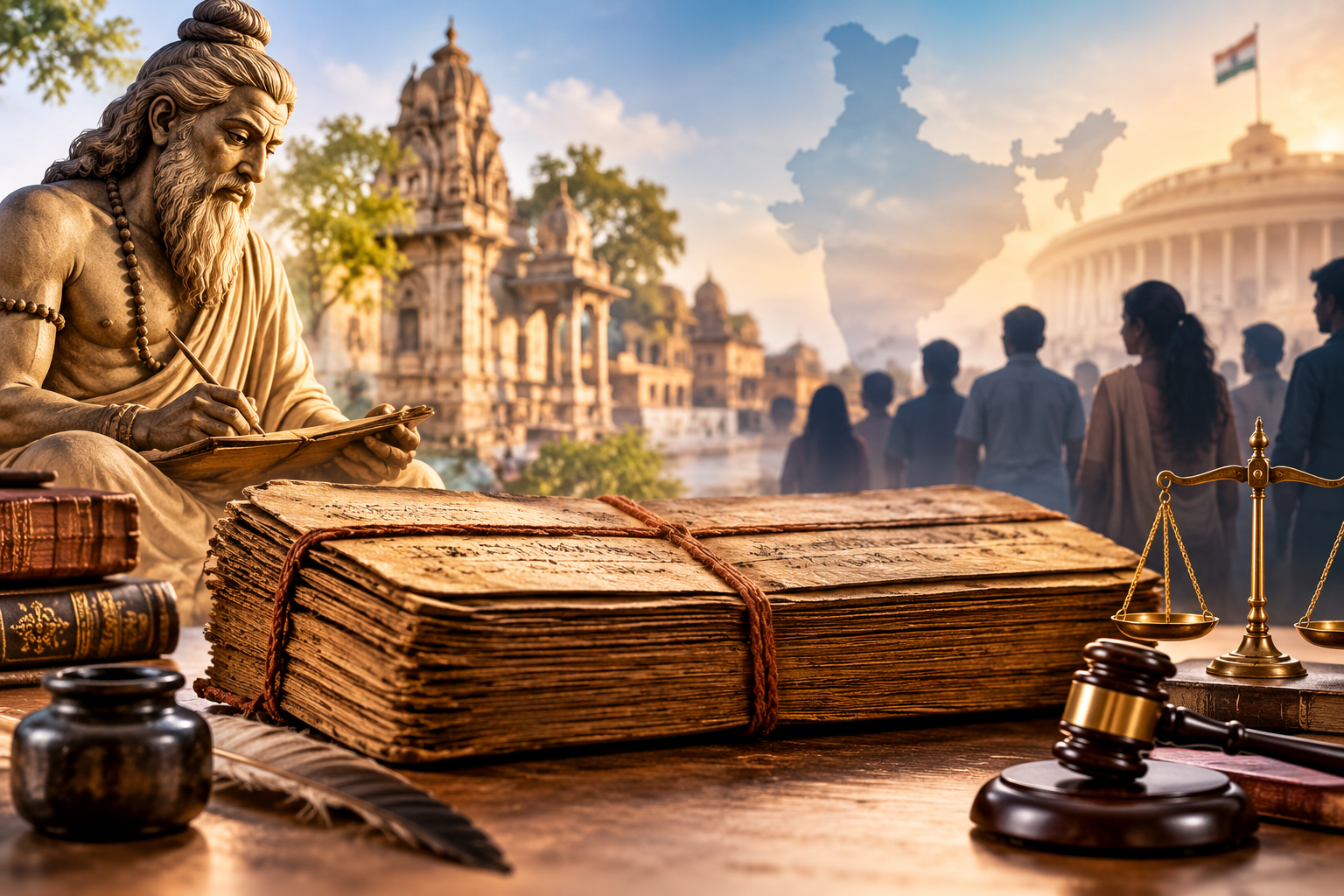
The debate over the Manusmriti in India is almost as old as its political use. Whenever elections approach, this ancient Dharmashastra returns to the centre of public discourse. A handful of verses are selectively quoted, presented as evidence of the entire Hindu social mindset, and then used to put the broader Sanatan tradition in the dock.
The real question, however, is not whether the Manusmriti contains controversial passages. It certainly does. The more important question is whether a text comprising 12 chapters and 2,684 verses can reasonably be judged by five or six quotations. If not, why is this intellectual shortcut repeatedly employed in the case of the Manusmriti? Yet in public debate, this vast text is routinely reduced to a handful of quotations. That is less an engagement with history than an exercise in political convenience.
Much of the Manusmriti deals with the duties of Brahmins, kings and the various stages of life. The first chapter discusses creation, the origin of scripture and social order. Chapters two to six largely describe the conduct and way of life prescribed for the dweej (Brahmins, Kshatriyas and Vaishyas). Chapter eight deals extensively with justice, law, punishment and the duties of the king, chapter ten with duties in times of crisis; chapter eleven with penance, and chapter twelve with karma, qualities, human aims and philosophical questions concerning dharma.
Around 1,059 verses are said to concern the duties and life of Brahmins, while nearly 980 deal with the responsibilities of the king. By contrast, only about 10 verses specifically address the duties of Shudras and Vaishyas. This disproportion is significant because the text places an enormous burden of responsibility on the king, who is considered accountable for the welfare and order of the entire kingdom. Likewise, the Brahmin is assigned the responsibility of preserving Vedic knowledge and the broader religious tradition.
The Brahmin is expected to practise restraint, self-control and moral conduct. He is advised to remain friendly towards all and patient even when confronted with hostility. The text also places obligations on him in his relationship with servants, daughter, and dependent members of the household, suggesting that he should tolerate even unpleasant words from them rather than immediately seeking royal intervention.
Seen in this broader context, the Manusmriti is not merely a manual of caste rules. It is an attempt, within the social framework of its time, to organise religious, moral, social and political life.
Women: Between Protection and Freedom
The sharpest contemporary controversy surrounding the Manusmriti concerns women. Critics frequently cite verse 3 of chapter nine: "Pita rakshati kaumare bharta rakshati yauvane, Rakshanti sthavire putrah na stri svatantryam arhati." It is commonly understood as saying that a woman should be protected by her father in childhood, by her husband in youth and by her sons in old age, and that she is not entitled to independence.
Critics argue that the verse denies women personal freedom, rights and the capacity to make decisions for themselves. Traditional interpreters, however, have argued that the terms rakshati (protection) and svatantryam should be understood in the social context of the time rather than automatically equated with modern notions of control or oppression. The argument is that, in a society where an unaccompanied woman could be vulnerable, protection was regarded as a familial and social responsibility.
But the same text also contains verse 56 of chapter three: "Yatra naryastu pujyante ramante tatra devatah; Yatraitaastu na pujyante sarvastatra aphalah kriyah." Where women are honoured, the gods are believed to rejoice; where they are not respected, religious rites are rendered fruitless.
Neither verse should simply be transplanted into the 21st century as a ready-made constitutional principle. But neither should the entire text be declared anti-woman solely on the basis of a few selected passages. A serious reading requires both textual criticism and historical context.
Do Other Religious Texts Escape Controversy?
The tendency to isolate controversial passages is not unique to the Hindu tradition. When the question of admitting women into the Buddhist Sangha arose, the traditional accounts say that the Buddha was initially reluctant. At the urging of his disciple Ananda, women were eventually admitted, accompanied by specific rules governing relations between monks and nuns.
In the 'Tamotama Sutta' of the Pali Tripitaka's Anguttara Nikaya, the Buddha describes four categories of human beings and discusses states of darkness and light based on their actions and the trajectory of their lives. The text outlines the nature of rebirths determined by karma and also makes reference to social categories. Similar principles are also found in the Sanatana and Jain traditions.
One can find passages in the scriptures of all religions that might appear objectionable from a contemporary perspective. Therefore, it is inappropriate to dismiss an entire religion or tradition based on selected excerpts from a text. For instance, there are lines in the scripture of a certain religion advocating the elimination of people who do not follow that faith. Logically, those who label Hinduism as anti-Shudra and anti-women by citing the "Manusmriti" ought to take to the streets in protest against that other scripture as well.
This is particularly relevant when the Manusmriti becomes an election-season political weapon. The legitimate question is whether the controversy is genuinely about historical understanding or whether an ancient text is being selectively mobilised for present-day electoral purposes.
Rights Were Accompanied by Duties
A common criticism of the Manusmriti is that it granted Brahmins privileges without imposing corresponding responsibilities. A closer reading presents a more complicated picture. The text divides ideal human life into four ashramas: brahmacharya, grihastha, vanaprastha and sannyasa. Assuming an ideal lifespan of 100 years, each stage was traditionally imagined as lasting roughly 25 years.
During brahmacharya, the student, particularly the Brahmin student, was expected to live with the Guru (teacher) and study the Vedas. This was hardly a life of privilege. Sleeping on the ground, serving the teacher and his family, seeking alms and living under strict discipline were part of the prescribed routine.
In the age of social media, the idea that "Brahmins begged for food" is sometimes invoked either mockingly or as an accusation. But bhiksha, or alms-seeking, was not simply a synonym for poverty in the Indian religious tradition. The Buddhist bhikshu and bhikshuni institutions also emerged from a wider ascetic culture in which withdrawal from material possessions and dependence on alms could represent spiritual discipline rather than economic helplessness.
Nor was the grihastha stage merely a life of comfort. The text prescribed the Pancha Mahayajnas with treta agani , hospitality, charity, restraint and ethical conduct. Alcohol consumption was prohibited for the Dweej (twice-born), while avoidance of certain foods, including onion and garlic, is also mentioned.
The vanaprastha stage involved withdrawal from ordinary worldly life after the appearance of wrinkles, grey hair or grandchildren. A person was expected to live on naturally available food, practise austerities and contemplate the Upanishadic tradition. Finally came sannyasa, in which the individual withdrew from social obligations and pursued an independent spiritual life.
This system is largely irrelevant to the organisation of modern society. Yet it demonstrates that the conceptual framework of the Manusmriti was not simply about rights and privileges, it also placed considerable emphasis on duty, restraint and discipline.
Punishment: The Hardest Question
The most difficult part of the Manusmriti to defend from a modern constitutional perspective is its system of punishment. Chapter eight prescribes different penalties for different social categories. By contemporary standards of equality before law, such distinctions are clearly unacceptable.
One particularly harsh passage prescribes severe punishment for a Shudra who insultingly addresses a twice-born person by name or lineage, in verse 271 of chapter eight: “Naamajaati-graham tveshaam abhidrohen kurvatah; Nikshhepyo’yomayah shankur jvalann aasye dashaangulah.” The verse is understood as prescribing punishment involving a heated iron implement. Such a penalty is unquestionably brutal and would be regarded as inhuman today.
Yet the text also prescribes severe forms of penance for the twice-born. Chapter 11, verse 90, states: "Suram pitva dvijo mohad agni-varnam suram pibet." The verse prescribes an extreme penance for a dweej person who consumes alcohol, involving the drinking of a substance described as fiery or boiling until the body is burned and purification is achieved. Theft, killing a Brahmin, drinking alcohol and violating the teacher's wife are classified among the mahapatakas, or great sins.
The Manusmriti undeniably accepts distinctions based on varna, including in punishment. That cannot simply be reconciled with the modern constitutional principle of equality before law. But the opposite simplification, is that the Brahmin is presented only as a privileged beneficiary, is equally incomplete. The text simultaneously places him under stringent religious discipline and moral obligations.
The Question of Child Marriage
Verse 94 of chapter nine is another contentious passage: "Trimshadvarsho vahet kanyam hridyam dvadashavarshikim; Tryashtavarsho'shtavarsham va dharme sidati satvarah." The verse is commonly read as referring to marriage involving very young girls, which understandably raises serious questions from a modern perspective.
However, in the interpretation of the traditional commentator Medhatithi, this verse is viewed not merely as specifying fixed ages of 30 and 12 years, but also as indicating an age difference between the man and the woman rather than establishing an absolute marriageable age.
Historical evidence further complicates any simplistic conclusion. Marriage practices changed between the Vedic and Smriti periods, and the distinction between marriage and gauna, or the later commencement of conjugal life, was significant in many historical contexts. Even the early marriages of figures such as Mahatma Gandhi and Dr B.R. Ambedkar illustrate that marriage in childhood and the beginning of full marital life were not always identical events.
Therefore, the mention of a practice in the Manusmriti and the mandatory enforcement of that practice across the entire society are not one and the same thing.
Not One Smriti, but a Layered Tradition
Perhaps the greatest mistake in understanding the Manusmriti is to treat it as the sole constitution of the entire Sanatan tradition. Hindu Dharmashastra developed through multiple Smritis and competing interpretations. Tradition recognises 18 major Smritis, among which the works associated with Manu, Yajnavalkya and Parashara acquired particular importance.
The question of widow remarriage illustrates this diversity. The Manusmriti generally does not endorse widow remarriage and discusses the institution of niyoga. Yet the Parashara Smriti, in chapter four, verse 30, states that "Nashte mrite pravrajite klibe cha patite patau, Panchasv apatsu narinam patir anyo vidhiyate." It provides for another husband for a woman in five circumstances, in cluding the disappearance, death, renunciation, impotence or social fall of her husband.
It demonstrates that the Dharmashastra tradition did not function as a single, frozen legal code. Different texts responded differently to changing social circumstances, customs and interpretations.
A Text Cannot Be Separated from Its Commentaries
The commentary tradition is indispensable to understanding the Manusmriti. It has been interpreted by numerous scholars, among them Kulluka Bhatta, whose Manvarthamuktavali became one of its most influential commentaries. Medhatithi of Kashmir produced one of the earliest and most important surviving commentaries, known as the Manubhashya. Gangānath Jha translated Medhatithi's commentary into English.
Without engaging with this interpretative tradition, taking a Sanskrit verse, translating it literally and then using it to make sweeping claims about the entire text is intellectually hazardous.
Ancient Indian texts developed elaborate traditions concerning context, prescription, prohibition, rhetorical statements and interpretation. "Show me the verse and I will give you the verdict" may work as political rhetoric, but it cannot substitute for scholarship.
Beyond Controversy: Universal Ethical Teachings
The Manusmriti also contains teachings that cannot reasonably be confined to one caste or community. One well-known passage says: "Satyam bruyat priyam bruyat, na bruyat satyam apriyam, Priyam cha nanritam bruyat, esha dharmah sanatanah." Speak the truth; speak what is pleasant; do not speak a truth merely to cause needless hurt, but do not speak a pleasant falsehood either. This is presented as an enduring ethical principle, and its moral significance is not limited to any particular social group.
The text also reflects on the debt owed to parents, observing that the sacrifices parents make in giving birth to and raising their children cannot be repaid even over a hundred years. Elsewhere, it links the honouring of women with the success of religious observances.
Manusmriti and the Modern Hindu Society
Scholars differ over the precise date of composition of the Manusmriti. Its present textual form is generally placed around the second century BCE to second century CE, although elements of its underlying tradition are considerably older.
It must therefore be read in its historical setting. The social, political and religious order for which it was composed no longer exists. Judging the entirety of Hindu civilisation on the basis of its more objectionable passages is therefore as historically unsound as ignoring those passages altogether.
Modern Hindu society has moved far beyond the social order described in the Manusmriti. Contemporary Hindu religious life is shaped not only by the Vedas but also by the Upnishad, the Puranas, temple traditions, Bhakti movements and diverse local customs. The traditional four-stage model of life is no longer a universal social practice. Modern Hindu religious life also gives central importance to forms of devotion that are not central to the Manusmriti.
Even the textual world itself reflects historical change. The Manusmriti predominantly refers to three Vedas, although there is also a reference to Atharvanic revelation at one point, whereas the contemporary understanding commonly speaks of the four Vedas. This does not make the Manusmriti irrelevant. It means that Sanatan tradition has always evolved through layers of texts, interpretations and social practices.
It was never confined to one book. The Vedas, Upanishads, Smritis, Puranas, epics, philosophical schools, Bhakti traditions and local customs together produced a plural and continuously evolving civilisation.
Manu exists alongside Yajnavalkya and Parashara, Dharmashastra exists alongside the Puranas and Bhakti; and modern India has added another foundational text to this historical evolution-the Constitution.
The Manusmriti deserves criticism where it conflicts with the principles of equality, dignity and individual freedom that define modern constitutional democracy. But criticism is strongest when it is informed by the whole text, its commentaries, its historical setting and the diversity of the tradition to which it belonged. It cannot simply be treated either as the permanent constitution of Hindu society or as a complete indictment of an entire civilisation. Reducing nearly 2,700 verses to five or six politically convenient quotations does not amount to historical scrutiny. It amounts to using history as a political weapon.
(The writer is a senior journalist and political analyst. Views personal.)










[[comment.comment_text]]