GREEN NUMBERS, REAL IMPACT: How Indian Companies Account for Their Carbon Footprint

 20 minutes ago
In a world that counts every rupee of profit, perhaps it is time to count every tonne of carbon as well.
Every product we consume carries an environmental story. The steel used to construct a flyover, the electricity powering an office, the car driven to work and even the food delivered to our doorstep consume energy and natural resources. Embedded in these everyday activities is an often-invisible cost: greenhouse gas emissions.
For decades, businesses have measured success through revenue, profitability, market share and shareholder returns. Today, another indicator is gaining prominence: the carbon footprint. As climate change intensifies, investors, regulators and consumers are demanding greater corporate accountability. Companies are increasingly expected not only to measure their environmental impact but also to disclose the emissions generated by their operations and supply chains.
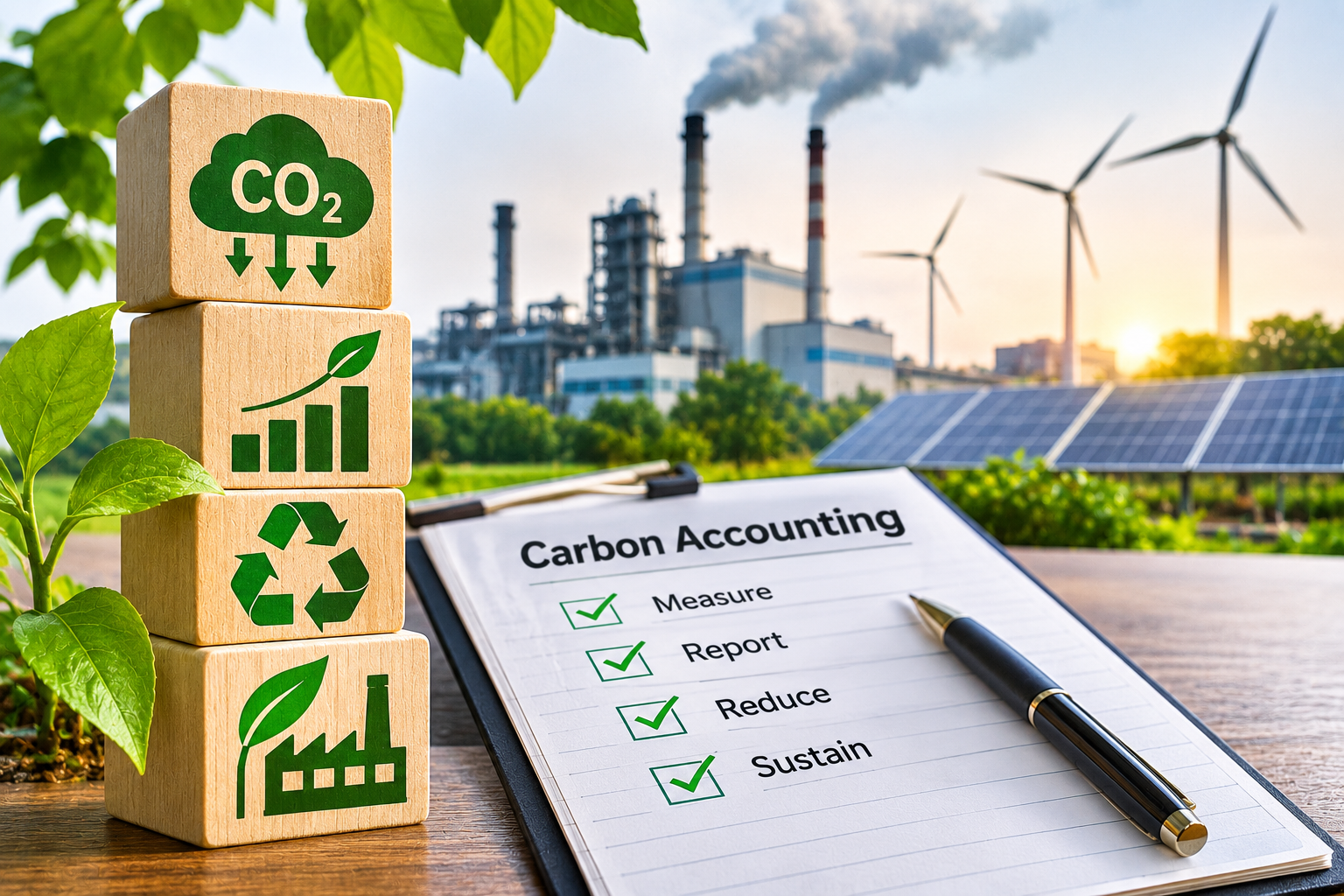
This is where carbon accounting assumes significance. It enables businesses to identify sources of greenhouse gas emissions, assess their environmental impact and develop strategies to reduce their carbon footprint. The underlying principle is simple: what gets measured can be managed. However, tracking emissions across factories, offices, transportation networks and complex supply chains is considerably more challenging than recording conventional financial transactions.
India’s Evolving Corporate Accountability Framework
India has begun integrating sustainability into mainstream corporate reporting. An important step in this direction was the introduction of the Business Responsibility and Sustainability Reporting (BRSR) framework by the Securities and Exchange Board of India (SEBI).
The framework requires the top 1,000 listed companies, ranked by market capitalisation, to disclose information relating to their environmental, social and governance (ESG) performance, including greenhouse gas emissions and energy consumption.
The subsequent introduction of BRSR Core identified key sustainability indicators for assurance, helping strengthen the reliability, consistency and comparability of corporate disclosures.
This marks a significant shift in India’s corporate landscape. Environmental performance is no longer simply a voluntary declaration of corporate goodwill; it is increasingly becoming a matter of measurable accountability. Nevertheless, the real test lies in whether companies use these disclosures to transform their business practices and reduce emissions.
From Carbon Measurement to Corporate Action
The effectiveness of carbon accounting becomes evident when emissions data translates into operational improvements and investment decisions.
HDFC Bank offers an example of how monitoring energy consumption can generate measurable environmental benefits. According to its FY2024–25 Integrated Annual Report, automated energy-management systems installed across 350 branches saved 623.84 megawatt-hours of electricity, avoiding an estimated 453.53 tonnes of carbon dioxide equivalent emissions.
The bank also reported that 19 offices and branches operating entirely on green electricity helped avoid approximately 12,807 tonnes of Scope 2 emissions. These figures demonstrate how systematic monitoring of electricity consumption, coupled with a transition towards cleaner energy, can help financial institutions reduce their environmental footprint.
The steel industry presents a different and considerably more challenging scenario. Steel production traditionally depends on energy-intensive, carbon-emitting processes, making technological innovation essential to reducing its environmental impact.
In March 2026, Tata Steel inaugurated a ₹3,200-crore scrap-based electric arc furnace in Ludhiana, Punjab, with an annual production capacity of 750,000 tonnes. The facility is designed to produce steel with emissions below 0.3 tonnes of carbon dioxide per tonne of steel and is expected to use approximately 50 per cent renewable energy.
By using recycled steel scrap as its primary raw material, the project illustrates how emissions measurement can inform investment in alternative production technologies. However, its stated emissions figure represents a design target rather than a guarantee of actual performance under all operating conditions.
Why Emissions Intensity Alone Is Not Enough
Mahindra & Mahindra’s FY2024–25 disclosures highlight another important dimension of carbon accounting: the distinction between total emissions and emissions intensity.
The company reported combined Scope 1 and Scope 2 emissions of 317,659 tonnes of carbon dioxide equivalent in FY2024–25, compared with 269,366 tonnes in FY2023–24. It attributed the increase to higher production and energy consumption. However, its reported emissions intensity per crore of revenue remained unchanged at 2.73 tonnes.
This distinction offers an important lesson. A company may maintain its emissions intensity even as its overall emissions increase because its business activity is expanding. Consequently, assessing corporate environmental performance requires examining both absolute emissions and emissions relative to business activity.
( Dr Babita Chaudhary is an Assistant Professor of Finance and Accounts at CHRIST University, NET/JRF-qualified, and holds a Ph.D. from Guru Jambheshwar University of Science and Technology, Hisar. Ms Reeya Tekwani is pursuing a BBA (Honours with Research) at CHRIST University, with academic interests in financial markets, investment analysis, sustainable finance and corporate strategy.)










[[comment.comment_text]]