Who Is Bharat Mata?
 44 minutes ago
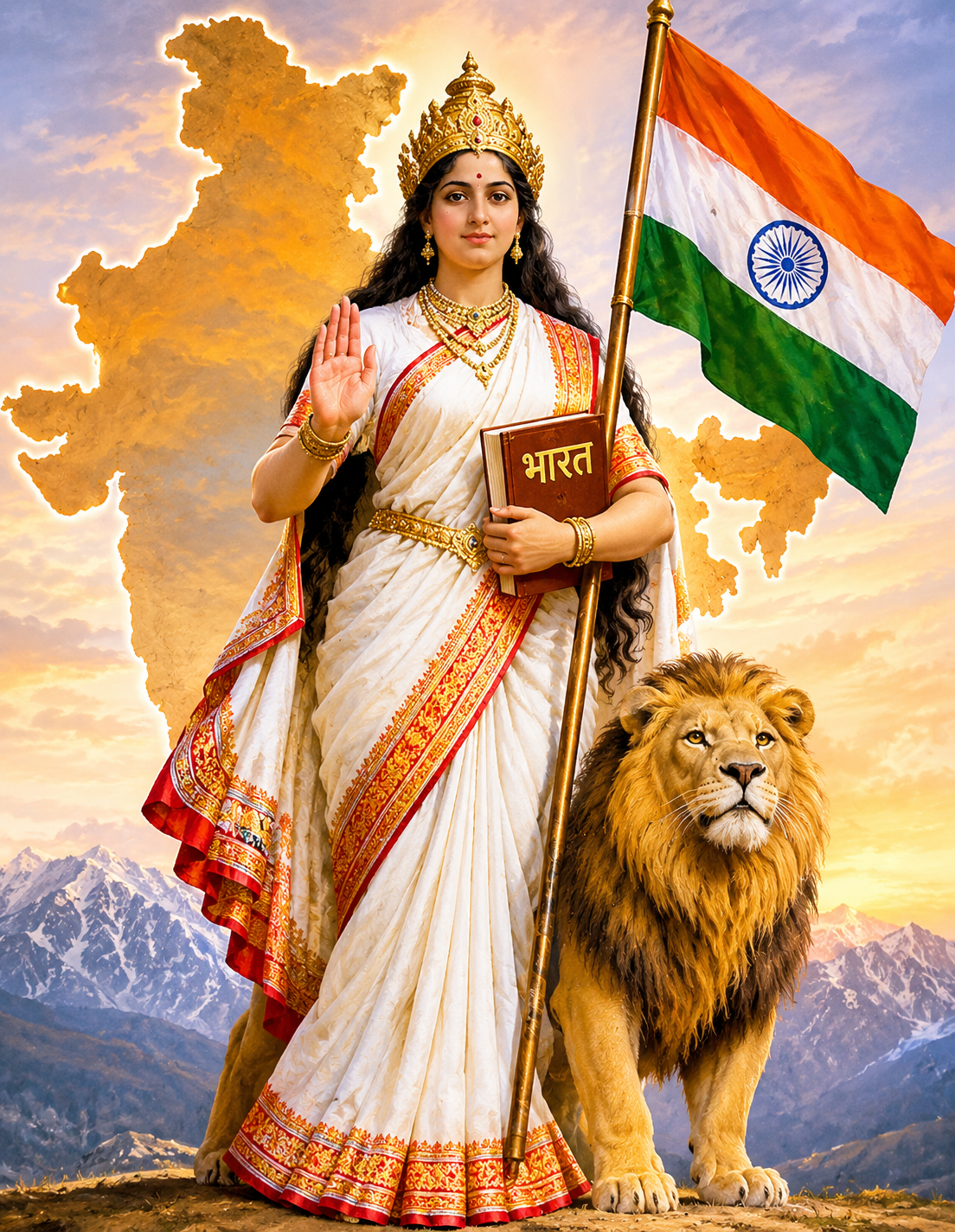
Is Bharat Mata a place to worship, a deity to call upon, or the millions of individuals whose lives give the country purpose? The response provided by Jawaharlal Nehru is still extremely pertinent to India's conception of nationalism and patriotism.
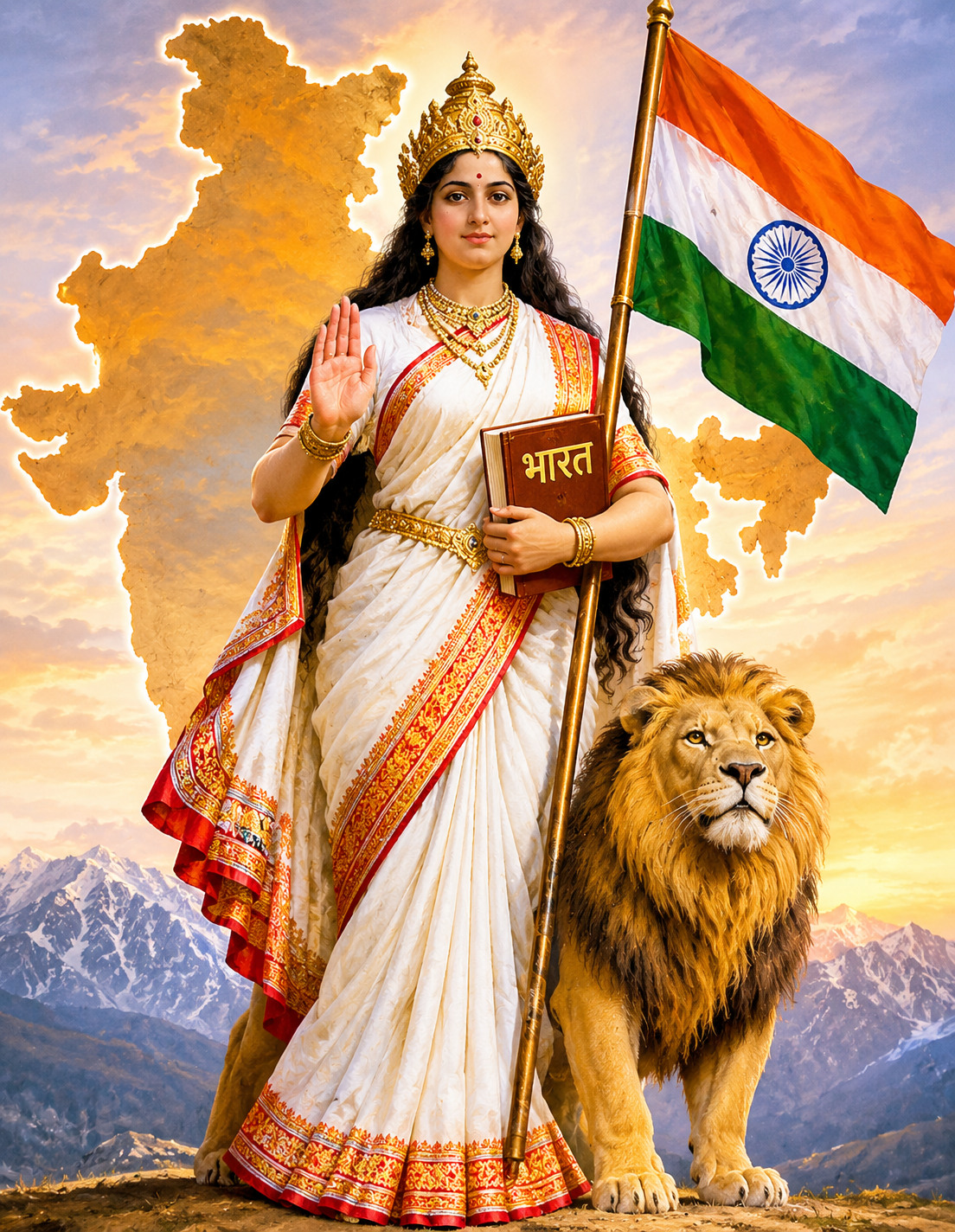
Bharat Mata is one of the most emotionally and historically significant expressions in India's national identity. Numerous catchphrases, songs, acts of remarkable bravery, and sacrifices have been inspired by it. It developed into a potent symbol of resistance, solidarity, and shared ambition during the independence movement. Millions of people devotedly venerated the homeland, and many gave their lives in her honour.
There is a paradox, though. Sometimes, an expression that brought people together in the fight against colonial control has turned into a political loyalty test. The phrase "Bharat Mata Ki Jai" has occasionally been used to demand evidence of patriotism rather than continuing to be a declaration of love for the nation. A more basic question should be raised when a national emblem is used to cast doubt on someone's allegiance: Who is Bharat Mata?
Is she the geographically defined territory, a religious emblem, a legacy of civilisation, or something much deeper? In his groundbreaking book The Discovery of India, written while incarcerated at Ahmednagar Fort in 1944, Jawaharlal Nehru provided a remarkably humanitarian response.
His response did not dismiss Bharat Mata's emotional appeal or try to downplay its cultural value. It was an attempt to uncover the human reality that underlies the national emblem.
People Make the Nation
In The Discovery of India, Nehru describes his political tour experiences in India, when he would speak to groups of common people and hear them chant "Bharat Mata Ki Jai" over and over. He was inspired by their fervour to pose a straightforward yet significant query: Who was this Bharat Mata that they were so devoted to? Did they refer to the fields, forests, rivers, and mountains? Was that the actual geographic area?
After giving it some thought, he came to the astounding conclusion that Bharat Mata was basically the millions of people that lived there. India's living identity is a result of the labour and dreams of innumerable common men and women, as well as the farmers who cultivate its fields, the workers who support its economy, the women who handle daily tasks, and the children who symbolise its future.
"Bharat Mata, Mother India, was essentially these millions of people, and victory to her meant victory to these people," Nehru wrote. This was not merely a poetic comment. It was a philosophical assertion regarding the essence of Indian nationalism. Nehru changed the focus of patriotism from an ethereal religious or geographical emblem to the nation's living people.
A Nation Beyond Geography
Nehru never downplayed the significance of India's cultural, historical, and geographic heritage. His vision of India was fundamentally shaped by the Himalayas, the Ganga, its woods, villages, cities, and ancient civilisational customs. He acknowledged the remarkable persistence of a civilisation moulded by a variety of languages, ideologies, faiths, and past events.
But a nation could hardly be defined by its geography alone. A nation gets its physical identity from its mountains and rivers, its memory from its history, and its continuity from its culture. But the people are what give it life.
Nehru believed that India's greatness came from the people who lived there as a whole, not only from its illustrious history. His perspective did not reduce the homeland; rather, it expanded its definition by including common Indians.
Raising the slogan, the people weren't only commending something outside of themselves. Maybe without realising it, they were commemorating their shared identity. They were Bharat Mata as well.
The Democratic Spirit of Nehru’s India
This understanding contained a deep democratic element. Nehru put the masses at the center of the national consciousness by associating Bharat Mata with millions of common Indians.
India cannot be exclusively owned by any one person, caste, religion, language, or political group. Regardless of social or economic standing, the country belonged equally to its farmers, labourers, tribal communities, women, minorities, and all citizens.
This was especially important for a nation that had just emerged from colonial power, was characterised by great cultural and religious variety, and was split by centuries of social inequality. By forcing uniformity on its citizens, India was unable to develop its sense of national identity. Acceptance of diversity and equal citizenship has to be the foundation for its togetherness.
Nehru believed that nationalism was about enabling individuals with diverse identities and opinions to share a shared political destiny, not about forcing everyone to think alike. Because every Indian was a member of the country and had an equal right to its independence, dignity, and future, his vision of Bharat Mata was intrinsically democratic.
Patriotism Beyond the Slogan
Nehru's perspective also poses an important question: Is patriotism a duty to the people who make up the nation, or is it just an emotional statement?
The pain of the millions of Indians that make up Bharat Mata is inextricably linked to the state of the country. In addition to being social or administrative issues, poverty, hunger, illiteracy, unemployment, discrimination, and unequal opportunity pose threats to India's dignity.
As a result, patriotism becomes an ethical commitment rather than just a catchphrase.
Raising "Bharat Mata Ki Jai" could be a sign of true patriotism. However, the omission of that specific slogan does not prove a lack of patriotism on its own. The words a citizen chooses to say cannot be used to gauge their level of loyalty.
Love for the nation and blind submission to those claiming to represent it must be distinguished in a democratic society. Respect for fellow citizens, defending their rights, and caring for their welfare are all examples of patriotism.
The Inclusive Spirit of Bharat Mata
Nehru's humanist perspective had a strong secular component as well. People from various languages, cultures, and religions came together during India's liberation movement. Freedom from colonial oppression and the creation of a sovereign nation were the shared political goals of their collaborative struggle.
National identity could hardly be limited to a single religious interpretation in such a heterogeneous country.
In India's cultural and nationalist past, the goddess figure of Bharat Mata has a significant position. For many, it stands for loyalty, selflessness, and a close emotional bond with the motherland. Another perspective was provided by Nehru's interpretation: the nation as a common human community.
No one had to give up their cultural customs or religious convictions in order to achieve this. Instead, it acknowledged that India's identity transcended all religious and cultural manifestations.
Hindus, Muslims, Christians, Sikhs, Buddhists, Jains, Parsis, and adherents of all other faiths, together with nonreligious individuals, are all equally part of India. They do not have to adhere to a specific form of patriotism in order to feel like they belong.
Here, the constitutional guarantees of equality, liberty, and dignity are in harmony with Nehru's humanist nationalism. The legitimacy of the Indian Republic comes from its people, not from their allegiance to a predetermined political vocabulary or religious identity.
Why Nehru Matters Today
In modern India, Nehru's question has taken on new relevance. Public events, strong symbols, political language, and emotionally charged slogans are increasingly being used to convey national pride. Celebrating India's military prowess, scientific advancements, athletic triumphs, and rising international prominence is perfectly acceptable. A country has every right to be proud of its achievements.
However, national self-reflection must not be replaced by national confidence.
The deeper meaning of patriotism runs the risk of being lost when a slogan is used as a political tool to cast doubt on someone's allegiance. The democratic spirit is undermined when people are evaluated based more on their vocabulary than on their behaviour, contributions, and regard for others.
Nehru's interpretation challenges us to consider the human effects of nationalism rather than just its outward manifestation.
What does it imply, if Bharat Mata is the people, when women experience insecurity, workers lack social safety, farmers fight for a respectable living, children continue to lack access to high-quality education, and citizens are denied equal opportunities? These are not incidental issues. These are enquiries concerning Bharat Mata's personal health.
It is impossible for a nation to truly honour its citizens while ignoring their pain. Furthermore, if the dignity of the nation's citizens is disregarded, national pride cannot be fulfilled.
The Soul of Bharat Mata
Nehru's view should not be interpreted as an attempt to resolve all religious and cultural disputes pertaining to the term. People are free to relate to national symbols according to their own customs and beliefs, and they can have a variety of meanings.
His lasting contribution was to elevate the common Indian to the forefront of the country's consciousness. He reminded the nation that India was more than just a place on a map, a historical landmark, or an image used in political speeches. Millions of people's lives, challenges, and goals built this dynamic collective reality.
The awareness that the folks shouting the phrase were a part of the Bharat Mata they were celebrating is maybe the most poignant element of his story. The motherland existed among them and through them, not somewhere far away.
Nehru's humanist worldview has a deeper meaning. Bharat Mata is the human community whose dignity we must uphold, not only the land we inherit.
Therefore, ensuring that every citizen may live with dignity, freedom, equality, and opportunity is the actual celebration of the motherland, rather than just declaring love to her.
Serving the millions of people who make up Bharat Mata, upholding their rights, and sharing their difficulties is an act of patriotism in and of itself. The true test of a person's love for their nation is not how loudly they call it by name, but rather how much they care about the people who make it what it is.
(Author a doctorate in laws, is a senior lawyer, columnist, and civil society activist.)




[[comment.comment_text]]