Jantar Mantar vs. Jaipal Munda Stadium
 1 month, 4 weeks ago
Gustave Le Bon, a French philosopher, famously noted that a person in a crowd tends to lose his or her unique consciousness and become a part of a collective urge. On the other hand, a true movement performs the exact opposite. Individual consciousness is sharpened rather than dulled. It increases people's awareness, sense of responsibility, and awareness of the moral ramifications of their behaviour.\
The best example of this distinction is still the Indian liberation struggle. Millions of Indians were inspired to rebel against the British Empire by Mahatma Gandhi, but first he taught them self-control. Satyagraha's primary tenet was self-discipline rather than opposition. Gandhi was all too aware that a moral triumph might easily become a political defeat if a movement went into violence. For him, the nobility of the end was just as vital as the purity of the means.
In the end, the moral bravery and disciplined resistance of those millions of Indians posed a greater threat to the British Empire than just their overwhelming numbers. This leads us to what may be the most crucial democratic principle: the moral legitimacy of a movement is its greatest asset.
A government may have the police, the state's coercive power, constitutional authority, and an extensive administrative apparatus. However, when a movement has moral legitimacy, it has a new type of strength—the ability to force even the most powerful institutions of power to examine themselves and reevaluate their behaviour.
A court ruling or an institution cannot bestow moral legitimacy. It is something that civilisation has earned. Society starts to support demonstrators when people start to see that they are fighting for justice, equality, fairness, and the greater good rather than simply their own interests. The most powerful source of support for every democratic movement is that public trust.
However, moral legitimacy is as brittle as it is hard to obtain. What years of struggle may have been created can be destroyed in an instant by a single violent episode, an ugly phrase, a personal attack, or one act of irresponsible behaviour. Because of this, mature movements take care of themselves before holding their rivals accountable. They are aware that discipline is a prerequisite for gaining society's trust, not just a way to keep things in order.
Every movement is unique. Some movements make history because of their moral stature, while others let the cacophony of their own violence obscure their original goal. Because of this, a movement should never be evaluated based only on the size of its followers. Its character, discipline, language, behaviour, and, most importantly, its ability to exercise self-control must be evaluated.
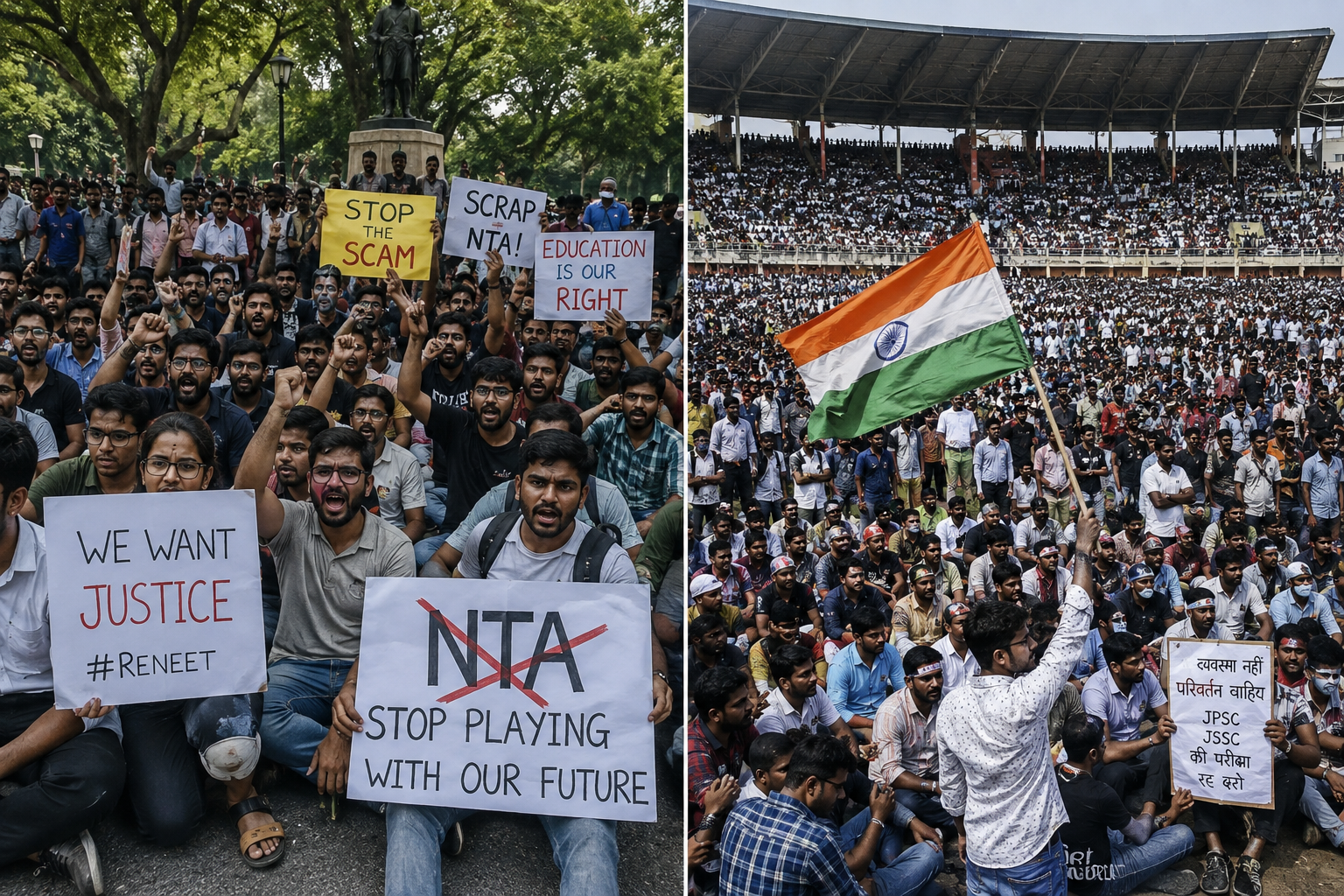
This distinction becomes more significant when we contrast the student protests at Delhi's Jantar Mantar with Ranchi's Jaipal Munda Stadium. At first glance, they could appear to be protests with different causes in two different cities. A closer look, however, exposes a much more important question about Indian democracy: Are two different democratic student protest cultures emerging? Protest is seen as a disciplined, morally aware, aggressive, and determined form of democratic disagreement. The alternative could allow anger, strife, and group instinct to overshadow the movement's original motivation.
Students definitely have the right to demonstrate; that is not the question. What form of protest actually makes democracy stronger is the real question. When society can declare, "Their cause is just, and their conduct honours it," a movement has gained moral authority. This is the ultimate strength of a movement, not noise or numbers.
In the context of Indian democracy, Jantar Mantar is more than just a place. It has served as the nation's capital of dissent for many years, drawing people from all around the nation who want to be heard by those in positions of authority. The idea that democracy must reduce the gap between the people and Parliament is the source of its deeper symbolic meaning. In one way or another, every demonstration that makes it to Jantar Mantar has attempted to join the national dialogue about democracy.
But today, students are fighting for their future while seated in Ranchi's Jaipal Munda Stadium. Their worries about purported irregularities in the JPSC and JSSC exams, the need for recruiting transparency, and the preservation of the dreams of a whole generation of youth are equally grave. They have come bearing the burden of years of preparation, their families' financial sacrifices, and unfulfilled hopes.
However, there is a clear distinction between these two protest cultures—not necessarily in the gravity of their complaints, but rather in the language they use and the self-discipline they exhibit.
Outside of the stadium, a straightforward, handwritten banner at the Ranchi protest location has garnered notice. "CODE OF CONDUCT" is written at the top in bold letters. It could seem to be just a simple set of four guidelines at first. However, a closer inspection shows something far more important: a democratic rule of conduct for a student movement.
According to the first criterion, the platform exists only for the protest's declared objective. There won't be any political, caste-based, anti-national, or national comments. This is an attempt at the movement's own moral self-discipline, not just an administrative directive. The kids appear to grasp a basic reality: a movement starts to lose its moral power the instant it loses sight of its initial goal.
Even more important is the second rule, which states that only JPSC and JSSC-related topics may be discussed. It contrasts sharply with a well-known trend in which movements progressively stray from their initial goals and turn into forums for more significant political conflicts. The Ranchi students are stating unequivocally that their goal is to demand accountability and reform in the examination system, not to become tools of political confrontation.
Participants are asked to refrain from using derogatory language and making personal accusations under the third guideline. This is a restatement of one of democracy's core tenets: institutions and policies, not individual dignity, should be the focus of criticism. Disagreement need not turn into animosity in a civilised society. A democracy's quality can be determined not only by how strongly its members oppose one another but also by the language they use in doing so.
Perhaps the most crucial of all is the fourth rule, which states that everything must be presented through constitutional channels. Although the sentence is brief, it has enormous democratic significance. Young people are frequently accused of being impetuous, angry, and impatient. However, these young people are choosing to protest in accordance with the Constitution's rules. That is a sign of democratic maturity rather than just following the rules.
Another important message from the Ranchi students is that the system is the problem, not the individual. For this reason, they have made a conscious decision to refrain from making disparaging or disrespectful comments about any specific individual. In a democracy, this distinction is crucial. It is possible and necessary to challenge institutions. It is necessary and possible to criticise policies. It is possible and necessary to hold governments responsible. However, abuse, humiliation, and personal animosity undermine the moral standing of the very movement that purports to advocate for justice.
The sheer act of raising the volume of a protest does not make it more powerful. Furthermore, becoming more combative does not make a movement more democratic. Occasionally, the strongest protest is the one that clearly understands both what it is fighting for and what it refuses to become.
This is where Jaipal Munda Stadium and Jantar Mantar diverge the most. Which movement is correct or incorrect is not the question. Which movement is better at maintaining its cause at the centre of its protest is the true question. Only when a movement's discipline outweighs its rage and its goals outweigh its catchphrases can it gain moral power.
The Ranchi movement is unique in this regard. It has attempted to blend discipline with protest. It has shown that one can speak loudly without using abusive language and that one can fight fiercely without compromising constitutional principles. India most needs this type of democracy right now.
The Ranchi students have made one thing very clear through their modest Code of Conduct: they are fighting against a defective system rather than an individual; their goal is reform rather than conflict; and their weapon is constitutional discourse rather than violence. Because of this, their protest becomes a living example of democratic maturity rather than just a movement against irregularities in recruitment exams.
Selective activism is another important issue that has been brought up during the entire story. Many people on social media are wondering why well-known academics, public activists, and social activists who frequently participate in national and international protests are not as conspicuous among the students who are having difficulties in Ranchi. Does a student's future become less significant in Ranchi if it is crucial in Delhi? Why should the location of a young person's voice determine its importance if it is a democratic concern? This is not a charge against any specific person or group. It has to do with democratic principles.
In a democracy, sensitivity only makes sense when it is shared by everybody. There will inevitably be doubts about the genuineness of our devotion if we support movements only because they share our ideological views. Students' future is neither left nor right; neither the opposition nor the ruling party owns it. It is exclusive to India.
The government should take note of this equally significant message. Can't the government demand an equally strict standard of responsibility from its administration if students are able to establish a code of behaviour for their own protest? Can examination authorities not make their processes clear and responsible if protesting students are able to control their language? Does the State not have an equal obligation to safeguard young people's trust in its institutions if they are exhibiting respect for the Constitution?
In the end, history won't care if the demonstration happened at Jaipal Munda Stadium or Jantar Mantar. It will enquire as to whether those pupils' voices were heard. Were their years of diligence rewarded? Did democracy provide them justice, or did it only allow them to protest?
Because allowing people to take to the streets is hardly the greatest triumph of democracy. The fact that people no longer need to repeatedly take to the streets to demand what was rightfully theirs in the first place is its greatest triumph.
The government needs to realise that disciplined movements are difficult. They are actually more difficult. Anger can be easily turned into a catchphrase, but it is harder to keep it within the bounds of decency and constitutional behaviour. While self-control establishes the moral authority that gives a democratic conflict durability, violence may temporarily give the appearance of power.
Therefore, just because a movement is quieter doesn't mean it is feeble. Not every passionate movement is strong, and not every peaceful movement is weak. Sometimes the most profound voice is the one that continuously taps on society's conscience rather than yelling.
For this reason, the actual distance between Jaipal Munda Stadium and Jantar Mantar shouldn't be expressed in kilometres. The democratic vision should be used to measure it. Where the crowd was bigger, where the noise level was higher, or whose photos went viral are not the questions. What we seek from democratic protests—"noise or solutions"—is the true question.
Jantar Mantar reminds people that they have the right to challenge authority. The Jaipal Munda Stadium's modest Code of Conduct, on the other hand, serves as a reminder of something as significant: the ability to challenge authority comes with the obligation to control our own behaviour.
In the end, the message coming from both locations is the same, and the government would be well to pay attention. Silencing students is not necessary. They must be acknowledged. Because the greatest measure of democracy's success is not the number of movements it has been able to subdue, but rather the number of times it has converted rage into debate, dialogue into reform, and reform into justice. The true test of democracy is that. It is also its greatest potential.



[[comment.comment_text]]