The Algorithm Versus the Apparatus: Uttar Pradesh’s New Electoral Contest

 1 month, 1 week ago
A Necessary, if Belated, Digital Turn
The opposition’s recognition that digital politics is now indispensable has come late, but not too late. For years, its parties treated the Bharatiya Janata Party’s dominance of social media largely as a source of grievance. They are now beginning to accept the more demanding conclusion: indignation is not a communications strategy.
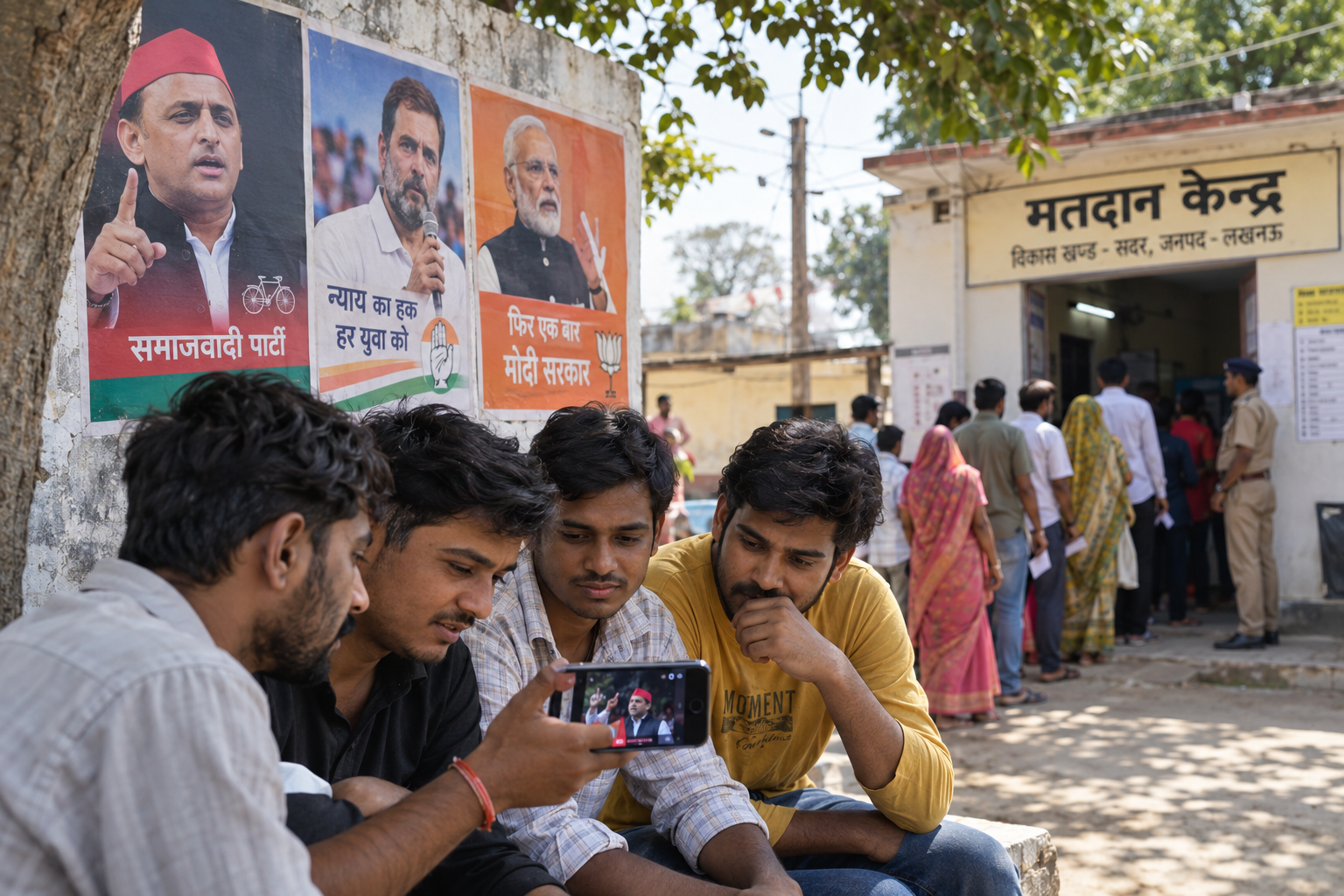
Ahead of the 2027 Uttar Pradesh Assembly election, the Samajwadi Party and the Congress are expanding their digital outreach through regional creators, youth networks, messaging groups and party-run media initiatives. The effort reflects a serious attempt to challenge the BJP’s command of the political narrative, particularly among younger and rural voters.
The essential distinction, however, is between possessing an online presence and possessing an organisation. The BJP’s advantage has never rested on digital communication alone. It lies in the integration of messaging with cadres, elected representatives, local office-bearers and booth-level mobilisation.
Technology can amplify a message, localise a grievance and accelerate a campaign’s response. It cannot by itself identify supportive households, settle disputes within an alliance, select credible candidates, repair weak local committees or ensure voter turnout. The opposition’s digital turn will matter only if it strengthens these political fundamentals.
When the Smartphone Becomes the Political Street
The strategic case for digital expansion is nevertheless compelling. The established grammar of Indian campaigning—rallies, speeches, posters and television appearances—is no longer sufficient in a media environment divided across innumerable screens. Political messages now compete with entertainment, sport, education, devotional content and everyday conversation.
The smartphone has become the contemporary street corner. The influencer increasingly performs the role once occupied by the neighbourhood intermediary. The WhatsApp group resembles a ceaseless ward meeting, while the meme—compressed, repeatable and emotionally legible—has become a species of political pamphlet.
This transformation matters because mediated familiarity can be more persuasive than institutional authority. A party spokesperson arrives encumbered by affiliation; a local creator arrives with an established vocabulary, recognisable humour and an audience accumulated through repetition. The creator may translate an abstract policy dispute into the language of a district, a caste group, an occupation or a generation.
A national unemployment rate is bloodless. A graduate who has spent four years preparing for a government examination, only to confront a leak, cancellation or indefinite delay, is not. A speech about social justice may dissipate by evening; a local video documenting an alleged indignity can be replayed thousands of times before breakfast.
Digital politics makes ideology intimate. That is its force—and its danger.
Learning the Language of the Digital Public Sphere
The most intelligent feature of the new strategy is decentralisation. Instead of insisting that every argument originate at party headquarters, an opposition campaign can allow a trusted regional voice to explain why a policy matters, why a promise failed or why an apparently local dispute belongs to a larger pattern.
The method is especially suited to Uttar Pradesh. Its political geography is too vast, its social coalitions too intricate and its linguistic registers too varied for a singular metropolitan idiom. A creator speaking in Bundeli or Bhojpuri may possess less national visibility than a television anchor, yet command more credibility in the audience that matters.
This is not merely a change of medium. It is a redistribution of political authorship. The voter is no longer expected only to receive the message; she can annotate it, adapt it, ridicule it, circulate it and embed it in local experience. The campaign becomes a network rather than a broadcast.
Decentralisation can also reduce the distance between party headquarters and local experience. Instead of requiring every argument to originate in Lucknow or Delhi, a campaign can allow trusted regional voices to explain why a policy matters in a particular district or why a local dispute reflects a broader failure of governance.
Yet decentralisation has a demanding precondition: parties must relinquish some control. A network that is permitted only to echo approved scripts is not a network at all. It is a collection of small loudspeakers.
The Credibility Paradox of the Influencer
Here lies the influencer strategy’s central paradox. Parties seek independent digital personalities precisely because audiences trust them more than professional politicians. But the moment those personalities begin to sound like unpaid spokespersons, their principal asset—autonomy—evaporates.
The objective should not be to establish hundreds of miniature party offices on YouTube. It should be to cultivate a conversation that feels indigenous to the constituency rather than airlifted from Lucknow or Delhi. Such a conversation must tolerate scrutiny of the opposition itself: poor candidate selection, dynastic entitlement, local factionalism and broken promises cannot be wished away by clever editing.
Authenticity is not an aesthetic filter. It is a political relationship. Voters can distinguish advocacy from ventriloquism, particularly when every creator repeats the same phrase at the same hour. Coordination may enlarge reach, but excessive choreography reveals the hand behind the curtain.
A responsible digital campaign must therefore permit a measure of disagreement while enforcing accuracy. Creators should function as interpreters and advocates, not as distributors of centrally scripted outrage. Otherwise, a supposedly new politics will reproduce the habits of conventional propaganda on newer platforms.
PDA and the Limits of Algorithmic Coalition-Building
The digital project is inseparable from the Samajwadi Party’s larger social proposition: PDA—Pichhda, Dalit and Alpsankhyak. The formulation is demographic, but its ambition is political. It seeks to transform distinct communities into a shared argument about representation, dignity, constitutional protection and access to power.
Social media is unusually efficient at performing this act of connection. An episode of alleged caste discrimination can be reframed as evidence of institutional hierarchy. A dispute over reservation can enter a broader conversation about representation. A law-and-order controversy can become a test of whether the state dispenses protection impartially.
The strategic task is not simply to publicise grievances. It is to persuade citizens that apparently separate disappointments arise from the same structure of political exclusion. That is how an incident becomes a narrative, and a narrative becomes an indictment.
Yet coalition-building cannot be reduced to algorithmic aggregation. Communities that share an adversary do not automatically share priorities. Candidate distribution, local rivalries, sub-caste competition, religious polarisation and the distribution of organisational resources can fracture a coalition that appears seamless online.
PDA will succeed only if it becomes a durable local compact rather than an ingenious slogan. The algorithm can reveal affinities. Politics must negotiate them.
The Examination Hall as a Political Fault Line
For younger voters in Uttar Pradesh, the most consequential issue may be neither ideological rhetoric nor campaign spectacle, but uncertainty surrounding employment, competitive examinations and public recruitment.
A cancelled examination is not an administrative footnote to the candidate who has invested years in preparation. It is coaching fees, rent, travel, parental expectation, deferred income and the slow erosion of self-respect. It is the humiliating obligation to explain, once again, why diligence has produced no appointment.
Paper leaks and recruitment irregularities have already produced protests and a palpable crisis of trust. The government, for its part, can point to stricter laws and enforcement measures. The opposition will argue that punishment after failure is not equivalent to a reliable examination system. The electoral question is which account becomes more credible.
Youth networks make this grievance politically portable. Students already exchange notes, coaching updates, court orders and examination notices through Telegram and WhatsApp. The infrastructure of mobilisation exists before any party enters the conversation. The opposition’s opportunity is to connect private disappointment with public accountability without appearing to appropriate genuine distress for episodic spectacle.
If handled seriously, the “examination generation” could become more consequential than a campaign hashtag. If handled cynically, it will recognise another political organisation arriving with slogans after the damage has been done.
The BJP’s Advantage Is Institutional, Not Merely Digital
This is where the opposition must temper enthusiasm with realism. The BJP’s digital advantage does not arise principally from memes, videos or hashtags. Its deeper strength is institutional: a communications apparatus connected to cadres, office-bearers, ideological affiliates, elected representatives and booth-level mobilisation.
A viral video produces attention; an organisation preserves it. A WhatsApp message reaches a voter; a booth worker reaches the voter again. A rally manufactures theatre; an election-day apparatus manufactures turnout. Communication is converted into infrastructure, and infrastructure into repetition.
The opposition is attempting to construct that chain while simultaneously preparing to contest the election. The temporal asymmetry is formidable. Organisational depth is cumulative: it depends upon routines, records, relationships, dispute resolution and the unglamorous maintenance of local committees between elections.
The BJP also possesses the capacity to contest the meaning of events. An opposition claim on unemployment can be answered with growth figures, welfare delivery or recruitment data. An allegation about law and order can be challenged with a rival narrative. A damaging clip can be contextualised, discredited or submerged beneath fresher content.
The important advantage is not simply speed, but stamina. Digital politics is an attritional contest. The side that wins Tuesday’s argument and vanishes on Wednesday has won almost nothing.
Views Are Not Votes
Digital campaigns are particularly vulnerable to confusing visibility with support. A video crosses five million views and is described as a breakthrough; a phrase trends for a few hours and is presented as momentum; thousands of comments are treated as evidence of a groundswell.
Polling stations, however, do not accept engagement metrics. A view is not a vote. A follower is not necessarily a supporter. A supporter is not necessarily registered in the relevant constituency. A registered supporter is not necessarily persuaded to leave home on election day.
The opposition’s decisive work is consequently less glamorous than its digital campaign. It must identify sympathetic voters, maintain constituency records, recruit dependable volunteers, reconcile local factions, guard against duplication and misinformation, persuade the undecided, and organise transport and assistance within the law.
Online popularity can help perform these tasks only when it is translated into structured participation. A creator’s audience must become a volunteer list; a grievance group must become a constituency network; a burst of outrage must become sustained civic attention. The conversion mechanism—not the content—is the strategic secret.
The algorithm can indicate whom to contact. It cannot substitute for the contact.
Artificial Intelligence and the Scarcity of Trust
Generative AI will make campaigning faster, cheaper and stranger. Songs can be manufactured, satire generated, speeches translated, images altered and videos produced at industrial speed. Hyperlocal messages can be tailored to linguistic and cultural niches that conventional media routinely neglects.
Yet the rapid expansion of synthetic content makes transparency indispensable. The Election Commission of India has repeatedly warned parties against deceptive or manipulated material and requires clear labelling of AI-generated or significantly altered campaign content. Technological innovation cannot be permitted to weaken electoral trust.
AI can imitate a voice, but it cannot manufacture the social memory that makes a voice trustworthy. It can optimise a slogan, but it cannot compensate for an implausible candidate, a fractured alliance or a party organisation that appears only during elections.
Indeed, the more synthetic politics becomes, the greater the premium on an identifiable human being in the neighbourhood—a person who can answer questions, admit uncertainty and remain present after the cameras depart. There is an old-fashioned word for that: credibility.
The Booth Is the Final Test
The opposition’s digital strategy is necessary but incomplete. It rightly recognises that the BJP cannot be challenged merely through larger rallies, sharper television appearances or more frequent statements. What is required is an alternative political ecosystem capable of linking public communication with sustained local organisation.
Yet ecosystems do not win elections in the abstract. Organisations do. The decisive questions are brutally mundane. Can an influencer’s following be converted into a constituency network? Can a student WhatsApp group become a durable local association? Can anger over recruitment become a reform agenda rather than a temporary spectacle?
Can the PDA coalition survive the intricate arithmetic of individual constituencies? Can allies accustomed to bargaining over leadership, tickets and territory behave as a coalition long enough to defeat an adversary more practised in organisational discipline? Can digital enthusiasm withstand the disappointments of candidate selection and seat-sharing?
These are not secondary matters to be settled after the narrative is perfected. They are the narrative’s test. A campaign that speaks magnificently about participation while excluding local workers from decisions will eventually expose its contradiction.
The polling booth is where the romance ends. It is an exceptionally poor consumer of hype.
The Test Is Organisation
For years, opposition parties have argued that the BJP monopolised India’s political conversation. Their effort to create a more competitive digital space is therefore overdue and democratically welcome. But digital pluralism will have little electoral consequence unless it is matched by political seriousness.
The BJP’s advantage was never merely technological. It built a system in which narrative, cadre, welfare outreach, constituency intelligence and booth mobilisation reinforce one another. The opposition may now be acquiring reach; it must still demonstrate discipline, continuity and the ability to act collectively.
That requires more than turning influencers into amplifiers. Parties must protect the credibility of independent voices, convert followers into volunteers, transform grievances into a governing programme and sustain local networks after the campaign’s immediate excitement has faded.
The opposition must also offer voters a persuasive account of what it would do with power. A campaign built only on discontent may attract attention, but it will not automatically command trust. Candidate quality, alliance management, policy credibility and booth-level presence will determine whether digital energy becomes a durable political alternative.
Uttar Pradesh will therefore test not whether the opposition can compete online—it increasingly can—but whether it can convert communication into organisation and organisation into turnout. The screen may shape the contest. The booth will settle it.
The opposition’s digital turn is a necessary correction, not a complete strategy. Unless it is matched by unity, credible policy and relentless local organisation, the governing party will retain the decisive advantage: the ability to turn a message into a vote.
(A well-recognised Delhi-based author and commentator, is a regular TEW columnist on politics, culture, and sports.)








[[comment.comment_text]]