Jayaprakash Narayan : The Economic Philosophy of Total Revolution

 an hour ago
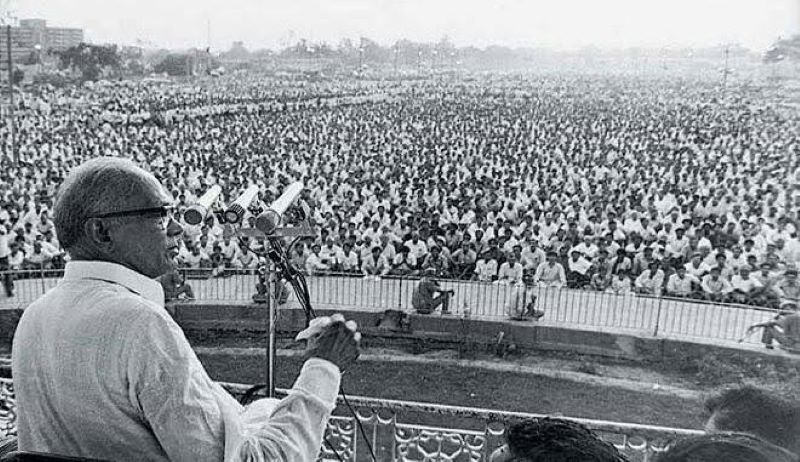
Jayaprakash Narayan was a born revolutionary, a freedom fighter, a socialist thinker, and an embodiment of the spirit of struggle. He was no ordinary political worker but an authority on socialism. It could rightly be said that few in India understood Western socialism as deeply as he did. He sacrificed everything for the liberation and service of his country. His dedication was tireless, and his capacity to endure hardship was unparalleled. As India debates unemployment, agrarian distress, and widening inequality, it is worth returning to JP's economic thought. Not out of nostalgia, but because his diagnosis of what ails modern economies has aged remarkably well, and his prescriptions remain startlingly relevant.
JP described Total Revolution as a combination of seven revolutions—social, economic, political, cultural, ideological, educational, and spiritual. Within this framework, the economic sphere was not an afterthought. He insisted that the changes in the economic sphere must be such that "the uplift of the Harijans, Adivasis, Muslims, Agricultural Labourers, Landless farmers and such others will come first." That sentence is the moral centre of everything he wrote on economics. Development, for JP, was not measured in growth rates but in the condition of the person standing last in line.
His critique of Western capitalism was uncompromising. Its most obnoxious feature, he argued, is that it judges everything in terms of money and has hardly any regard for human values. Money, JP conceded, is a useful medium of exchange; but to make it a determining factor of every human virtue is highly injurious to society. It results in unlimited greed and blurs the vision of man. In private capitalism, production is undertaken with the purpose of profit and not with the object of supplying the needs of society, so that while the producers of the primary needs of life are condemned to live in penury, speculators and producers of luxury goods flourish day by day and roll in plenty. Anyone who has watched food inflation coexist with booming luxury sales will recognise the accuracy of that description.
Yet JP was no defender of state socialism either. In both capitalist and state-controlled economies, he observed, the worker or artisan has no choice for himself of any creative work, except to sell his labour. He becomes merely a wage-earner—a condition that dwarfs human personality by checking the development of intelligence, artistic sense, and of character which implies responsibility. This is a point that both the market's cheerleaders and its critics tend to miss. The problem with contemporary work is not only wages but meaning; not only exploitation but the stunting of human capability.
JP also warned that large-scale industrialisation leads to the concentration of power, civil strife, and ultimately to imperialism and war, and results in the squandering of natural resources based as it is on the utilisation of non-renewable resources. Decades before climate change became a global concern, he had identified the ecological irrationality of the industrial model. And in a labour-abundant country like India, he noted, centralised production results in large-scale unemployment, poverty, and imbalances in society. The persistence of jobless growth in India today suggests he was right.
What did JP propose instead? A Gandhian frame that laid emphasis on agricultural development, equitable land ownership, the application of appropriate technology to agriculture such as improved labour-intensive tools and gadgets of which the gobar gas plant is a fine example, the development of domestic and rural industries and the widest possible spread of small industries, regional planning and development. This is not romantic nostalgia for the village. It is a serious development strategy that begins with local resources, local needs, and local employment. The aim of economic development, JP insisted, should be man—ensuring at least a minimum standard of living to the common man and providing work for every adult or head of the family.
The scheme of Antyodaya—the upliftment of the last person—was his practical instrument for this. It considers man as its aim, aims to break all barriers of caste, creed, or religion, and is not only a grand measure for village welfare but also a master stroke for national integration. This deserves emphasis at a moment when welfare policy is often debated in the language of fiscal burden rather than human dignity. JP's test for any policy was simple and severe: does it reach the poorest first?
Crucially, JP distinguished between nationalisation and socialisation. He did not believe in nationalising everything as it has been done in the Communist countries, convinced that nationalisation has produced not socialism but bureaucratisation, exploitation, and unusual distribution of wealth. Instead, he sought bringing under social ownership and control all the means of production, distribution, and exchange, including banks, transport, mines, and public utilities. Ownership, he held, may vest in the state, in an individual or company, cooperative society, and in local community. The organisational pattern of a decentralised economy would overwhelmingly be of the owner-worker or cooperative type, neither bureaucracy-ridden nor exploitative. For this, the political institution of Panchayati Raj will have to play an important role. Economic centralisation, he argued, is as harmful for the development of the country as political centralisation, and political decentralisation cannot be effective without economic decentralisation. That last formulation should be printed on the wall of every ministry of rural development.
On land, JP was unambiguous. Land is not only the most significant category in production, it is the means of subsistence for the vast majority of the population. He urged the government to take up land reforms in all seriousness, with attention to homestead and ceiling laws, share-cropping, and agricultural wages—and he warned that landlords and the bigger and dominant farmers have systematically defeated land reforms. He was right then, and the incomplete record of land reform in most states since has only confirmed it.
On prices, JP was similarly blunt: while global factors matter, the most important factors are the wrong plans and policies of the government of India, which give rise to black marketing, hoarding, and disappearance of goods from the market. He called for action committees of students and citizens to mobilise people's power against such practices. One may question the efficacy of such committees, but the underlying insight—that inflation is not merely a monetary phenomenon but a political one—remains sound.
JP was an economic reformer rather than an economic theorist, and his philosophy mostly revolves around social justice and social welfare. His laboratory was India, a poor and exploited country—unlike that of Marx, which was England. He offered an alternative strategy of development for solving the problem of poverty, unemployment, and inequality. Towards the end of his life he said: "My vision is of a free, progressive and Gandhian India."
That vision remains unfulfilled. But it would be a mistake to treat it as a closed chapter. In an economy where growth and employment have diverged, where farm distress persists, and where the ecological costs of the industrial model are becoming impossible to ignore, JP's questions are more urgent than his answers ever were. Who owns? Who decides? Who benefits? And who is left last? The measure of a republic is not its GDP but its last citizen. Jayaprakash Narayan understood this before most economists did. India would do well to remember it.
(The author, a former Vice Chancellor of Dr. Shyama Prasad Mukherjee University at Ranchi, is a public intellectual and senior TEW columnist.)







[[comment.comment_text]]