Super El-Nino’s effects on Elephants

 37 minutes ago
6DABF343-1F86-4D13-9691-E41D4D2F201D.jpgA Super El Nino is an extreme El Nino climate event characterized by sea surface temperatures in the central and eastern equatorial Pacific Ocean rising by 2°C or more above normal.
Impacts of Super El Nino:
Global Weather Extremes: It drives record global heat, intense droughts in regions like Australia, Southern Africa, and Indonesia, and catastrophic flooding in parts of South America and North America.
Impact on India: It typically weakened the southwest monsoon, heightened the risks of drought, reservoir depletion, and heat waves across central and northern India, while potentially enhancing the northeast monsoon along the coast of Tamil Nadu.
24D115E9-8301-4AE7-B206-6C254CAF19FC.jpgSuper El Niñodisrupted atmospheric circulation across the Indian subcontinent, suppressing the Southwest (SW) Monsoon causing rainfall below the normal, while driving warmer winters and extreme weather spikes. Because the current 2026–2027 event is peaking in late 2026, its impacts are actively unfolding across India's seasons, agriculture, and economy.
As the super El Niño peaks through winter 2026–2027, India typically sees above-normal minimum and maximum temperatures rather than severe cold waves.
El Niño's atmospheric warming lingers into the following spring, increasing the likelihood of early, intense heat waves across northern, central, and southern India in March and April 2027.
The World Health Organization (WHO) flags India as high-risk during strong El Niño cycles due to heatstroke, water scarcity, and shifting patterns of vector-borne diseases like dengue and malaria.
Forests: High risk of forest fires and early starts of fire season due to low soil moisture and high temperatures. Death of large forest trees-reduced forest regeneration and altered phenology of tree and other vegetation-affecting the fodder resources. Delayed fruit production and increased water stress in plants affecting the regeneration of the vegetation in the next season too.
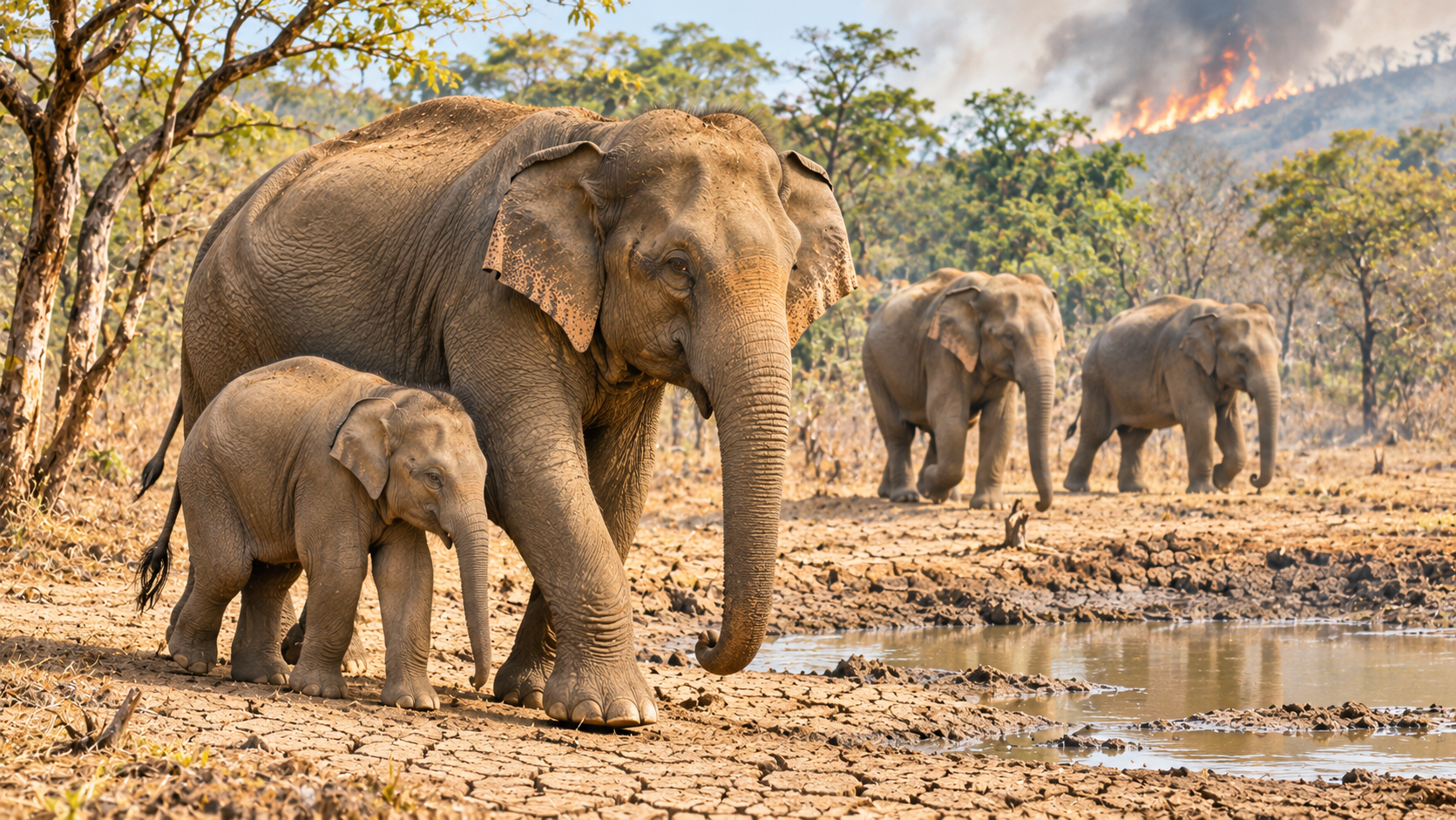
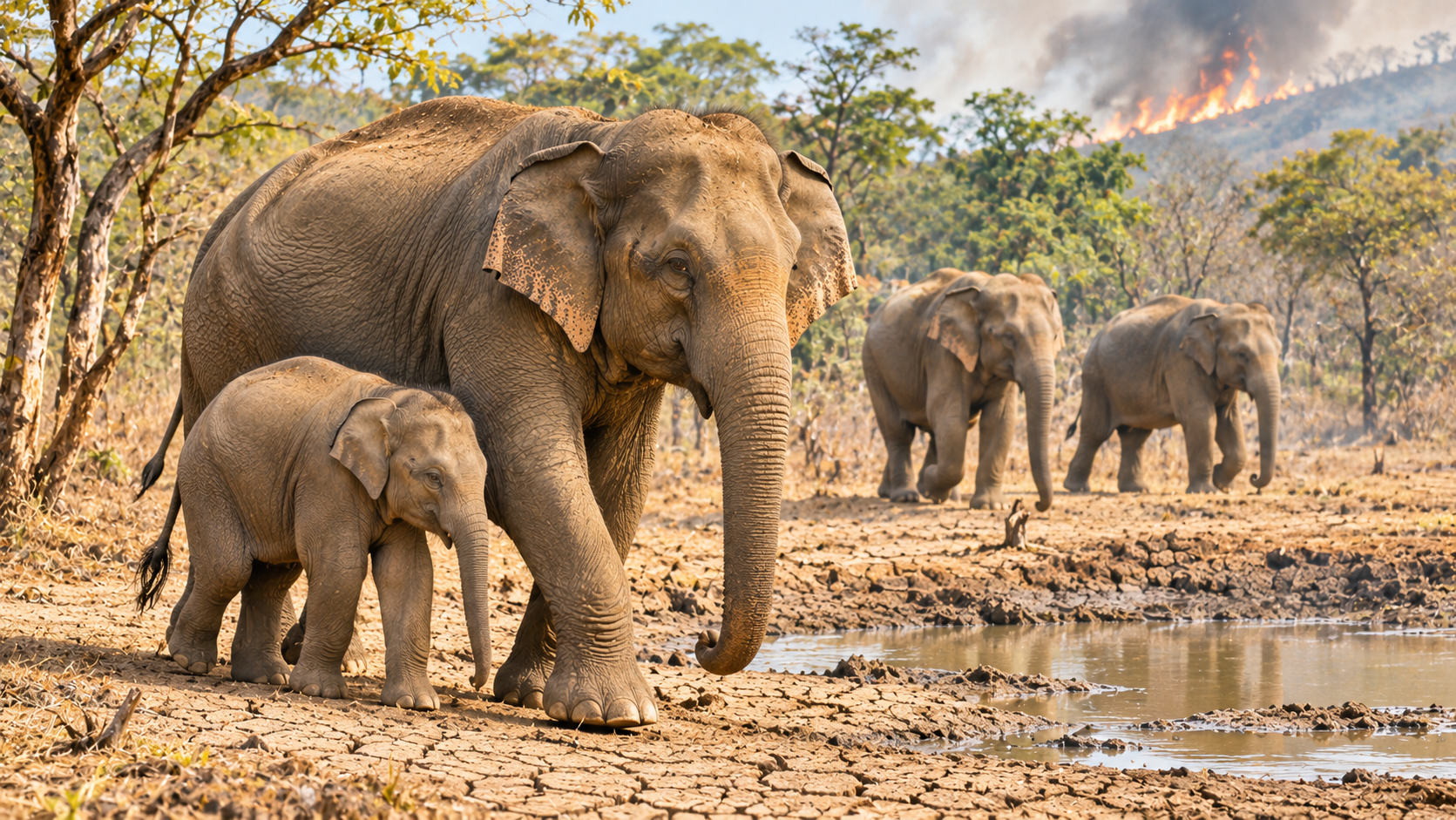
Wildlife: Forest streams and waterholes will dry up 2-3 months early (by Dec-Jan instead of March-April), forcing animals to concentrate in forest fringes causing more “human-wildlife conflicts” Physiological stress, changes in animal behaviour, reproduction and migration.
In oceans: widespread coral bleaching and mortality, marine heat-waves in northern Indian Ocean in 2027 hitting oil sardines (fish production) and other species- when human deaths are feared, deaths of wild animals will be unaccountable in the coming summer unless some miracle is blessed.
In the above scenario let us examine the flagship species of wild animals in India whose conservation represents the conservation of those animals will ensure all the lower order animals of the Indian forests in the situation of Super El-Nino. The flagship species of animals that represented the animals in their ecosystem are tiger with ‘Project Tiger’ and the elephants with ‘Project Elephant’
Let us know about the elephants first since the elephants face more trouble during pinch period for water, food and shade. The elephant is the largest land mammal which moves in herds and finds difficulty in meeting its demand for survival and starts migration and thus creates ‘Human-Elephants Conflicts (HECs) when they enter human habitations and then they face diseases and death etc during droughts.
Elephant is an animal of the family ‘Elephantidae’ under the order ‘Proboscidea’ in which there are two species ‘African elephants’ and ‘Asian elephants’. Earlier elephants were under the order of ‘Pachydermata’ after the death of their ancestor ‘Mammoths’ in Ice age-the elephants were shifted under the order ‘Proboscidae’ but still they are called as ‘Pachyderms’- a wrong nomenclature.
The African elephant is larger in size than Asian elephants, maximum height-4.50 m & 3.50m; weight-7,500kg & 6,000kg; the back bone- bends downward and bends upward; both sex have tusks & only males have tusks respectively. Tusks are the innermost molar but one upper tooth, and have bone marrow up to 50 % length and continues to grow throughout its age and are strong.
Elephants have large ears with sensitive hearing, thick dark skinned without sweating glands but sensitive to heat and fire, four legged with 3-5 nails with pad-like legs. Two small eyes with short distance, Nose at the tip of the proboscis-long trunk has a sensitive smelling sense, it holds up to 10 litres of water for drinking etc. It has normal taste, eats palatable fodder, fruits, leaves and likes fibrous barks, food grains- consumes up to 250 kgs or 4 % of its body weight and an adult drinks up to 150 litres of water say 2.5% of its body weight. It is a very good swimmer and climbs hillocks for foraging-pushes down trees for foraging, sprints for chasing up to 50 m but cannot jump even a 1.00 wide ditch. Generally continues to forage during day and night except 2-3 hours rest and sleeps during night- layingdown or standing. It is a very intelligent animal. The female attains adulthood between 8-12 years, gestation period 19 to 22 months-give birth to one calf and nurses for 2-3 years and keeps in company of 2-3 litters as a family, and lives for 60-70 years in the wild.
How the elephants-mammoth land mammal faces the drought and hot Sun during Super El-Nino is the issue of this article. Elephants are social animals and live in herds headed by an experienced mommy, which leads them in search of water, fodder and safety.
When forests catch fires in the pinch period-elephants sense it at faraway distance with the smell of smoke and get rid of that area to a safer location.
Elephants visit the water hole twice in a day in the morning and in the evening.Generally they concentrate around water holes in the pinch period (Huge concentration of elephants in the back waters of water-receded tank bed of Kabini reservoir in between Bandipur TR and Nagarahole TR can be witnessed in the pinch period) they drink, dip and swim if the water body is a big one and enjoy-especially young ones (If it is a smaller one-they spoil its quality with defecation and urination into it-when they drink such contaminated water will suffer body weakness).
Elephants food requirement is huge which they cannot meet in the prolonged drought when the fodder growth was less during monsoon as a result, the dry grass too become scares, fruits, flowers and leaves from forest trees too become scares, they will rely on the bark of trees and the climbers to forage……then scraping of green grass with legs wherever available near water holes like Kabini backwaters or marshy patches-for which elephants spend more time in hot Sun and get dehydrated and grow bodily weak …in such situation of the drought-the elephants succumb to the Sun stroke and die; some time-spurt of their body bacteria-Staphylococcus-seizing the lungs- force the affected elephant to fall down- struggle and die- like so, 10 elephants died in the summer of 1996 in the Nilgiri Elephant Reserve (ER), Mysore ER and Wayanad ER (I have witnessed a heart-rending scene of a huge she elephant struggling on the ground to breathe its last in Bandipur TR as Dy. Director in 1996)
For e.g. The situation in the Nilgiri Biosphere Reserve (NBR)-in the above ERs is not conducive to the elephants to migrate in their traditional routes because all the above cited ERs are surrounded by the human habitations which have been cordoned by barriers like Elephant Proof Trenches, Old Rail Fence, Solar Fence, and stone walls etc against HECs forcing elephants to move within the NBR and survive… a forced situation for the elephants to live in a huge enclosure during the droughts of this type without viable corridors to migrate to have better habitat to meet their biological requirements as in the past or in African countries. This is not a situation only in the above 3 ERs but it is the same case in the other ERs of India.
But in Karnataka-the elephants are spreading along the Western Ghats via coffee estates of Madikeri and Hassan districts and they have colonized and are spreading northwards. Their movement is in large number up to 50 in a herd crossing agricultural fields is a mesmerizing scene on lookers and heart burn for the farmers with more young ones and tuskers that indicates that its population in the state is safe and on increase say about 6,000+ as on 2026.
The population of the elephants in India was about 21,200 + in 2005 and it is said to be about 22,460 in India in 2026 in spite of efforts to conserve them with the Project Elephant since 1992…even though the recruitment of newborn elephants is positive, it is negated by many deaths of elephants due to poaching for ivory, death due to old age, disease and HECs in India. (It is said that its population has fallen from 27,312 in 2017 to 22,460 in 2025-which was projected as 29,000+ before thecensus of 2025; a sad situation.)
Elephant is a royal animal, religiously venerated and worshiped as the symbol of ‘Lord Ganesh’ and it is a ‘national heritage animal’ and the ‘state animal of Karnataka, Kerala and Jharkhand’ and Schedule-I animal with high degree of protection. The elephants deserve to be protected with total control of forest fires and creation of sufficient water hole-facilities to overcome the ills of the super El Nino in the pinch period of 2027 in the best interest of the elephants, biodiversity and the resilience of the environment and climate of the country.
-----------
(Author, a former Indian Forest Service officer, Karnataka, is a well-recognised columnist on wildlife, forestry, and environmental issues.)









[[comment.comment_text]]