US–CHINA: BEHIND THE DIPLOMATIC SMILES, AN ECONOMIC WALL IS RISING

 an hour ago
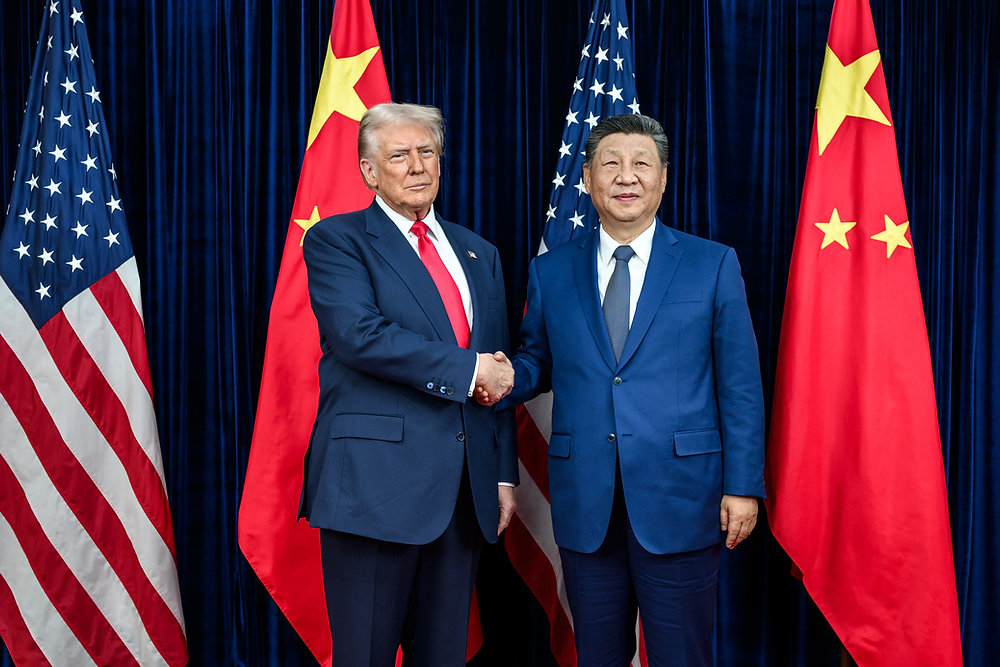
The warm personal chemistry displayed by US President Donald Trump and Chinese President Xi Jinping, marked by ceremonial welcomes, friendly gestures and public bonhomie, offers a reassuring picture of diplomatic engagement between the world’s two largest economies. Yet, beneath this carefully cultivated cordiality, a fundamentally different reality is unfolding. Washington and Beijing are steadily tightening economic controls, restricting investments and erecting barriers around critical technologies and strategic industries. Their relationship increasingly illustrates the contradiction between diplomatic cooperation and deepening economic confrontation. The forthcoming meeting in Shenzhen may produce another display of goodwill, but the larger question is whether personal diplomacy can arrest a rivalry that is becoming institutionalised in both countries.
What began during Trump’s first presidency as a tariff-driven trade dispute has evolved into a much broader contest for technological supremacy and strategic economic influence. Both governments now invoke national security to justify restrictions on trade, investment and technology transfers. Washington is seeking to limit China’s access to advanced artificial intelligence chips and restrict American investments in sensitive Chinese sectors, including biotechnology, artificial intelligence and hypersonic weapons. Beijing, meanwhile, is expanding export controls over technologies associated with artificial intelligence, biotechnology and solar power. Its growing command over rare earth elements and critical minerals has provided it with considerable leverage over international manufacturing and supply chains. These developments indicate that the confrontation is no longer confined to bilateral trade; it is increasingly about who controls the foundations of the future global economy.
China’s changing response deserves particular attention. Having initially relied largely on reciprocal tariffs and symbolic countermeasures, Beijing is now developing a more comprehensive legal and regulatory framework to defend its economic interests. Its measures include mechanisms to counter foreign sanctions, scrutiny of corporate activities and restrictions on investments considered detrimental to national security. The reported blocking of major foreign acquisitions, alongside legal proceedings against companies complying with American restrictions, reflects the widening reach of this approach. Equally significant are China’s export restrictions on strategically important technologies and materials. Such measures have implications far beyond Washington and Beijing. Countries dependent on Chinese manufacturing and mineral supplies, including India, must increasingly navigate an economic environment in which access to essential resources can become a matter of geopolitical negotiation.
The limited trade truce between the two countries has provided temporary relief but has hardly addressed the underlying causes of friction. Even the extension of tariff concessions and suspension of selected export restrictions have failed to restore confidence among businesses. American companies continue to report difficulties in securing certain critical materials, while Chinese companies face growing uncertainty over access to American capital and technology. The emerging process of financial and technological decoupling threatens to disrupt investment decisions, increase production costs and fragment international supply chains. More importantly, it creates an atmosphere of uncertainty for multinational corporations that have traditionally regarded both countries as indispensable markets. The danger is that economic security, increasingly defined through national restrictions, may gradually overshadow the principles of open trade and mutually beneficial interdependence.
The Trump-Xi engagement must therefore be judged not merely by diplomatic ceremonies or the personal warmth between the two leaders, but by whether it produces durable institutional arrangements that reduce economic uncertainty. Tariffs may offer negotiable ground, but artificial intelligence, semiconductor technology, rare earths and strategic investments represent much more difficult challenges. Neither country can realistically expect to eliminate its dependence on the global economic system without imposing substantial costs on itself and others. For the international community, particularly emerging economies, the priority must be to prevent this rivalry from turning into competing economic blocs. India should strengthen its domestic technological capabilities, diversify critical mineral supplies and preserve constructive economic engagement with both powers.
All said and done, Washington and Beijing must recognise that strategic competition need not mean economic isolation. The world needs bridges of cooperation rather than an expanding wall of restrictions. Diplomatic smiles can open doors, but only sustained political commitment and mutual restraint can prevent those doors from being closed again.








[[comment.comment_text]]