The 90-Day Deadline: Justice Delayed is Justice Denied

 an hour ago
The PoSH Act, 2013 was implemented so that women could bring forward complaints of sexual harassment at the workplace. This also has a time limit for the inquiry to be concluded. This ensures that the complaints won't be left open-ended and both parties will have a conclusion to their complaint.However, in many organisations the ninety days passes before the inquirycan be concluded. This may involve putting off the hearings, delaying examination of witnesses and not resolving any documents. This can cause:Anxiety for the complainant as they won't know what is going to happen next and will struggle to return to a normal working environment.
When the law says that an inquiry must be completed within 90 days, what happens when the Internal Committee fails to meet that deadline?This raises an important question: Long periods of suspension for the respondent cause loss of professional opportunities and damage to their reputation with uncertainty.
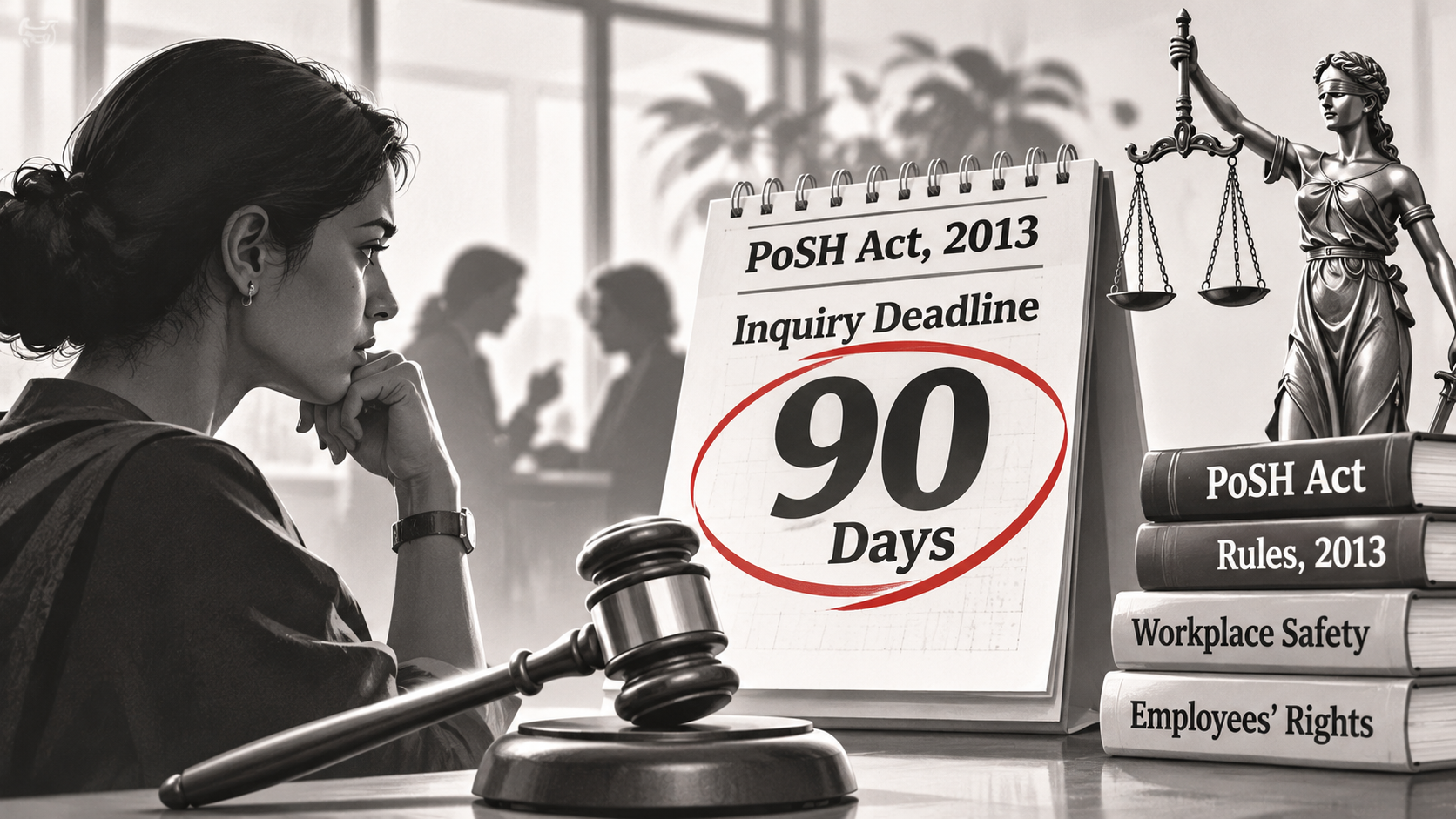
Section 11(4) of the PoSH Act states, "The inquiry under sub-section (1) shall be completed within a period of ninety days."
This is very clear and shows that the Internal Committee should complete the inquiry within ninety days. There is no situation in which the inquiryswould be left to hang.
Rule 7 of the PoSH Rules, 2013 outlines the process of how the inquiryshould happen. It puts time limits on how long it should take to pass the complaints to the respondent, responding to the complaint and completing the inquiry.
Section 13 of the Act says the IC must submit their report within ten days of completing the inquiry.
Overall, the law expects the committee to complete their work within a set timeframe.
Does an inquiry become invalid if it goes over ninety days?
This is where we need to look at the law in more detail. The PoSH Act sets a time limit of ninety days for the inquiry. There isn't any mention of the IC losing jurisdiction or the inquiry becoming invalid as it goes over 91 days. This is an important point. If the inquiry goes over ninety days it doesn't mean that the respondent has the right to have the complaint dismissed. It also doesn't give the IC the right to continue without any reason. The committee must take the time limit seriously. If they need more time thenthey should have genuine reasons and record this. The delay, reasons for the delay, how it impacts the parties involved and where the inquiry is at may become relevant if the inquiry is challenged.
The Inquiry Being Delayed is not a minor Procedural issue
Imagine an employee being suspended as soon as a complaint is received.
The inquiry has started however the IC hasn't completed the inquiry within the ninety days. The employee is suspended and only receiving part pay. There is no clear indication of when the inquiry will be completed and no written reason for it being delayed. The hearings are continuing to be put off. Can an employee expected to be in this position indefinitely?
Sometimes an employee will need to be suspended or put on some form of temporary arrangement to protect the complainant and to ensure the inquiryisn't affected. However, this shouldn't replace the inquiry being completed. The employer and IC should take reasonable steps to ensure the inquiry is completed without unnecessary delays. A complaint shouldn't become a long-term punishment for the parties involved.
Say of the Supreme Court
In Aureliano Fernandes v. State of Goa (Civil Appeal No. 2482 of 2014) decided on 12th May, 2023, the Supreme Court looked at the serious procedural issues involved with a sexual harassment inquiry. The committee held twelve hearings most of which were back-to-back. This meant they completed the inquiry in approximately 39 days. The Supreme Court ruled that the inquiry was rushed and the respondent hadn't had a reasonable opportunity to prepare a defence. They stated, "The nature of a complaint of sexual harassment cannot be invoked to deny fairness in procedures."
Although this case was about an inquiry being completed too quickly it is still relevant to those who had a delayed inquiry. This shows that just because an inquiry is quick it doesn't mean it is fair. The inquiry should be completed within a reasonable time frame however it must also be fair.
What happens if the respondent is suspended for longer than 90 days?
Suspension during a PoSH inquiry can be a sensitive issue.
Section 12 of the Act outlines some temporary measures that the IC can suggest if the complainant writes to them. This includes transferring the complainant/respondent and granting extra leave to the complainant.
This doesn't mean that all PoSH complaints will result in suspension.
If the employee is to be suspended under the service rules/employment then they must consider if it is still reasonable to do so.
Things to consider:
1. Is there a genuine reason to keep the employee suspended?
2. Could there be a risk of influencing witnesses or tampering with evidence?
3. Could the same outcome be achieved by transferring the employee or changing the reporting line?
4. Has the IC recorded the reasons for the delay?
5. Has the employer regularly reviewed the suspension?
6. Are they actually receiving their subsistence allowance as per the rules/contract?
Just because 90 days have passed does not mean they will automatically be released from suspension. Just because the complaint is still outstanding doesn't give the employer full freedom to suspend the employee without considering the situation. You need to consider the circumstances of each case.
Can the complainant claim relief for the delay?
Yes. The complainant also has a valid right to have their inquiry completed in a timely manner. A delay can cause the complainant to lose their dignity, confidence and be unable to work without fear. It could also cause issues with preserving evidence and getting witnesses to participate. The complainant can write to the IC and employer requesting that the inquiry is concluded as soon as possible. In cases where there has been serious inactivity or unreasonable delays, suitable remedies can be considered with the appropriate authority/court. This will depend on the circumstances and service rules. The ninety-Day Time Limit isn't just to protect the respondent from being in limbo for a long period of time. It also ensures that the complainant gets a swift resolution to their grievance.
Can the respondent challenge a delayed inquiry?
The respondent can raise this as a procedural issue. However, this must be based on the facts and how it has impacted them. Simply stating that ninety days have passed is unlikely to be enough to halt the inquiry.
The respondent should consider:
1. When the complaint was received.
2. When the inquiry actually started.
3. When the hearings occurred and when they were adjourned.
4. Why the inquiry was delayed.
5. Did the IC give any reason for the delay?
6. Did the employer give any written instruction or extension?
7. Has the delay impacted their defence?
8. Have they been suspended or suffered any negative service impact?
Often it is a good idea to write to them requesting that the inquiry is completed within a set reasonable timeframe. If there has been an unreasonable delay and the authorities aren't taking action then the respondent can seek suitable remedies. This will depend on the service rules and forum available. Generally the remedy should be to address the delay and impact caused. Just because ninety days have passed doesn't mean they will be found innocent or the inquiry cancelled.
(The author, a well-recognised lawyer and campaigner for female rights, has authored “Breaking the Silence: A Handbook on the PoSH Act”. She also holds a POCSO Train-the-Trainer Certificate.)











[[comment.comment_text]]