Recalibrating India’s Green Jurisprudence: Ecological Watersheds, Carbon Sinks and the Regulatory Overhaul

 2 hours ago
Reframing the Forest Conservation Debate
India’s forest governance stands at a critical juncture. The Forest (Conservation) Amendment Act, 2023, has significantly reshaped the legal framework governing forest land, seeking to reconcile environmental protection with infrastructure development, national security and India’s international climate commitments, including its Net Zero target for 2070.
Having spent a lifetime managing the fragile ecosystems of the Western Ghats in the Shimoga region, I view these changes not merely through the language of legislation but through their physical consequences for hills, valleys, watersheds and river systems. The central question is whether the amendments represent a necessary modernisation of forest administration or weaken ecological safeguards in pursuit of economic and strategic objectives.
India’s challenge is not simply to determine how many trees can be planted or how much carbon can be absorbed. It is to protect the ecological functions that sustain water security, biodiversity, soil stability and human livelihoods. A forest is not merely a collection of trees; it is a living system whose value cannot be measured by carbon figures alone.
The 2023 Amendments: Redrawing the Boundaries of Forest Protection
The most consequential change introduced by the 2023 amendments is the insertion of Section 1A, which specifies the categories of land covered by the legislation. These include land formally notified as forest under the Indian Forest Act, 1927, or other applicable laws, as well as certain lands recorded as forest in government records on or after October 25, 1980.
This statutory approach seeks to establish clearer boundaries for the application of forest conservation requirements. Supporters argue that it will reduce uncertainty for landowners and facilitate commercial forestry, infrastructure development and administrative decision-making. Critics, however, warn that forests and wooded ecosystems that lack formal notification or appropriate revenue records could be left vulnerable.
The implications are particularly significant in the context of the Supreme Court’s 1996 judgment in T.N. Godavarman Thirumulpad v. Union of India, which extended forest conservation principles beyond formally notified forests to areas satisfying the dictionary meaning of the term. The subsequent narrowing of statutory coverage has therefore raised concerns about the continuity of protection for unclassed forests, community woodlands and other ecologically valuable areas.
The amendments also introduce exemptions for specified strategic and infrastructure projects. These include certain projects within 100 kilometres of India’s international borders and specified linear public utility projects in areas affected by Left-Wing Extremism, subject to the conditions prescribed by law. In addition, activities such as zoos, safaris, eco-tourism facilities and certain silvicultural operations receive different treatment under the amended framework.
The policy intention is to facilitate essential infrastructure and reduce procedural delays. Yet exemptions must be assessed not only by their administrative convenience but also by their cumulative ecological consequences.
Developmental Imperatives Versus Conservation Priorities
The debate surrounding the amendments reflects two competing approaches to environmental governance.From the developmental perspective, the revised framework promises greater legal certainty, more predictable administrative procedures and faster implementation of strategically important projects. Formalising the categories of land covered by the law may help reduce disputes over private holdings and encourage agroforestry and commercial timber cultivation. Exemptions for specified border infrastructure are also presented as necessary to address national security requirements.
The amendments additionally refer to India’s international climate commitments, including the Paris Agreement, signalling an effort to align domestic environmental policy with broader climate objectives.
Conservationists and legal scholars, however, argue that administrative certainty cannot come at the expense of ecological continuity. A forest may possess immense hydrological and biodiversity value even when it is absent from official records. If statutory protection depends too heavily on documentary classification, ecologically important landscapes may become vulnerable to diversion and fragmentation.
There are also concerns about the implications for forest-dependent communities. Projects involving forest land must be examined in conjunction with applicable provisions of the Forest Rights Act, 2006, including the rights and consent requirements that apply in particular circumstances. Procedural exemptions under one law should not be interpreted as automatically extinguishing obligations under other applicable legislation. The real policy challenge is therefore to distinguish between eliminating unnecessary bureaucratic obstacles and weakening substantive environmental safeguards.
Beyond Carbon Accounting: The Ecological Value of Natural Forests
For those who have worked in forest administration, one of the most troubling aspects of contemporary environmental policy is the tendency to treat tree cover as a convenient numerical measure of ecological success.
Consider the shade-grown coffee estates of Shimoga, Chikmagalur and Coorg. Their extensive canopies can absorb carbon, provide habitat for certain bird species and contribute to landscape connectivity. These are valuable functions. Yet managed plantations and agroforestry systems are not ecologically interchangeable with natural forests.
Natural forests generally contain a more complex combination of native species, undergrowth, soil organisms, organic matter and interconnected ecological processes. Their value extends beyond the number of trees standing above the ground.
This distinction becomes particularly important in the Western Ghats and the Himalayan region, where forested mountain landscapes perform indispensable watershed functions. Their vegetation and soils influence rainfall infiltration, groundwater recharge, streamflow regulation and erosion control. Intact forest ecosystems can help moderate runoff and maintain water availability during dry periods, although the precise effects vary with local geology, vegetation and climatic conditions.
When a natural forest in a critical catchment is destroyed or fragmented, planting commercial trees elsewhere cannot necessarily compensate for the resulting damage. The replacement plantation may absorb carbon, but it may not reproduce the original ecosystem’s biodiversity, soil structure or hydrological functions.
The consequences can extend downstream through declining water security, increased erosion, sedimentation and greater vulnerability to landslides in susceptible terrain.
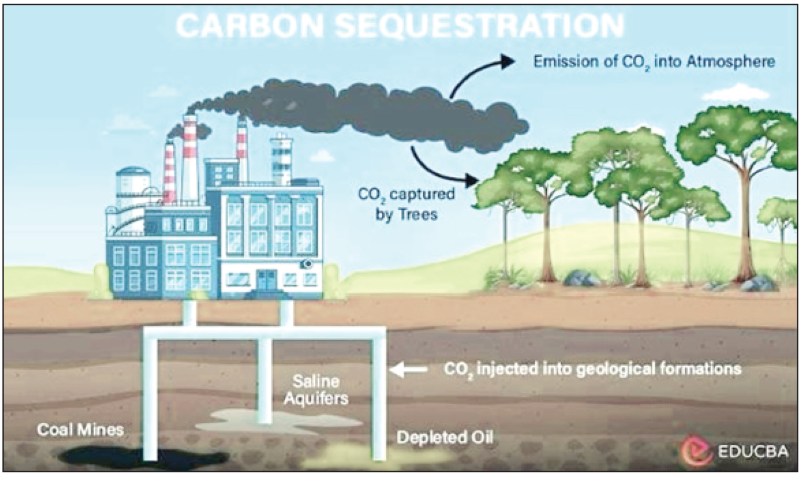
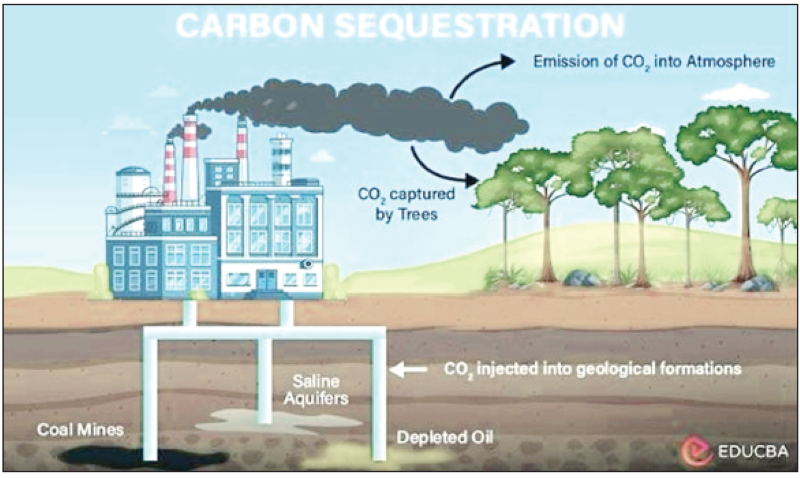
Carbon sequestration and watershed protection are complementary objectives, not interchangeable accounting categories. A policy that records additional tree cover while overlooking the destruction of a vital catchment risks declaring ecological success where substantial damage has occurred.
Compensatory Afforestation and the Limits of Available Land
The limitations of the current approach become clearer when compensatory afforestation is considered. Under this mechanism, developers undertaking eligible forest-land diversion are required to meet prescribed compensatory afforestation obligations, with funds channelled through the Compensatory Afforestation Fund Management and Planning Authority (CAMPA) framework.
The underlying principle is straightforward: forest loss should be accompanied by measures intended to restore or compensate for the lost ecological assets. The practical difficulties, however, are substantial.
India faces competing demands for land. Agriculture must support food security, settlements must accommodate a growing population, and renewable-energy projects require suitable sites for solar installations and wind infrastructure. Finding land that is legally available, ecologically appropriate and suitable for afforestation can therefore be difficult.
The existence of substantial CAMPA balances does not, by itself, establish that afforestation has failed. Unspent funds may reflect several administrative, legal and operational constraints. Nevertheless, where suitable land cannot be identified or planting obligations cannot be implemented effectively, the availability of money alone cannot deliver ecological restoration.
Afforestation is not simply a financial transaction. It requires suitable land, appropriate native species, long-term maintenance, protection from degradation and independent monitoring of survival and ecological outcomes.
Nor should compensatory planting be treated as an automatic licence to destroy an irreplaceable natural forest. The location, quality, maturity and ecological functions of the original forest must be considered alongside the proposed compensation.
From the Godavarman Era to Contemporary Forest Governance
The present debate must also be understood in its historical context. The Forest (Conservation) Act, 1980, was introduced to strengthen oversight of the diversion of forest land for non-forest purposes. It served as an important restraint on the conversion of forest areas, but its implementation also generated disputes over land classification, administrative authority and development approvals.
The Supreme Court’s 1996 Godavarman judgment significantly expanded the practical reach of forest conservation law by requiring protection to extend beyond formally notified forests. Subsequent judicial oversight helped bring neglected forest landscapes within the conservation framework, although it also placed substantial demands on administrative institutions.
The National Green Tribunal, established under the National Green Tribunal Act, 2010, created a specialised forum for adjudicating a wide range of environmental disputes. Its work complements, rather than replaces, the constitutional jurisdiction of the Supreme Court and High Courts. High Courts retain their powers under Articles 226 and 227 of the Constitution, while the Supreme Court exercises its own constitutional jurisdiction.
The institutional challenge today is to make environmental regulation more efficient without sacrificing scientific scrutiny or access to justice. Lengthy procedures can delay legitimate projects, but inadequate assessment can produce ecological damage whose consequences last for generations. A more effective system would combine transparent land records, time-bound decision-making, scientifically informed appraisal and accessible judicial review.
Deemed Forests and the Need for Legal Certainty
The issue of deemed forests illustrates the tension between administrative discretion and ecological protection. Before the 2023 amendments, uncertainty over the identification of forest land could expose landowners to prolonged disputes. The absence of uniform records and consistent classification procedures sometimes complicated decisions concerning private properties and other wooded areas.
The amended framework seeks to establish clearer statutory criteria. Yet documentary certainty should not be confused with ecological certainty. A landscape does not cease to perform forest functions simply because its status has not been properly recorded.
Recognising this difficulty, the Supreme Court has issued directions requiring states and Union Territories to identify and compile information on forests and forest-like areas in accordance with the applicable judicial framework. The Court’s interventions are intended to ensure that the process of statutory transition does not leave potentially protected areas without safeguards while inventories and records are being completed.
Comprehensive mapping is therefore essential. Digital forest inventories should integrate revenue records with satellite imagery, ecological assessments, ground surveys and information about community-managed landscapes. Such systems would help distinguish genuine classification disputes from attempts to exploit gaps in official documentation. The objective should be to eliminate arbitrary administrative power without creating opportunities for the irreversible loss of ecologically valuable land.
Recalibrating Green Jurisprudence: A Watershed-Centred Approach
India needs a more comprehensive framework for evaluating forest diversion, afforestation and ecological restoration. Such a framework should move beyond a narrow emphasis on recorded acreage and carbon sequestration towards a broader assessment of ecological functions.
First, natural forests and commercial tree plantations must be assessed separately. Forest accounting should recognise differences in biodiversity, soil quality, ecosystem maturity and landscape connectivity.
Second, watershed value should become a central consideration in project appraisal. Forests that protect headwaters, recharge zones, perennial streams and erosion-prone slopes warrant assessment based on their specific hydrological significance. Their loss should not be treated as equivalent to the removal of an equal area of trees elsewhere.
Third, compensatory afforestation must be evaluated through measurable outcomes. Survival rates, native-species composition, soil recovery, water retention and long-term ecological integrity should matter more than expenditure or the number of saplings planted.
Fourth, forest inventories should be transparent and scientifically robust. Digital records, field verification and publicly accessible mapping can reduce uncertainty while helping prevent the exclusion of unrecorded but ecologically important landscapes.
Finally, developmental exemptions should be accompanied by appropriate safeguards. Strategic infrastructure may be necessary, but project planning should examine alternatives, minimise fragmentation and assess cumulative impacts on sensitive ecosystems. Applicable community rights and statutory protections must remain integral to decision-making.
These measures would not place conservation and development in permanent opposition. Rather, they would help ensure that development decisions account for the ecological systems on which agriculture, energy production, public health and economic activity ultimately depend.
Conclusion: Forests as Ecological Infrastructure
India cannot afford to frame forest conservation as a simple contest between economic growth and environmental protection. The Forest (Conservation) Amendment Act, 2023, seeks to address legitimate concerns about legal certainty, infrastructure development and national security. At the same time, its implementation raises important questions about the protection of unrecorded forests, the treatment of natural ecosystems and the adequacy of compensatory afforestation.
The answer lies in a more sophisticated understanding of what forests contribute to national development. Their value cannot be reduced to the acreage recorded in government registers, the number of trees planted or the carbon absorbed in a given year. Forests are ecological infrastructure: they regulate water flows, sustain biodiversity, protect soils and support communities across entire landscapes.
India’s green jurisprudence must therefore distinguish between tree cover that contributes to carbon sequestration and natural forests whose complex ecological functions cannot readily be replicated. The protection of critical watersheds must remain a central principle of forest policy, not an afterthought in project appraisal.
The true measure of environmental progress is not how many trees appear on a balance sheet, but whether the forests that sustain our rivers, soils and communities remain healthy and resilient. India’s economic future and ecological security are inseparable. A regulatory framework that recognises this relationship will be better equipped to reconcile development with the enduring needs of nature and society.
(Author, a former Deputy Chief Conservator of Forests in Karnataka, is a known expert on forestry, wildlife, and governance issues.)









[[comment.comment_text]]