Israel’s Voters Divided: Is a National Unity Government Possible?


 an hour ago
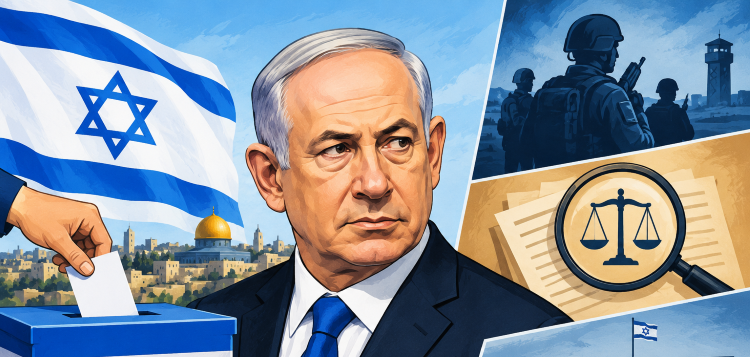
The electoral landscape in Israel remains sharply divided, with recent polling suggesting that neither major coalition is likely to secure a decisive parliamentary majority. Amid ongoing regional warfare and heightened security crises, forming a stable governing coalition presents unprecedented political challenges. To avoid relying on Arab political parties—whose policy demands remain unacceptable to both main factions—Israeli political leaders are increasingly expected to forge a national unity government.
The concept of a national unity government is not unprecedented in Israeli political history, having been deployed during past crises to bypass gridlock and project stability. However, the current political deadlock reflects deeper historical and strategic dynamics that trace back to the founding of the modern state. Understanding today's impasse requires examining how post-World War II geopolitical realignment and Western strategic interests reshaped the West Asian corridor.
Following the horrific atrocities of the Holocaust, European powers sought a permanent solution for displaced Jewish populations while honoring earlier diplomatic pledges. Zionist leaders, including Theodor Herzl and prominent international financiers like the Rothschild family, had actively negotiated with Britain and France prior to the collapse of the Ottoman Empire. These early agreements established foundational backing for a Jewish homeland in Palestine, positioning the future state as a key partner for Western interest in the region.
Western backing of Israel was strongly driven by critical economic and security priorities in West Asia. The region served as a vital maritime trade corridor connecting Europe to Asia via the Suez Canal and the Red Sea. Furthermore, the discovery of massive oil reserves transformed West Asia into an essential energy hub, prompting European powers and the United States to secure reliable regional allies to safeguard oil transit and commercial investments.
Concurrently, European powers sought to contain the surge of anti-Western Arab nationalism and rising socialist movements during the Cold War era. Prominent Arab leaders, such as Egypt's Gamal Abdel Nasser, championed Non-Aligned Movement principles and anti-colonial sentiment across the Middle East. In response, Western nations favored strong strategic alliances to counter anti-Western sentiment and check Soviet influence in the region.
The territorial expansion resulting from the 1967 War fundamentally reshaped the geopolitical reality of the Middle East. Israel assumed control over the West Bank, East Jerusalem, Gaza, the Golan Heights, and the Sinai Peninsula, cementing its military dominance. Over subsequent decades, successive U.S. administrations designated Israel as a primary non-NATO ally, supplying billions of dollars in diplomatic, economic, and military assistance each year.
Despite official international support for a two-state framework outlined in historic UN resolutions, regional peace remains elusive. The military campaign in Gaza has ignited widespread public outrage across Europe and the United States, particularly among younger demographics demanding a reassessment of unconditional foreign aid. Public demonstrations and domestic political movements have highlighted a growing rift between elite political leadership and grassroots public opinion.
Within U.S. domestic politics, foreign spending in the Middle East has emerged as a central point of debate. Movements such as "Make America Great Again" question the expenditure of tens of billions of dollars overseas during economic strains at home, advocating instead for domestic infrastructure and education investments. Nevertheless, established political figures across both major U.S. parties maintain firm bipartisan support for Israel's strategic security partnership.
Looking ahead, Israeli policymakers confront acute existential threats, chief among them the ongoing regional confrontation with Iran and its proxy network. Managing these security challenges requires immediate consensus, overriding internal legislative disputes over domestic governance and economic policy. Consequently, key political institutions and party leaders are moving toward a unified security front.
Ultimately, the probability of a national unity government underscores a persistent truth in Israeli politics: external security pressures frequently mandate internal political compromise. While initial attempts to form a government through party defections may take place, shared geopolitical priorities regarding Iran, regional defense, and territorial control will likely drive rival coalitions into a joint governing alliance.
(The author, a former JNU researcher, is a well-recognised commentator on politics and society in West Asia.)







[[comment.comment_text]]