Rehearsal for Democracy: How Model UN Shapes Young Leaders
 54 minutes ago
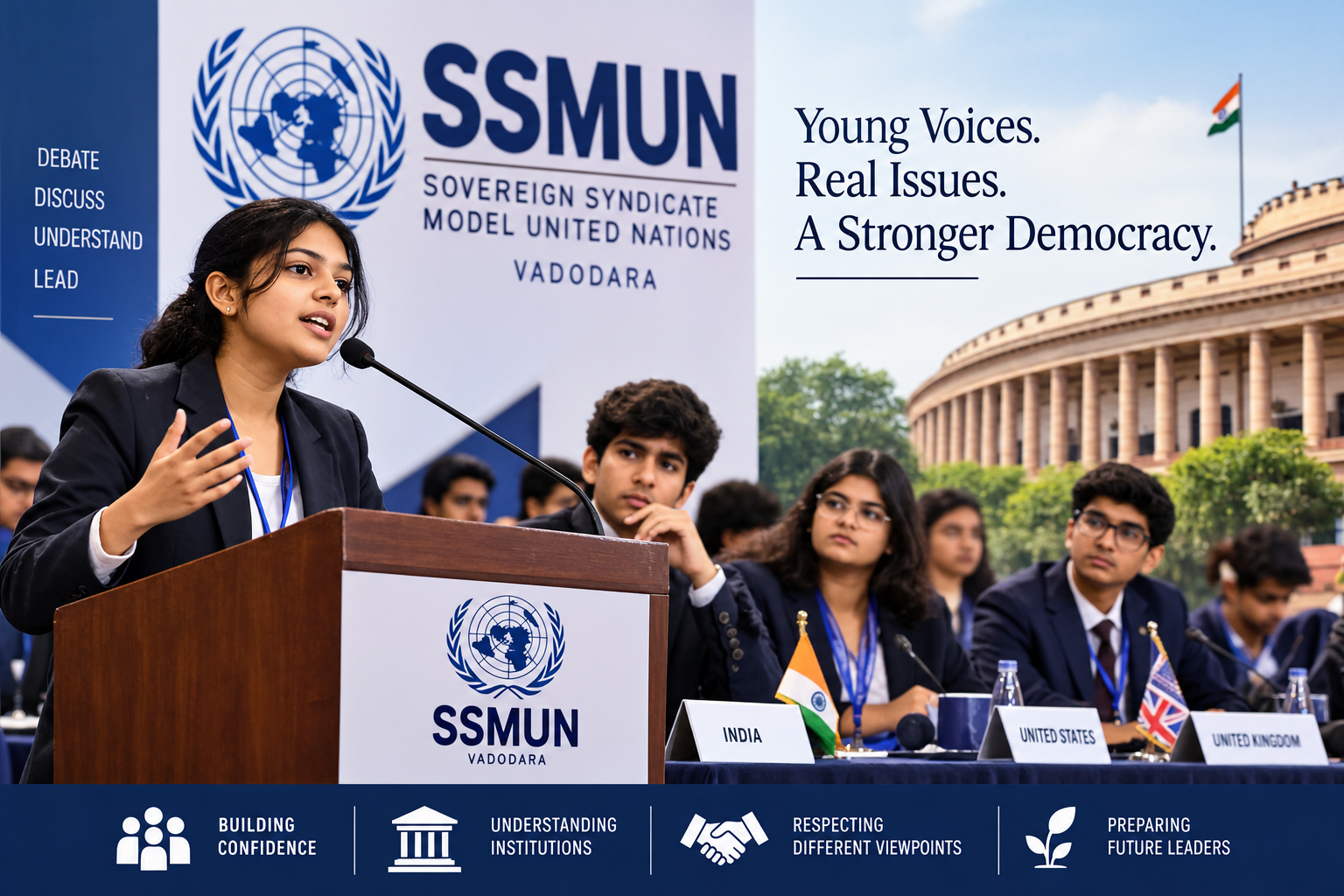
Every generation is told it is the future. Few are handed the tools to practise for it. That is why the inaugural Sovereign Syndicate Model United Nations (SSMUN) in Vadodara deserves more than a passing mention. In two days, a room full of students stopped being spectators of public life and became participants in it.
Why confidence is the real curriculum
The founder of Sovereign Syndicate, Jatan Brahmbhatt, has been clear about what he wants from the platform: to help Gen Z become more outspoken and bolder. It is a modest-sounding aim, but it addresses a real gap. Young Indians are among the most informed in history. They carry the world's news in their pockets and hold strong opinions on everything from exam reforms to maritime security. Yet much of that opinion is expressed in comment sections and reels, spaces where no one has to listen, respond or be accountable.
A Model UN reverses that. It asks a student to stand up, take a position, defend it in front of peers and answer difficult questions on the spot. It rewards preparation over volume. Most importantly, it teaches the lesson that Maulik Desai, one of the guests, put so well at the opening: raise your voice without fear, but learn to listen first. A generation often accused of talking past each other needs exactly that balance.
Learning how institutions actually work
There is also a civic education here that no textbook can deliver. When a delegate is assigned the role of a minister, an opposition leader or a diplomat from a country whose views they may not share, they must understand the arguments of the other side well enough to represent them. They discover how a motion is framed, how time limits discipline a debate, how disagreement can be fierce without becoming disorder, and how decisions emerge from structure rather than shouting.
In a political climate where cynicism about institutions comes easily, that experience matters. A student who has wrestled with the pressures of drafting, debating and voting is far less likely to dismiss democratic processes as noise. They begin to see them as hard, human work that needs capable people. Those are the people this country will need in its legislatures, courts, civil services, newsrooms and boardrooms.
The encouragement that made the difference
Events like this succeed or fade depending on whether those with experience and standing choose to back them. Here, the presence of Vadodara's Member of Parliament, Dr Hemang Joshi, gave the effort real weight. He did not merely attend. He encouraged the participants, appreciated the founder's efforts, and then did something far more valuable than applause: he invited the entire organising team and the delegates to witness the winter session of Parliament in Delhi.
That invitation is worth dwelling on. Praise is easy to give and quickly forgotten. An invitation to see the real thing is a signpost. It tells young people that what they practised in a conference hall is a rehearsal for something genuine, and that the doors of the institution they have been simulating are not closed to them. For a student who spent two days playing a parliamentarian, watching the actual proceedings, the pace, the protocol and the weight of the chamber, can turn a pleasant weekend activity into a lasting ambition.
It also models how elected representatives can engage with the young. Too often, political leaders appear before students only to deliver speeches. Engaging with their efforts, appreciating their initiative and opening the institution to them is a more respectful and more productive approach. It treats young people as stakeholders rather than an audience.
A coalition of dignitaries behind the youth
The MP was not the only public figure to lend credibility to the event. SSMUN was affiliated with a distinguished group of dignitaries drawn from government, the judiciary, the legal profession and law enforcement, and each played a significant part in empowering the youth and ensuring the event's success. They include Mr. C R Patil, Union Minister, Mr. Dinesh V Trivedi, SGST Commissioner and Tribunal Judge, Mr. Jagdish K Ramani, Advocate, High Court and Supreme Court, Mr. Sandeep Singh, Inspector General of Police and Mr. Narsimha Komar, Police Commissioner of Vadodara.
The range of this list matters. The institutions these individuals represent are the very ones delegates spent two days simulating the executive, the judiciary, the bar and the police. For a young participant, knowing that people who work in these fields take such an initiative seriously sends a powerful message. It says that public life is a serious calling, and that those who practise it are willing to stand behind the next generation. Their association gives the platform a credibility that no amount of publicity could buy, and it gives students a ready network of role models to learn from.
A word of caution, and of hope
None of this means a Model UN alone will produce a generation of leaders. Confidence without substance can turn into mere performance, and the best organisers know it. The real test of such platforms is what follows: whether delegates keep reading, keep questioning, volunteer in their communities, and carry the habit of respectful debate into college campuses and workplaces. Organisers can help by building year-round engagement, such as mentorship, policy discussions and interactions with practitioners, rather than relying on a single annual event. With such a strong circle of dignitaries already associated with the platform, that kind of sustained mentorship is well within reach.
Still, the starting point matters. Many young people never get the first opportunity to speak seriously in public, and the ones who do often remember it for life. By creating that space, and by drawing in mentors and public representatives who take it seriously, the Sovereign Syndicate team has done something worth celebrating.
The road ahead
Vadodara has long prided itself on being a city of culture, education and enterprise. Adding a home-grown platform for youth leadership strengthens that identity. The founder's vision, a bolder and more articulate Gen Z, is well placed, and the MP's invitation to Delhi gives it a clear horizon.
If the delegates do make that journey to Parliament this winter, they will walk in not as tourists but as students of the craft, having already argued, listened and learned. That is the best outcome any such event can hope for: not a trophy or a headline, but a young person who leaves convinced that their voice belongs in the room where decisions are made, and who knows how to use it well.
(The author, currently pursuing a Master’s degree in Journalism from Maharaja Sayajirao University of Baroda, is the founder of blogging site: dumpyourthoughts.)


[[comment.comment_text]]