JONARAJA: The Chronicler of Kashmir’s Political and Cultural Transition

 an hour ago
Kashmir occupies a distinctive place in the history of Indian historiography. Its tradition of recording political events, dynastic changes and social transformations stretches back several centuries and finds its most celebrated expression in Kalhaṇa’s Rājataraṅgiṇī, composed around 1148–49 CE. What makes this tradition particularly remarkable is that it did not end with Kalhaṇa. It was continued by successive historians, among whom Jonarāja holds an important position.
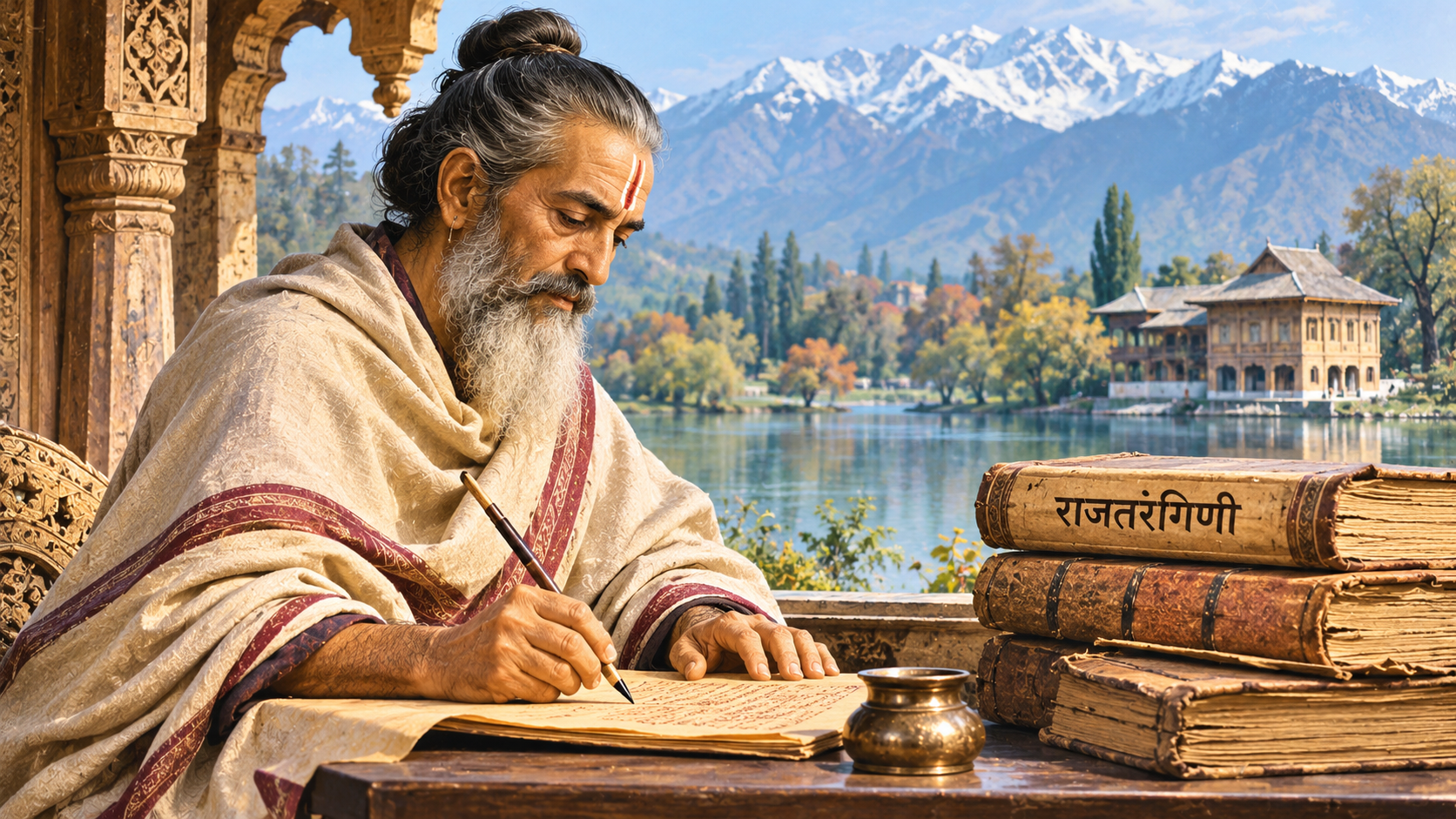
Jonarāja was a fifteenth-century Kashmiri Sanskrit scholar and historian, associated with the court of Sultan Zain-ul-Abidin (1420–1470), popularly known as Bud Shah. His historical chronicle, commonly called the Dvitīyā Rājataraṅgiṇī or Second Chronicle, continued Kalhaṇa’s narrative and documented a decisive period in Kashmir’s political and religious history.
His importance lies not simply in extending an earlier historical account but in preserving a record of the transition from the late Hindu dynasties to the establishment and consolidation of the Kashmir Sultanate.
Continuing the Rājataraṅgiṇī Tradition
Kalhaṇa concluded his chronicle with the reign of King Jayasimha in the twelfth century. The centuries that followed witnessed dynastic instability, internal rivalries, political fragmentation and the eventual establishment of the Shah Mir Sultanate in 1339.
Jonarāja took up the historical narrative from where Kalhaṇa had stopped, covering approximately three centuries of Kashmir’s history. His account records the succession of rulers, political intrigues, changes in administration and the emergence of a new political order.
The continuity between the two chronicles is significant. Jonarāja consciously adopted Kalhaṇa’s literary and historical framework, retaining Sanskrit as the medium of historical expression. In doing so, he preserved an indigenous tradition of historical writing during a period of substantial political and cultural change.
His work is therefore an important primary source for reconstructing medieval Kashmir, particularly the transition from the Lohara and subsequent Hindu dynastic periods to Muslim sovereignty.
Historical Record of Political Transformation
One of Jonarāja’s principal contributions is his account of the establishment and consolidation of the Sultanate.
He records the political developments surrounding the rise of Shah Mir, who established the Sultanate in 1339, and the reigns of subsequent rulers. His narrative provides insights into court politics, succession disputes, administrative instability and the changing relationship between the ruling establishment and different sections of society.
His account of Sultan Sikandar (1389–1413), in particular, is historically significant. Jonarāja describes the religious policies associated with this reign and their consequences for Hindu religious institutions and sections of the population.
These passages are important sources for understanding the religious and social changes of the period. At the same time, they must be read with due attention to the author’s cultural background and the conventions of Sanskrit court historiography.
Jonarāja’s chronicle is not a detached modern history. It reflects the perspective of a Sanskrit scholar witnessing the transformation of the political and religious environment in which his own intellectual tradition had developed.
This makes his testimony particularly valuable, while also requiring critical comparison with other historical and literary sources.
Zain-ul-Abidin and the Question of Religious Accommodation
Jonarāja’s association with Sultan Zain-ul-Abidin provides another important dimension to his historical contribution.
Zain-ul-Abidin succeeded Ali Shah and ruled Kashmir from 1420 to 1470. He is widely remembered for his comparatively tolerant policies, administrative reforms and patronage of arts, crafts and learning.
Jonarāja’s favourable account of the Sultan reflects the political and cultural atmosphere of his reign. The ruler’s policies encouraged the participation of sections of the Hindu population in public life and helped restore aspects of the older cultural and scholarly traditions.
The Sultan’s patronage of Sanskrit learning is especially noteworthy. His association with Jonarāja illustrates that intellectual activity could continue across religious and political boundaries.
However, this relationship should not be interpreted as evidence that all religious and social tensions had disappeared. Rather, it demonstrates a significant phase of accommodation within a changing political order.
Jonarāja’s account is consequently valuable not only for what it records about individual rulers but also for what it reveals about the relationship between political authority, religious communities and intellectual institutions in medieval Kashmir.
His Historical Method and Intellectual Orientation
Jonarāja did not develop a systematic theory of historiography in the modern academic sense. His historical method is best understood through his treatment of chronology, political succession, royal conduct and the consequences of historical events.
Three characteristics stand out.
First, he regarded history as a continuous record. The succession of dynasties did not justify abandoning the historical experiences of earlier periods. His continuation of Kalhaṇa demonstrates an understanding of Kashmir’s past as an interconnected historical narrative.
Second, he attached importance to the conduct of rulers. His descriptions of political instability, oppression, administrative failure and enlightened governance reflect the classical Indian conception of Rajadharma, under which kingship entails responsibility towards the people.
Third, he recognised the historical significance of cultural and religious institutions. His chronicle records the consequences of political change for established traditions and communities, thereby providing material for understanding the wider social history of Kashmir.
These features make his work more than a catalogue of royal successions. It is a historical account of a society undergoing substantial institutional and cultural transformation.
A Scholar Beyond Historiography
Jonarāja was also a distinguished Sanskrit scholar and literary commentator. His intellectual contribution extended to the interpretation of classical Sanskrit literature.
He is associated with commentaries on Bhāravi’s Kirātārjunīya, Maṅkha’s Śrīkaṇṭhacarita and Jayānaka’s Pṛthvīrājavijaya. These works demonstrate his engagement with Sanskrit poetry, grammar, literary interpretation and textual scholarship.
His literary accomplishments are important because they establish that Jonarāja was not merely a court chronicler. He belonged to Kashmir’s established scholarly tradition and possessed the linguistic and literary competence necessary to interpret its classical heritage.
His career also illustrates the survival of Sanskrit intellectual activity under the Kashmir Sultanate. The language continued to serve as a vehicle of scholarship and historical memory even as political authority and cultural institutions evolved.
The Continuation of His Historical Legacy
Jonarāja died in 1459, before the end of Zain-ul-Abidin’s reign. His historical undertaking was continued by his disciple Śrīvara, who composed the Third Rājataraṅgiṇī and carried the narrative further into the fifteenth century.
The tradition was subsequently extended by Prājyabhaṭṭa and Śuka, whose accounts brought the chronicle into the sixteenth century.
This succession of historians is one of the most remarkable features of Kashmir’s historiographical tradition. Unlike many medieval chronicles that remained isolated literary works, the Rājataraṅgiṇī developed into a continuing historical enterprise.
Jonarāja was central to this continuity. By preserving Kalhaṇa’s framework and extending its chronology, he provided later historians with both a literary model and a historical foundation.
Modern scholarship has further examined his work through critical textual studies. Walter Slaje’s Kingship in Kashmir (AD 1148–1459) is an important contribution to the study and critical reconstruction of Jonarāja’s chronicle.
Historical Significance
Jonarāja must be assessed within the historical circumstances of fifteenth-century Kashmir. His work provides an indispensable account of the transition from indigenous Hindu dynastic rule to the Sultanate, the consequences of political and religious change, and the emergence of new patterns of governance and cultural patronage.
His chronicle also demonstrates that political transformation does not necessarily erase older intellectual traditions. Sanskrit scholarship and historical writing continued to contribute to Kashmir’s cultural life under a different ruling establishment.
For contemporary historians, Jonarāja’s greatest value lies in the evidence he preserves. His work allows us to examine a complex period through the testimony of a scholar who lived within it, rather than relying exclusively on later accounts or retrospective interpretations.
Jonarāja’s enduring contribution was to ensure that Kashmir’s historical narrative did not end with Kalhaṇa. He carried forward an established tradition of historiography through one of the most consequential transitions in the Valley’s history. His chronicle remains an essential source for understanding medieval Kashmir and its political, religious and cultural evolution.
He deserves recognition not merely as Kalhaṇa’s successor but as an important historian in his own right and a custodian of Kashmir’s historical memory.
(Author, a noted Senior Advocate, is a public intellectual and a well-recognised columnist.)








[[comment.comment_text]]