‘Nvidia: The Man, the Mission and the Making of a Tech Giant’ for publication

 32 minutes ago
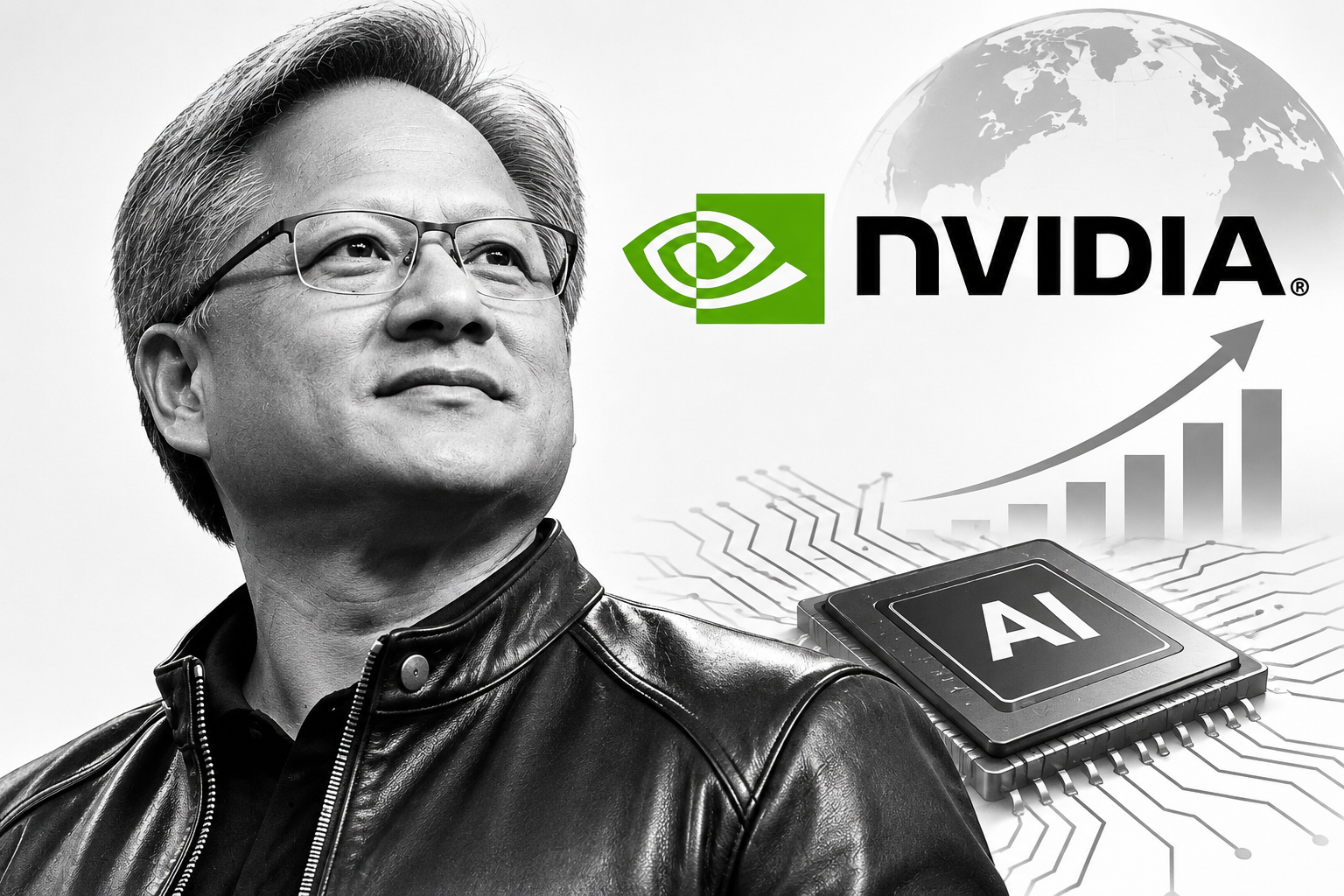
At first glance, Jensen Huang looks like an ordinary technology executive. Yet his trademark black leather jacket is more than a fashion statement. It is a quiet rebellion against conventional corporate culture – a reminder that you do not need a Wall Street suit to change the world.
Huang is known for his reserved demeanour and his relentless pursuit of ambitious goals. He rarely talks about himself, preferring instead to focus on his team and his products. And what a product Nvidia has built! It is not some ordinary software that competitors can easily replicate. Nvidia has not built its fortune by selling hype. It has created the technological engine on which much of the future of computing and artificial intelligence is being built.
In today's global AI race, Nvidia is no ordinary competitor. It has become an indispensable supplier of the computing power that makes the AI revolution possible. But this is not merely a story of technological brilliance or corporate success. It is, above all, the story of a man whose determination, resilience and unconventional leadership helped make it happen.
“The probability of success: zero per cent.” That was how Jensen Huang described the prospects of his venture when he founded Nvidia in 1993 with Chris Malachowsky and Curtis Priem. They had just $40,000 in capital and what seemed like an impossible dream. They were entering a market already dominated by powerful players, attempting to develop a technology called the GPU, or Graphics Processing Unit, in which few investors were willing to place their faith.
Three years later, the dream was on the verge of collapsing. In 1996, Nvidia was barely 30 days away from bankruptcy. The company had enough money left to meet its payroll for just one more month. Its first chip, the NV1, had proved to be a major technological miscalculation. Microsoft had shifted its software strategy, and the NV1's incompatibility with Microsoft's Direct3D standard had created a serious problem. Nvidia's entire business model was suddenly in jeopardy.
This was the moment when most people would have thrown in the towel. But adversity often reveals the true mettle of a leader.
Huang refused to give up. He took an extraordinary gamble, cutting nearly three-quarters of the workforce, although several employees had already left amid the company's mounting troubles. He then committed almost all of Nvidia's remaining resources to a new chip, the RIVA 128, even before it had completed testing.
The gamble paid off spectacularly. Within just four months, Nvidia sold one million chips. The business found its footing, momentum returned, and the company was pulled back from the brink.
That near-death experience became embedded in Nvidia's corporate DNA. Even today, Huang reportedly begins meetings with a stark reminder: “Our company is only 30 days away from going out of business.”
It is more than a dramatic catchphrase. It reflects a philosophy of permanent urgency: never become complacent, never take success for granted, and never assume that yesterday's victory guarantees tomorrow's survival.
Perhaps the roots of this philosophy lie in Huang's own childhood.
Born in Taiwan, Huang moved with his family to Thailand and eventually to the United States as his family sought a safer future amid the uncertainties surrounding the Vietnam War. His mother did not speak a word of English. Yet she would pick ten new words from a dictionary every day and make her sons memorise them.
In America, Huang was sent to a boarding school in Kentucky. Far from being an elite academic institution, it was a military reform academy.
His early experiences were hardly comfortable. One of his first responsibilities at school was cleaning toilets. Struggling with broken English, he also faced bullying and physical intimidation. But rather than allowing these experiences to define him, Huang turned adversity into an asset.
His 17-year-old roommate could neither read nor write. Huang taught him to read, while his roommate introduced him to bench pressing and weightlifting.
Huang has often emphasised the importance of adversity in shaping character. His philosophy can be summed up in his words: “Greatness does not come from intelligence. Greatness comes from character. And character is not developed through cleverness; it is forged through adversity and the ability to endure pain.”
His first job was at a local Denny's diner, where he washed dishes and worked as a waiter. It was there, not in a corporate boardroom, that he learned some of his most enduring lessons about working under pressure.
He has described how his heart rate actually slows down in highly stressful situations. As he puts it, “I do my best work when everything is at stake.”
That lesson came not from his Stanford education but from the frantic rush hours at a diner. Indeed, when Huang and his co-founders began planning Nvidia in 1993, they did not do so in a glamorous corporate office. They sat together over coffee at that very diner and discussed the future of the company that would eventually transform the technology industry.
Huang's leadership style is as unconventional as his personal journey. He has challenged the traditional corporate hierarchy between executives and employees, choosing to engage directly with engineers rather than relying exclusively on layers of management.
At Nvidia, failure is not necessarily treated as a crime. It is regarded as an opportunity to learn. When a project fails, those responsible are expected to make a ‘failure presentation’, explaining what went wrong and what the organisation can learn from the experience. The objective is not simply to assign blame but to ensure that the same mistakes are not repeated.
His most consequential strategic decision, however, may have been recognising the potential of artificial intelligence long before it became a global obsession.
While much of the technology industry remained focused on gaming, Huang quietly invested in CUDA, or Compute Unified Device Architecture, a parallel computing platform that enabled Nvidia's GPUs to perform tasks far beyond graphics processing.
That decision fundamentally changed the company's trajectory. CUDA transformed Nvidia from a graphics card manufacturer into a central force in the global AI ecosystem.
In 2016, Huang personally delivered the DGX-1 deep-learning supercomputer to OpenAI, the organisation that would later develop ChatGPT. It was a symbolic moment that captured Nvidia's growing importance in the emerging AI revolution.
The larger lesson from Huang's journey is worth reflecting upon. Our greatest weaknesses, deepest hardships and most difficult crises can eventually become our greatest strengths – provided we have the courage to learn from them.
As Huang has said, “I have cleaned tables. I am prepared to deal with every kind of mess and difficult situation.”
That statement perhaps captures his leadership philosophy better than any corporate strategy document could.
However, the Nvidia story also raises important questions about the relationship between a company's success and the individual who leads it. When a founder becomes synonymous with an organisation, can the institution sustain its identity and momentum without him?
Recent international media reports have brought Nvidia and Huang into the spotlight amid controversy surrounding allegations relating to his personal life and scrutiny involving the company.
On November 12, 2026, Nvidia officially announced that Huang had resigned as the company's President and CEO. Chief Financial Officer Colette Kress was appointed interim CEO.
If confirmed, this would mark one of the most consequential leadership transitions in the company's history. The man who guided Nvidia for 33 years and transformed it into a global technology powerhouse would no longer be responsible for its day-to-day leadership.
The immediate question is not simply who will occupy the corner office. It is whether Nvidia can preserve the technological advantage, extraordinary pace of innovation and distinctive corporate culture that Huang helped create.
After all, building a great company is one challenge. Building an institution that can thrive beyond its founder is quite another.
Jensen Huang's greatest legacy may ultimately be determined not by how high he took Nvidia, but by whether the company can continue to soar without him.
(The author is an Assistant Professor of Economics at B.R.A. Bihar University, Muzaffarpur, and a person of versatile tastes.)











[[comment.comment_text]]