Nana Patekar: A Powerful Voice of Resistance
 2 hours ago
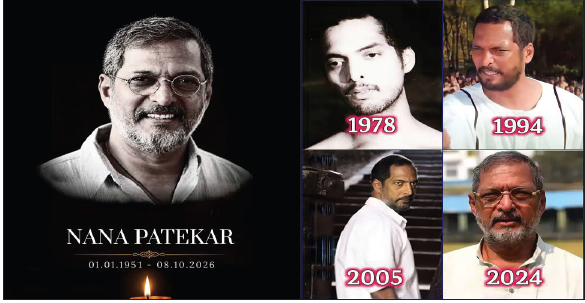
Some actors go up on screen, take on a role, and then walk away. Some use the power of their craft to make their characters unforgettable. However, a select handful transcend the character and start addressing the times they live in. Nana Patekar was one of those uncommon breeds.
He was more than just a dialogue actor. He caused words to shake with truth, irony, grief, and rage. His eyes held questions bigger than the story itself, and his voice frequently appeared to contain the restlessness of an age. Even when he was portraying a fictional character, he frequently appeared to be speaking directly to society, which made his performances extremely frightening. That's what set Nana apart. He did more than just act. He confronted him at his best.
When an Actor Became a Question
Few actors have been able to use speech as a means of social action, despite the fact that Indian film has produced many strong performers. Among them was Nana Patekar. A discourse was rarely merely a dialogue in his performances. It might turn into a slap, a warning, an accusation, or even a mirror.
His voice in Krantiveer became that of a man who could not stand the moral breakdown all around him. His well-known comments, "Ye Musalman ka khoon, ye Hindu ka khoon… batao ismein Musalman kaun sa hai aur Hindu kaun sa hai?" were more than just dramatic statements. By distilling the politics of identification to the most fundamental reality—blood has no religion—they pierced through the foolishness of community enmity.
Additionally, the statement "Aa gaye meri maut ka tamasha dekhne..." went beyond the character. It brought up an unsettling question about a society that can make the misery of another person into a spectacle. This was Nana's great power. He had the ability to unnervingly bring a made-up moment to life.
Dialogue as Resistance
Power, brutality, crime, helplessness, and the person imprisoned within a greater system were recurring themes in his films. The well-known line from Yashwant, "Ek machhar saala aadmi ko hijda bana deta hai," was offensive, provocative, and purposefully awkward. Beneath its rawness was an observation about power: occasionally a seemingly trivial detail can reveal a system's overall powerlessness.
The words "Dhandhe mein koi kisi ka bhai nahin, koi kisi ka beta nahin" from Parinda encapsulated the harsh logic of a society where power, profit, and survival take precedence above relationships. Another sentence in Ab Tak Chhappan conveyed an even more unsettling notion: "Hum sab system ka hissa hain, system decide karta hai, apan follow karta hai."
That sentence can be interpreted as a description of any institution, including politics, bureaucracy, and law enforcement, where the word "system" gradually obscures personal accountability.
Who makes the decision? Who pays attention? Who assumes accountability? And who is responsible when everyone says they are only following the rules? These kinds of queries were frequently left unanswered by Nana's performances. The character owned the words. The enquiries were societal in nature.
More Than Anger
However, it would be too simple to make Nana Patekar angry. He had the capacity for vulnerability, humour, sensitivity, and quiet. His portrayal in Welcome served as a reminder to viewers that an actor capable of sounding like a guy on the verge of social breakdown could still craft incredibly humorous characters.
His rendition of "Bhagwan ka diya hua sab kuch hai" as Uday Shetty revealed another aspect of his skill. That flexibility was important.
It wasn't a mannerism; it was Nana's intensity. It served as a tool. He had the ability to both increase and drop his voice. Sometimes his quiet spoke more than a lengthy monologue, but he could also control a scene with words. Before he said a word, his expression had the power to alter the mood of a situation. A great actor is defined by how profoundly the audience listens, not by how loudly they speak.
The Voice Was the Character
Nana Patekar's voice had a unique quality. For the sake of film, it didn't sound polished. It had a lived-in vibe. It could be harsh, wounded, sardonic, menacing, defenceless, or explosive. Instead of the smoothness of produced performance, it conveyed the texture of everyday living. Maybe that's why his conversations grew so unforgettable. We didn't just hear them. We trusted them.
His portrayals frequently conveyed the idea that the character existed before the arrival of the camera and would persist beyond the conclusion of the scene. There was agony behind the quiet, experience behind the words, and history behind the rage. It is difficult to create that genuineness. It must be experienced.
An Actor Who Spoke to His Time
Actors that entertain it are produced by each age. However, some actors go on to become the voices of their generation. The latter group included Nana Patekar. He emerged during a period of profound economic, political, and cultural transformation in Indian society. Public life was becoming more and more marked by violence, conflict within communities, corruption, institutional authority, and the struggles of common people. His film did not offer simple solutions to these paradoxes. Rather, it revealed them. That is a crucial distinction.
To talk about society, an actor does not have to become a politician. He doesn't need a manifesto. Sometimes a single syllable, a pause, a glance, or a figure can ask a more powerful question than an entire speech. Nana could grasp that language.
His characters frequently found themselves at the nexus between the system and the individual. They were hurt, which is why they were upset. Silence had failed them, so they yelled. There was a greater societal reality hidden beneath those personas.
From Acting to Intervention
Great films don't necessarily transform society. However, it may cause social unrest. A relaxed audience may become uncomfortable as a result. It may make a viewer face a question they would prefer to avoid. That was Nana Patekar's power. He didn't always dictate what the audience should believe. He made it hard for the audience to avoid thinking. Because of this, his most potent dialogue has endured outside of the movies in which it was included.
They become part of the popular consciousness. They became references. They turned became metaphors for politics. They turned into societal critique. Additionally, they occasionally served as a medium for common people to vent their frustration that they were unable to communicate.
The Man Behind the Voice
The actor's life was characterised by hardship, self-control, and an unwillingness to romanticise achievement. Maybe that's why his performances didn't always feel ostentatious. His acting lacked superfluous gloss. The performance maintained a human and earthly quality even when the character was larger than life.
He could portray the strong man without making strength appealing. He could portray the aggressive man without elevating violence to heroic status. He was able to portray the injured man without being mushy. Additionally, he could portray the comedic man without sacrificing his humanity. An actor's endurance comes from that range.
A Voice Against a Numb Society
Violence is not necessarily the biggest threat to a civilisation. It might be apathy at times. When injustice becomes commonplace, corruption becomes commonplace, hatred becomes amusement, and misery becomes someone else's concern, a community becomes weak.
Voices of opposition become crucial at that point. That apathy was frequently aroused by Nana Patekar's film. When society demanded silence, his characters yelled. When others favoured obedience, they asked. When it seemed easier to conform, they rebelled. They also served as a reminder that life is more than just biology. It is also ethical. It is a form of resistance in and of itself to be sensitive in an insensitive age. That might be the most profound significance of Nana's film legacy.
Remembering Nana
Repeating Nana Patekar's well-known dialogues would only serve to highlight his contributions. Listening to the questions that lie within those conversations is the true tribute. He was questioning communal hate when he enquired about the distinction between Muslim and Hindu blood.
His characters exposed the systems that normalise violence when they faced it. They were making us consider our personal involvement as they talked about the system. Additionally, their laughter served as a reminder that resistance does not necessarily require a solemn demeanour.
Perhaps this was Nana's greatest accomplishment: he combined amusement with discomfort. He had the ability to make us laugh before provoking thought. He has the ability to infuriate us and then get us to feel uneasy about the reason for our rage. He had the ability to speak for a character and, in some way, a whole civilisation. Acting like that is not typical. That's the task of an artistic conscience.
The Voice That Remains
Actors come and go. Movies come and go. Even well-known conversations eventually become less remembered by the general public. However, certain voices endure because they attach themselves to something more than films. Resistance was associated with Nana Patekar's voice. to be furious about injustice. to find hypocrisy uncomfortable. to the dignity of the average person.
Therefore, honours, performances, or iconic personalities shouldn't be the only factors used to gauge his legacy. The questions he left behind should be used to gauge it. If art never bothers us, what good is it?
If an actor's performance finishes at the theatre door, what is their value? And if society can hear a voice and not change, what good is it? Nana Patekar ensured that his voice was not limited to the screen.
He gave voice to the screen. He asked the character a question. He forced the conversation to be confrontational. When he was at his finest, he forced the audience to examine themselves. Nana Patekar was never just an actor because of this.
He had a strong voice for resistance. Furthermore, strong voices do not go away when the performer exits the frame. They still exist—in conscience, in memory, and in the problems from which we are unable to move.
(The author, a Doctorate in Laws, is a senior lawyer and civil society activist.)




[[comment.comment_text]]