Jamboo Savari of Mysuru Dussehra

 3 hours ago
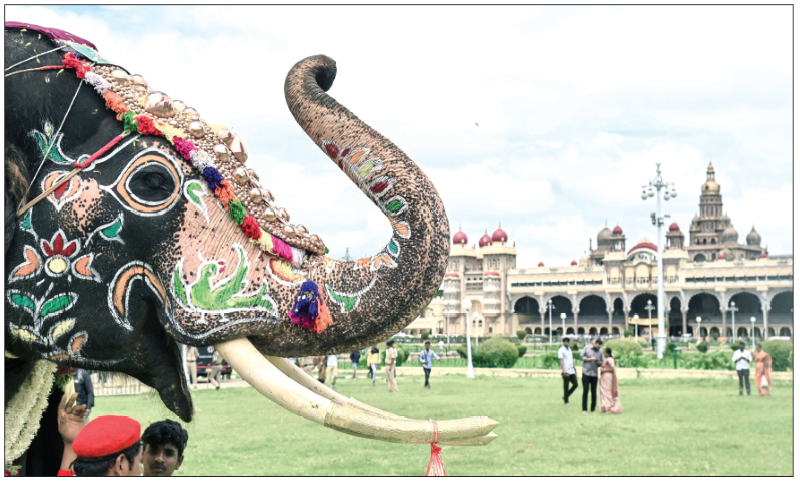
Vijayadashami, the 10th day of the Navaratri is celebrated as the day of triumph of the good over evils with religious fervour of Victory of Lord Rama over Ravana… but in Karnataka-it is believed as the slain of the wicked king-Mahishasura by the Goddess Chamundeshwari of the Mysore. The Vijayadashami is also called Dussehra-the finale after Navratri rituals- is a procession in which the Mysore-Kings had procession on a Jumboo-savari (Elephant ride) seated in a Golden Hauda (Ambari-weighing 750 kgs) tied on top of a tamed elephant-tusker escorted by two of its consorts (Kumki elephants) with pomp and reverence to put up a spectacular show of the might of the kings in defense and cultural progress up to Bannimantap-Shami tree for rituals and back after torchlight parade to mark the end of splendor-Dassehra.
The Dussehra was the annual victorious celebration of the Vijayanagar Empire of 15th century CE and it was picked up by the Mysore Kings-Wodeyars in 1610 after the fall of Vijayanagar Empire. After independence, the Privy Purse paid to ex-kings was abolished in 1971 and the Mysore King refused to participate in the Dussehra procession. Then, the Govt of Karnataka continued the traditional Dussehra procession with Jumboo-Savari by taking the idol of the Goddess Chamundeshwari in the golden Hauda in place of the king with all religious fervour in grand scale to attract more tourists from all over India and abroad with exhibitions and many cultural shows in the palace during the Navaratri.
With the progress of the state in socio economic, education, software technology and life -the state govt. not only upgraded the Mysore Dussehra but also started observing Dussehra in some district Hqs like Tumakuru, Shimoga, Dharwad and Madikeri etc and it may spread to all the districts to entertain and educate the public on the old traditional heritage of the state with Jamboo savari of the idol of the State Goddess-Chamundeshwari in the Ambari. Some taluks too are not falling behind in it. Here the problem is the Jumboos participation in the celebration of pomp and show with a congregation of huge crowds-use of drums, pipes, dances and bursts of crackers etc which disturbs the tranquility of elephants carrying heavy hauda on their back.
Mishaps-warning to be careful: In 2026 Dussehra on 19th of Oct. an incident occurred in the Shivamogga town where a male tamed elephant from the Forest Department commissioned for carrying the silver Hauda with the Idol of Goddess weighing 650 kg was got irritated in procession and ran amok causing the hauda to fall and damage to the idol. Luckily it went out of the crowd into a street causing no injury to people & no damage to any property. In 2024 a male elephant in the team of elephants in procession chased another male causing panic to the public-luckily both came under control in Mysuru Dussehra. In 2021 the elephant carrying the hauda panicked for the sound of crackers at Srirangapatna and ran amok luckily it was controlled by the mahaut.
The above incidents created a hue and cry in the media- where wildlife lovers criticized the use of elephants for Dussehra which cause trauma to animals against the principles of SPCA with demand to ban use of elephants for Dussehra and to go for mechanized elephants; But the public especially children and the tourists love to see jamboo savais and the state govt. is firm on using elephants for jamboo savaris and it has even defended against a PIL in the High Court.
Training for elephants: The training to elephants for Mysore Jamboo Savari is elaborate for months even after selecting the most experienced elephants for the Dussehra under care of a veterinarian. A team of 12-15 elephants participate in Dussehra with camp in the city for 2 month to get accustomed to the crowd, traffic, sound, crackers, pipes, drums while carrying a weight of the hauda by the selected elephant etc with rich diet and health care… with this training-the incidents of elephants going amach is minimal but it cannot be so in case of district Hqrs.
Elephants:
The Elephants are considered to be the world’s largest terrestrial mammals, commonly found in the deep forests of Asia and Africa. They are two species of elephants-Asian elephants and African elephants. Asian elephants are comparatively smaller in size than African elephants. Elephants are among the smartest and most social animals on the planet. Elephants are herbivorous animals; they eat leaves, twigs, fruits and vegetables and like fibrous food. The elephants’ population all around the world is rapidly decreasing due to poaching for ivory trade and loss of habitats, lack of food, water and corridors for seasonal movements to meet their physiological and biological requirements.
Elephants in India:
Indian elephants are a subspecies of Asian elephants. Historical documents indicate the use of Indian elephants in the war fares including the mythological war-Kurukshetra; as far back as in Mauryan Empire (321-185 BCE), Vijayanagar Empire(1336-1646 CE) and Mughal Empire (1526-1857 CE) were all used to capture wild elephants and train them for use in war fares. The elephants were domesticated and reared as pets for religious institutions and work. Elephants were used from the very beginning in transporting heavy goods and people from one place to another in olden days and later for perambulation, patrolling in forests, timber logging in forests and display in circuses/zoos etc.
The Mysore Khedda:
The Khedda-capture of wild elephants with a drive in the River Kabini in the midst of the Kakanakote forests of Mysore had organized 36 Kheddas with elaborate arrangements for the spectacular show for royal tourists drawn from all over India & the world to earn revenue. The Khedda was to capture elephants for taming, sale and for use of the government in timber lumbering and for Dussehra procession and to dole out for religious institutions etc. It was started in 1873-74 and the 1970-71 was the last one; it was stopped after the enactment of the WLPA, 1972.
Decline in population of elephants:
The population of animals like elephant, tiger, lion, leopard, rhinoceros, bear and other cats were very good in India with the legacy of wildlife conservation measures followed by the Maurya Empire by Chandragupta and Ashoka with empathy for all forms of life advocated by Buddhism. The elephant population was dense in south India and there used to be cry by the farmers against the elephants’ crop damages …for which the Governor of the Madras Presidency ordered for killing of elephants to control their population with rewards in 1873…The unscrupulous hunters exploited this situation and hunted elephants indiscriminately for ivory for sale in internal market and also to get rewards; Situation forced the elephants to fear the sight of humans and started charging in self defense; in retaliation to this behavior of elephants, British government declared such attacking tuskers as rogues all over India and ordered to be killed…which led for the decline of elephants population in India.
The British government treated the wildlife as a forest product and had no punishment for offences against wildlife as a result hunting of elephants continued for ivory for economic gains. The wild animals like lions, tigers, cheetahs, leopards, rhinoceros and herbivores in plenty were subjected for hunting as games by British officers and the feudal kings causing for decline of the wildlife population in India till the Wildlife Protection Act, 1972 came to force..
There is no proper record about the population of elephants in India till an ocular estimation by Dr Raman Sukumaran, an elephant research Scholar-a maximum of 24,000 in 1989. The government of India launched a special elephant conservation program-“Project Elephant” in 1992 to with creation of 26 ‘Elephant Reserves’ in 13 states to conserve elephants against poaching, creation of corridors to facilitate for their movement from habitats to habitats and for creation of food & water in nature with scientific census every 4 years. The population of elephants in India is on an increase and is said to be nearly 30,000 now.
Ban of wild animals’ display:
The Government of India banned the use of wild animals for display-in circuses in 1998. Many circuses which took stay against the ban of display of animals like tigers, lions, leopards, bears, etc lost the writ petition in the Supreme Court and all circus animals were taken over by the government and lodged in the Rescue Centers built for them and in Zoos in 2001. The display of elephants in circuses was banned in 2013.
But, this ban is applicable for capturing of elephants like in Khedda. The rogue elephants so declared by the Chief Wildlife Wardens are captured and have to be tamed as they cannot be left into the wilderness; when once tamed, they will be used by the forest department for operations against rouge wild animals, forest protection duties, and Dussehra processions and for religious institutions. There are about 2,700 captive elephants out of which 1,700 are owned by Private and rest in the forest department in camps & zoos. More elephants are captured in 'Human-Elephant-Conflicts' in South India. Whereas African elephants are free from captivity, not even in zoos.
Conclusion: The love & cooperation of public for conservation of the wildlife is very important to the government, as such their aspirations cannot be ruled out and the Forest Department has to train and keep a team of well trained elephants for Jamboo Savaris-Dussehra in Karnataka to fulfill the aspiration of the public /government as a tradition…if not, people may not tolerate the appearance of elephants at their habitations in the changed situation of declined wildlife habitats, water & fodder resources in India. This is a forced situation of ‘Quid pro quo’to oblige the aspiration of the public.
(The Author is a Retired Indian Forest Service Officer, Karnataka- A writer and an expert commentator on wildlife.)



[[comment.comment_text]]