Dense Mountain Population Puts Himalayan Monal at Risk of Vulnerability

 2 years, 11 months ago
"The majestic Himalayan Monal not only faces the threat of vulnerability due to a dense mountain population, but also embodies a deep-rooted spiritual and cultural significance that we must protect."
Amit Pandey , Nainital
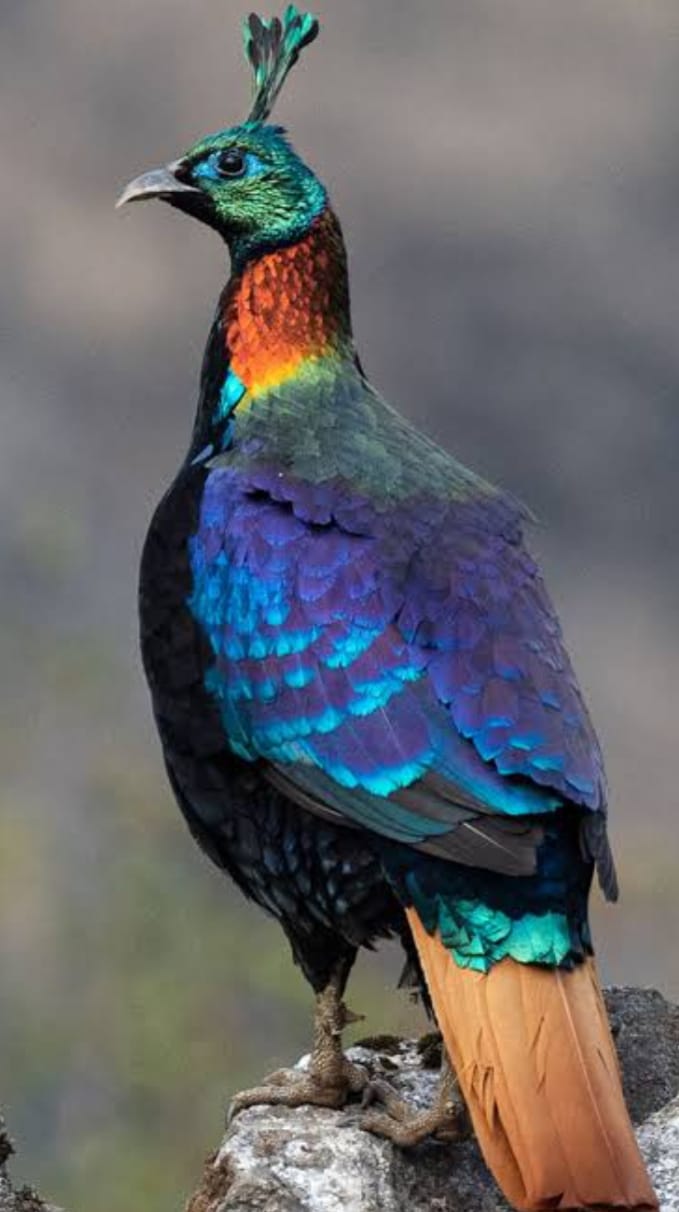
The Himalayan Monal, also known as the Impeyan monal, Impeyan pheasant, is a bird in the pheasant family, Phasianidae. The state bird of Uttarakhand, India, This State bird of Uttarakhand has been selected as the mascot for the 38th National games to be held in Uttarakhand in 2018. And it is known as The Monal.
The Himalayan Monal is one of the most well recognized pheasant species of the western Himalaya because of the male's metallic, rainbow-colored plumage and iridescent blue head crest. The bird has been incorporated into the traditional folklore of many Himalayan cultures .
The Himalayan monal's native range extends from Afghanistan and Pakistan through the Himalayas in India, Nepal, southern Tibet and Bhutan.In Pakistan, it is most common in the Khyber Pakhtunkhwa province and has also been recorded in Kaghan, Palas Valley and Azad Kashmir. In India, it has been recorded throughout the Indian Himalayan Region from Jammu and Kashmir to Arunachal Pradesh. It lives in upper temperate oak-conifer forests interspersed with open grassy slopes, cliffs and alpine meadows between 2,400 and 4,500 m (7,900 and 14,800 ft), where it is most common between 2,700 and 3,700 m (8,900 and 12,100 ft). It descends to 2,000 m (6,600 ft) in the winter. It tolerates snow and digs through it to obtain plant roots and invertebrate prey. InUttarakhand, the birds are currently found in grassy slopes above the treeline, primarily in Chopta, Munsyari, Kedarnath Wildlife Sanctuary, Pindari and Dodital area of Uttarkashi. “The Himalayan Monal is kept under schedule one of Wildlife (Protection) Act, 1972.
Some communities in the region attribute spiritual significance to the Monal. They believe that the sighting of a Monal is an auspicious sign, heralding good fortune and blessings from the divine.The females in turn only mate with the selected male and enter into a monogamous relationship. Due to habitat destruction and hunting, they have become rare and their population is endangered
In some areas, the Himalayan monal is threatened due to poaching and other anthropogenic factors. In the western Himalayas, the population responded negatively to human disturbance involving hydroelectric power development.It is not considered endangered in Pakistan and can be easily located. In some areas, the population density of the species is as high as five pairs per square mile. The main threat to the species is poaching, as the crest is valuable. It is thought to bring status to its wearer and is a symbol of authority.











[[comment.comment_text]]