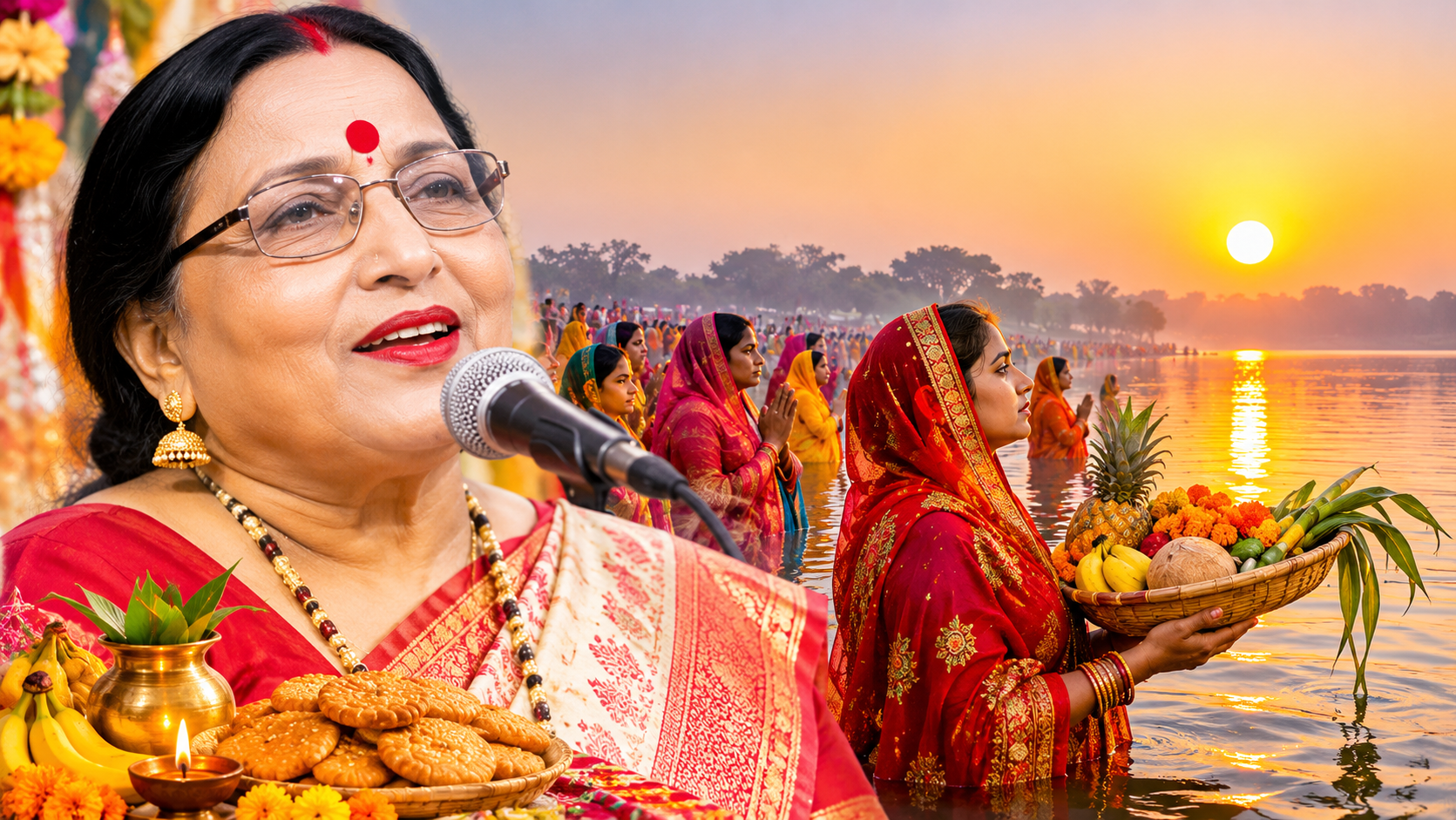
Sharda Sinha: The Voice That Made Chhath Eternal

 an hour ago
The great festival of Chhath will return this year, just as it did last year, and as it will continue to return in the years ahead. The riverbanks will come alive with devotion, the air will resonate with folk songs, and the familiar spectacle of faith and festivity will unfold once again. Yet someone will be missing.
Sharda Sinha, the Goddess of Melody will not be physically present among us. The nation lovingly celebrated her as the Bihar Kokila—the Nightingale of Bihar—is no longer with us. It was said that Goddess Saraswati herself resided upon her tongue. She has departed for the celestial abode, but her voice remains. And it will remain, because Chhath, as millions of devotees experience it, is almost unimaginable without her.
Indeed, in Bihar, few celebrations, festivals, rituals or religious occasions remain quite the same without the unmistakable resonance of her voice. But Chhath and Sharda Sinha are bound by a particularly intimate relationship. They are almost synonymous, inseparable in their cultural and emotional significance. Her songs are the spiritual flight of popular faith, a melody of joy for those observing the arduous fast, and the celebratory rhythm for those immersed in the festivities. Every moment of this great festival seems to echo one of her immortal lines: “Pag-pag liye jaaun tohri balaiyan”. With every step, I would ward off all evil from you.
There is something deeply moving about the fact that Sharda Sinha departed from this world during the very days of Chhath. At a time when people were immersed in the celebration of nature through her songs, she began her journey towards eternity. In the Sufi tradition, the passing of a spiritual seeker is not regarded merely as death; it is understood as a union with the Beloved, the Divine. This is called Urs – an occasion of celebration rather than mourning. In that sense, one might say that Sharda Sinha's departure coincided with a moment of collective devotion, when the soul's journey towards the Supreme seemed to merge with the spiritual rhythms of Chhath.
For the people of Bihar, an acquaintance with Sharda Sinha's voice often begins almost at birth. Hers is a voice that belongs to every household. From sohar songs celebrating the arrival of a newborn to the auspicious melodies accompanying weddings, her music has been woven into the fabric of everyday happiness. My own introduction to her music, however, came much later. I was born into the Awadhi linguistic and cultural tradition. Bhojpuri and Maithili were not languages with which I had any particular familiarity. It was only after life brought me to Bihar, where I eventually made my home, that I discovered the extraordinary musical world of Sharda Sinha.
I still remember a student at our college singing “Jai Jai Bhairav O Asur-Bhayavani.” She sang it beautifully. I subsequently learnt that the composition was by Vidyapati, the celebrated Maithili poet, while the rendition was associated with the distinctive musical style of Sharda Sinha.
I did not understand Maithili, but the sweetness of the composition needed no translation. Its melody had an immediate emotional appeal, while Sharda Sinha's resonant voice seemed to travel straight to the heart. The more I listened, the deeper my admiration grew.
Consider her rendition of Vidyapati's: “Sakhi he hamar dukhak nahin aur.” (O! Friend, there is no end to my sorrow.) Listening to these words in her voice transports one to a realm of empathy where another person's anguish of separation becomes one's own. That, perhaps, is the highest expression of love and humanity: the ability to feel another person's suffering as intimately as one's own. As Firaq Gorakhpuri says in his couplet – “Hasil-e-husn-o-ishq bas hai yahi/ aadmi aadmi ko pahchaney.” (the ultimate fulfilment of love and beauty lies in one human being recognising another). Sharda Sinha possessed this rare ability to transform emotion into shared experience.
There is another dimension to her musical genius. Take the thumri “Aaj Mohe Raghubar Ki Sudh Aayi,” beautifully rendered by Kumar Gandharva. Sharda Sinha, too, brought her own interpretation to this composition. Its words evoke an extraordinarily poignant image: Mother Kaushalya sitting beside a window, a large red bindi on her forehead, watching the monsoon rain pour outside. Her eyes, too, are overflowing with tears as she thinks of Ram and Lakshman, wondering what hardships they might be enduring in the forest. Such is the evocative power of her singing that the listener does not merely hear a composition; one inhabits its emotional landscape.
Different great voices lead us into different worlds. Begum Akhtar draws us into an ocean of pain and longing, where separation, anguish and deprivation find their most exquisite expression. Iqbal Bano brings us to the threshold of rebellion, where love becomes revolution and revolution becomes love. Abida Parveen offers spiritual nourishment, guiding the listener towards devotion and Ishq-e-Haqiqi – the love of the Divine.
Sharda Sinha, however, did something distinctive. Her songs transformed faith, devotion, love and spirituality into a celebration of collective belonging. Her music carried the earthy fragrance of the soil, the natural grace of rural life and the unaffected simplicity of the countryside. In her songs, a mother's tenderness found its melody; the exuberance of young womanhood found its voice; the shy longing of a newlywed bride found expression; and the dreams of young women acquired wings.
Her greatness also lay in her ability to transcend linguistic and regional boundaries. Although she was a Maithili herself, she sang Bhojpuri folk songs with such effortless command that one could easily have mistaken her for someone born and raised in the Bhojpuri-speaking cultural milieu.
She was equally concerned about the growing vulgarity in the name of Bhojpuri folk music. She once remarked: “Bhojpuri sangeet mein jo ashleelta ki dhara bahne lagi hai, main usko saaf karna chahti hun”. (I want to cleanse Bhojpuri music of the current of obscenity that has begun to flow through it.) This was not merely a comment on musical taste. It reflected her larger commitment to preserving the dignity and cultural richness of folk traditions. Through her music, she elevated the folk traditions of Bhojpuri, Maithili, Magahi and Bajjika to remarkable artistic heights. More importantly, she made regional musical traditions accessible and meaningful far beyond their geographical boundaries.
Today, wherever Chhath is celebrated across the world, Sharda Sinha's voice accompanies the devotees. A riverbank thousands of miles away becomes an extension of one's own homeland. Every ghat becomes one's own ghat. One of her songs captures this intimate relationship beautifully: “Patna ke ghat par/ hamahu araghiya deb/ He Chhathi Maiya/ hum na jaib dusar ghat”. (At the ghats of Patna, I too shall offer my oblation, O! Mother Chhathi, I shall not go to any other ghat.) This is the extraordinary cultural power of her music: it makes distance disappear and turns an unfamiliar riverbank into home.
When devotees set out carrying daura, the traditional baskets of offerings, on their heads, and walk towards the riverbanks to offer arghya to the setting and rising Sun, they carry more than the ritual offerings of Chhath. Their baskets contain rice, gram, vermilion, sweets, seven varieties of fruit, jaggery, thekua prepared with ghee, tender coconuts, jackfruit, betel nuts and betel leaves. But there is something else that accompanies them—the songs of Sharda Sinha.
As people surrender their egos before the rising and setting Sun, celebrating faith through humility and collective devotion, her voice continues to call out: “Dukhwa Mitayin Chhathi Maiya”. (O! Mother Chhathi, take away our sorrows.) At this moment, I am not on the banks of the Ganga. I am beside the Ghaghara, the river also known as the Sarayu, and Sharda. From the banks of one river, I send my salutations across linguistic and cultural landscapes to the land of Mithila. May the greetings of a son of Awadh reach the Mother of Mithila.
Today marks the second death anniversary of Sharda Sinha, the Goddess of Melody and the beloved Nightingale of Bihar. Her physical presence may have faded, but her voice remains woven into the cultural memory of millions. Festivals will return, generations will change, and new celebrations will unfold. Yet, whenever Chhath arrives, her songs will rise with the first offerings to the Sun.
My salutations to her. My deepest reverence. My heartfelt homage.
(The author is an Assistant Professor of Economics at B.R.A. Bihar University, Muzaffarpur, and a person of versatile tastes.)









[[comment.comment_text]]