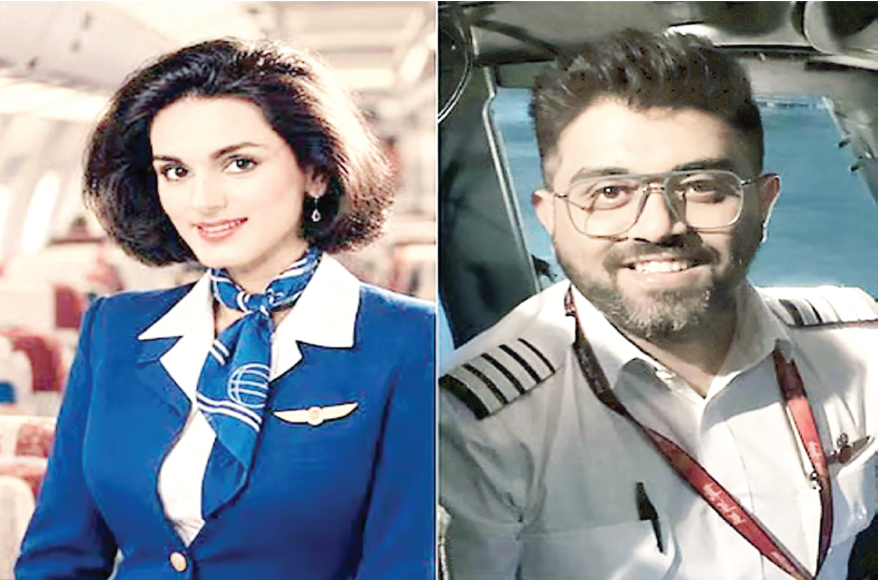
Proud of the Country: Heroics of Captain Smit Machchhar and Neerja Bhanot

 2 weeks, 6 days ago
The heroism of Neerja Bhanot, the Pan Am air hostess who sacrificed her life while saving passengers during the hijacking of Flight 73 in Karachi in September 1986, remains etched in India’s collective memory. Forty years later, another Indian aviation professional, Captain Smit Machchhar, has displayed extraordinary courage in an equally terrifying cockpit emergency, helping prevent what could have been a catastrophic loss of life aboard a FlyDubai flight.
The circumstances were entirely different, but the common thread is unmistakable: in moments when panic could have prevailed, individual courage, professional training and presence of mind became the last line of defence for hundreds of passengers.
Neerja Bhanot: Courage at Karachi
On September 5, 1986, Pan Am Flight 73, travelling from Bombay to New York via Karachi, was hijacked by terrorists of the Abu Nidal organisation before landing at Karachi. Neerja Bhanot, the senior flight purser, immediately understood the gravity of the situation.
After alerting the pilots, she collected and concealed passengers’ passports, reportedly preventing the terrorists from easily identifying American nationals among those on board. What followed was a seventeen-hour ordeal marked by uncertainty, gunfire and explosions.
When the hijackers eventually created an opportunity for passengers to escape, Neerja opened emergency exits and helped passengers reach safety. She remained at her post despite the extraordinary danger around her and was fatally injured while helping others.
Her reported words, “I’d rather die than run away”, came to symbolise her courage. Neerja was posthumously awarded the Ashoka Chakra, India’s highest peacetime gallantry award.
Captain Machchhar’s Battle in the Cockpit
The incident involving Captain Smit Machchhar of FlyDubai presents a different but equally disturbing scenario. During Flight FZ1073, operating from Dubai to Tel Aviv, an altercation reportedly erupted inside the cockpit involving the Indian pilot and his Omani co-pilot, Hamam al-Hammami.
According to information that has emerged, the co-pilot attacked Machchhar with a knife and/or crash axe and allegedly attempted to interfere with the aircraft’s controls. The aircraft subsequently experienced a dramatic loss of altitude, plunging from more than 34,000 feet to approximately 17,000 feet within seconds.
For passengers, the sudden descent initially appeared to be severe turbulence. The reality was far more frightening: an emergency was unfolding inside the cockpit itself.
Machchhar, despite his injuries, reportedly retained sufficient presence of mind to open the cockpit door. Passengers and crew members then intervened, overpowering the attacker and helping the remaining crew regain control of the aircraft.
The plane eventually made an emergency landing at Prince Sultan bin Abdulaziz Airport in Tabuk, Saudi Arabia. Both pilots were injured and taken to hospital, while Machchhar was subsequently airlifted to the UAE for further treatment.
Experience Under Extreme Pressure
Machchhar’s reported experience of approximately 9,750 flying hours over 17 years would have been critical in such an extraordinary situation. Aviation training is designed to prepare pilots for mechanical failures and other emergencies, but a deliberate attack from inside the cockpit presents an altogether different challenge.
That he continued to act despite sustaining serious injuries demonstrates an exceptional level of professional commitment.
Passengers, too, appear to have played a crucial role. Their intervention, together with the actions of other crew members, prevented the situation from becoming a disaster. The aircraft was eventually secured and the passengers continued their journey on a replacement FlyDubai aircraft after spending several hours on the ground.
Praise for an Indian Hero
Captain Machchhar’s courage has received recognition at the highest levels. President Droupadi Murmu and Prime Minister Narendra Modi praised his presence of mind and bravery.
During a video call, Modi reportedly told Machchhar that his actions had brought honour to India and to the country’s aviation community.
Israeli Prime Minister Benjamin Netanyahu also described Machchhar as a hero, saying that an Indian pilot had helped avert what could have become another 9/11-type catastrophe. Such praise reflects the potential magnitude of what was avoided.
The episode has also attracted attention from the United States. President Donald Trump has suggested that the incident could have links to Tehran, although the precise basis for that assertion and the facts behind any such connection remain matters for investigation.
What Caused the Attack?
This is where caution is essential. The motive behind the co-pilot’s alleged actions cannot be conclusively established until a formal investigation is completed. Reports that he had previously been barred from flying in Oman because of alleged extremist views, as well as questions concerning his subsequent professional movements, including a reported three-month attachment in Morocco, need to be independently examined.
It would be premature to conclude that the incident was a terrorist operation or that the co-pilot acted on behalf of an organised extremist network. Equally, if investigators establish that ideological or terrorist motivations were involved, the episode would represent an extremely serious breach of aviation security.
FlyDubai has acknowledged that an altercation occurred in the flight deck, but the full circumstances and underlying cause remain subject to investigation.
Aviation Security Cannot Depend on Luck
The incident also raises uncomfortable questions about the vulnerability of modern aviation. Commercial flying remains among the safest forms of transportation. Yet its safety ultimately depends upon multiple layers of trust: the competence and integrity of pilots, rigorous medical and psychological screening, cockpit security, crew coordination and the ability to respond to emergencies.
The FlyDubai episode demonstrates what can happen when that chain is suddenly threatened from within.
It also comes against the backdrop of another recent aviation incident involving an Air India flight from Phuket to Delhi, in which the aircraft reportedly experienced a sudden altitude drop and several passengers and crew members were injured. The subsequent action against the commander following a positive cannabis test has further highlighted concerns about substance use and pilot fitness.
These incidents are different and should not be conflated. But together they underline a fundamental principle: there can be no compromise with the fitness, judgement and integrity of those entrusted with hundreds of human lives.
Investigation Must Establish the Truth
The most important task now is to determine exactly what happened aboard FZ1073. Was the Omani co-pilot acting alone? Was there an ideological motivation? Were there previous warning signs that were overlooked? Did he have links with any extremist organisation? Were existing aviation-security protocols sufficient to detect and prevent such behaviour?
These are not questions that can be answered through speculation or political statements. They require a thorough and transparent investigation.
The authorities should also examine the pilot’s professional history, medical and psychological assessments, travel and employment records, and any previous indications of extremist sympathies. If there were warning signs, the aviation authorities must determine why they did not trigger appropriate action.
A Wider Question for Regional Aviation
The fact that FZ1073 was carrying predominantly Israeli passengers and was operating between Dubai and Tel Aviv inevitably gives the incident a wider security dimension, particularly amid the continuing tensions in the Middle East.
That does not by itself establish a terrorist motive. But flights connecting Israel with regional hubs deserve the highest level of security vigilance under present circumstances.
Any decision to suspend or restrict such routes, however, should be based on verified intelligence and formal security assessments rather than speculation.
The wider disruption to aviation in the region is already imposing enormous costs on airlines and passengers. Restrictions on airspace are causing longer journeys, cancellations, financial losses and considerable uncertainty for travellers.
Courage Must Be Matched by Vigilance
Neerja Bhanot’s story reminds us that extraordinary courage can emerge from an ordinary professional duty. Captain Smit Machchhar’s reported actions offer a similar lesson four decades later. But a safe aviation system cannot depend upon heroes appearing when systems fail.
Neerja could not prevent the hijacking of Pan Am 73. Machchhar could not prevent an alleged attack inside his cockpit. What they could do was respond with courage when confronted with circumstances beyond their control.
Their heroism deserves recognition. But the greater responsibility lies with aviation authorities, airlines and governments to ensure that such situations are prevented wherever possible.
The final lesson is therefore not merely about bravery. It is about vigilance, accountability and institutional preparedness. Passengers place their lives in the hands of aviation professionals. That trust must never be taken for granted.
(The author, a former IAS officer, after serving in various capacities in the Ministry of Home Affairs retired as the Chief Secretary in Sikkim government.)










[[comment.comment_text]]