Nayab Singh Saini's Appointment as Haryana CM
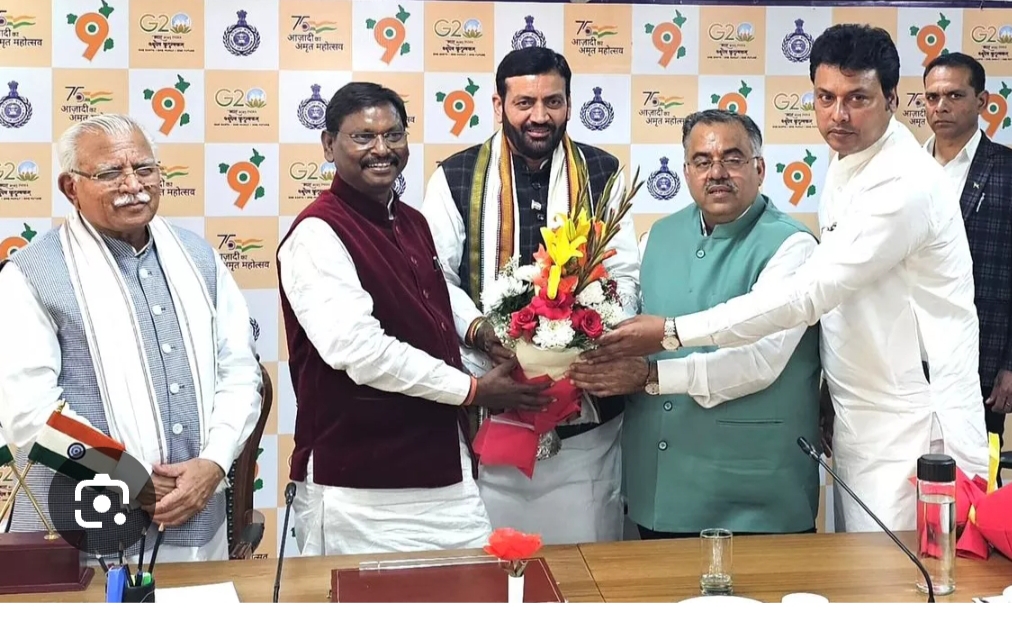

EW Correspondent, New Delhi: In a significant political development, the Bharatiya Janata Party (BJP) has appointed Nayab Singh Saini as the new Chief Minister of Haryana, signalling a strategic shift to consolidate non-Jat votes ahead of the Lok Sabha elections¹²³. This move comes after the BJP parted ways with the Jannayak Janta Party (JJP), which is predominantly supported by the Jat community.

Nayab Singh Saini, a prominent leader from the Other Backward Classes (OBC), has been chosen to lead the state, replacing Manohar Lal Khattar. The decision reflects the party's intent to appeal to the OBC electorate, which constitutes a significant portion of the state's demographic.

The BJP's strategy appears to be focused on non-Jat social engineering, a tactic that has been successful in other states like Gujarat. With Saini at the helm, the party aims to overcome the challenges faced by the previous government and counter any anti-incumbency sentiment.

Political analysts suggest that this move could potentially sway the Jatt voters, who have traditionally played a dominant role in Haryana's politics. By positioning an OBC leader as the Chief Minister, the BJP is attempting to broaden its support base beyond the traditional upper-caste and urban electorate.

The upcoming Lok Sabha polls will be a test of this new strategy, as the party seeks to replicate its past electoral successes and retain power in the state assembly. The appointment of Nayab Singh Saini is a calculated step towards achieving this goal, as the BJP leverages the popularity of the Modi brand to attract a wider voter base.

Political Journey of CM

Ahead of the Lok Sabha elections, political turmoil engulfs Haryana as the BJP-JJP alliance collapses. CM Manohar Lal Khattar resigned along with his cabinet and paved the way for leadership changes. Nayab Saini emerges as a potential candidate, with a background in the RSS and BJP. His close ties to Khattar and political journey from district president to MP position him as the right choice for the CM post.

Nayab Singh Saini was born on January 25, 1970, in a small village called Mizapur Majra in Ambala to a Saini family. He obtained his degree from B.R. Ambedkar Bihar University in Muzaffarpur and his BA and LLB degrees. He joined the Rashtriya Swayamsevak Sangh (RSS), through which he met Manohar Lal Khattar and was influenced by him. After some time, he joined the BJP and subsequently worked in several local party offices, including in Ambala Cantonment.

Nayab Saini's Journey to State President

In 2002, he became the district president of the youth wing of the BJP in Ambala. Then in 2005, he became the district president of the youth wing of the BJP in Ambala. Nayab Singh Saini served as the state president of the BJP's farmer wing in Haryana in 2009. In 2012, he was the district president of the BJP in Ambala. In 2014, he became a legislator from Narayangarh Vidhan Sabha. Then in 2016, he became a minister in the Haryana government. In 2019, he was elected as a Member of Parliament from Kurukshetra. After that, today he has been entrusted with the responsibility of the state president by the central leadership.
The Fluidity of Conviction: Trinamool’s Fracture and the Era of Post-Ideological Politics

The sudden, tectonic shift within the Trinamool Congress (TMC)—where a 20-strong rebel faction of Lok Sabha MPs has engineered a merger with a little-known, Tripura-based outfit to leap into the National Democratic Alliance (NDA)—is more than just a localised mutiny. Led by veteran Kakoli Ghosh Dastidar and backed by seasoned faces like Sudip Bandyopadhyay, this splintering offers a masterclass in modern political survival. More profoundly, however, it serves as a glaring obituary for ideological consistency in contemporary governance.

Dinesh Dubey   |  3 days, 16 hours ago

The Wedding Circus: Why is the Bride’s Father Still the Ringmaster's ATM?

Every single girl out there needs to have a checklist. Seriously, write down 10 to 12 hard questions about compatibility before you even think about looking at guys in an arranged marriage setup. Figure out exactly what you want first, so when you ask your questions, they cut straight to the point. I used this strategy recently. There was this guy I had already rejected before, but he came back crawling, asking for "just one chance to prove himself." I thought, fair point, let's see what you’ve got. During our conversation, I dropped one of my standard questions: "Will you take dowry?"

Khushboo Jha   |  3 days, 16 hours ago

India's labour force: The Invisible Hands That Keep India Running

The importance of this acknowledgment cannot be overstated. Every household depends on a wide range of activities that are essential for daily life. Meals have to be prepared, children have to be cared for, elderly family members need support, homes need to be cleaned and maintained, and countless small responsibilities must be managed every day. These tasks consume time, energy, and skill. If families were required to hire separate workers for each of these responsibilities, the financial cost would be enormous. Yet when these same services are provided by a homemaker, society often assumes they have no economic value simply because no money changes hands. This contradiction has allowed one of the largest forms of labour in the country to remain hidden in plain sight.

Samridhi   |  3 days, 17 hours ago

Beyond Tenure: Why Comparing Modi and Nehru Requires Historical Context

For centuries, Eurocentric frameworks dominated intellectual discourse, producing comparisons that subtly reinforced Western superiority. Thus, Kalidasa became the “Shakespeare of India,” while Chanakya was described as the “Indian Machiavelli.” Such characterisations appear flattering, but they implicitly position Western figures as the universal benchmark against which all others must be measured. In reality, Kalidasa and Chanakya emerged from independent civilizational traditions whose significance does not require validation through foreign parallels.

Seema Joshi   |  3 days, 17 hours ago

Modi’s Record Tenure as Prime Minister

Narendra Modi’s upcoming milestone on June 10, which will mark 4,399 consecutive days in office and surpass Jawaharlal Nehru as India's longest-serving democratically elected leader, raises a fundamental question: does political longevity guarantee effective governance?

Hasnain Naqvi   |  1 week, 2 days ago

The Politics of Pedestals!

India is a diverse country. We have different religions, different cultures, different languages, and different ways of life. Yet there is one thing that seems remarkably common across all of them our tendency to place women, mothers, daughters, rivers, and even the land itself on a divine pedestal while simultaneously taking them for granted in everyday life.

Khushboo Jha   |  1 week, 5 days ago

Comments

YOU MIGHT ALSO LIKE

View More

By Hasnain Naqvi   |   1 week, 2 days ago
Modi’s Record Tenure as Prime Minister
By Khushboo Jha   |   1 week, 5 days ago
The Politics of Pedestals!
By VK Bahuguna   |   2 weeks, 1 day ago
Delhi Gymkhana Club: The flashpoint of dispute