Manjusha Art Goes Global: Bhagalpur’s Folk Heritage Finds a New Canvas on Chhath Puja

 2 hours ago
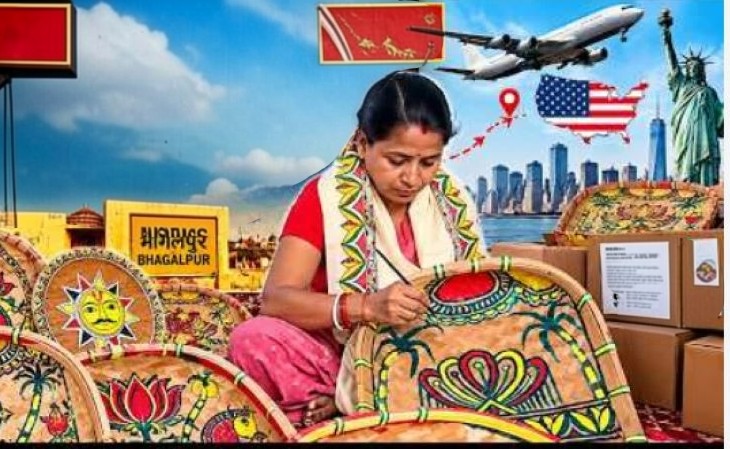
A traditional bamboo winnowing basket from Bihar is embarking on an unusual cultural journey across the ocean. An order for 200 Chhath baskets decorated with Manjusha paintings from the United States has brought fresh attention to Bhagalpur’s distinctive folk-art tradition. With interest from Australia also emerging, the development offers local artists an opportunity to reach new markets while carrying the stories and cultural identity of Anga Pradesh to the Indian diaspora.
The significance extends beyond an overseas order. It reflects efforts to bring traditional art into contemporary life. For artists, decorating a Chhath basket is not merely an exercise in beautification but a way of communicating cultural memory through an object deeply embedded in Bihar’s religious and social traditions.
Manjusha art originated in the Bhagalpur region and is closely associated with the legend of Bihula and Bishahari, the serpent goddess. Its distinctive lines, narrative figures and traditional colours set it apart from other Indian folk-art forms. Serpent motifs, flowers and symbolic patterns evoke a world where mythology, ritual and everyday life intersect. The paintings preserve not only a visual tradition but also stories through which communities remember their past.
Chhath Offers a New Canvas
Dedicated to the worship of the Sun God, Chhath expresses gratitude, discipline and humanity’s relationship with nature. Bamboo baskets, or soops, carry offerings during the rituals. Decorated with Manjusha motifs, these familiar objects unite two traditions: Chhath’s ritual practices and Anga Pradesh’s artistic heritage.
Manjusha master artist Manoj Pandit and his team have been preparing the baskets for the American order. Their designs feature the Sun God, lotus flowers and other festival-related imagery, with pink, green and yellow lending the baskets their distinctive appearance.
The work requires patience and precision. Artists prepare each surface before outlining the designs, then draw figures and fill them with colour. Attention to detail ensures that the finished products retain the character of Manjusha painting rather than becoming merely decorated commodities.
Artist Aman Sagar views the project as both an artistic and cultural undertaking. The objective is to communicate traditional heritage through an object familiar to Chhath devotees. The order has raised hopes of attracting new buyers and creating opportunities for practitioners. However, overseas demand also brings challenges: artists must meet deadlines without compromising quality or the painstaking craftsmanship that hand-painted designs require.
Manjusha’s visibility has grown through prominent public platforms. Manoj Pandit presented President Droupadi Murmu with a sari decorated with Manjusha paintings, which she wore. The episode brought additional attention to the art form, demonstrating how traditional crafts can reach new audiences through contemporary cultural engagement.
Decades of Work Behind the Recognition
Manjusha’s growing recognition owes much to generations of practitioners, artists, writers, cultural activists and social movements. Chakravarty Devi’s association with the tradition represents the importance of artists who sustained its visual language. Folk art survives through those who practise its techniques and pass their knowledge to younger generations. Documentation and exhibitions can extend this legacy, but cannot replace the foundational work of traditional artists.
An important figure in Manjusha’s early public introduction was Shekhar, a filmmaker, painter, art connoisseur, cultural activist and social worker. While studying at Kala Kendra in Bhagalpur, he helped bring the art form to wider attention through documentation, analysis and publication.
In 1989, a slide presentation on Manjusha painting was organised during the Shilpika Art Fair under the banners of Shilpika, Madhyam and Lok Chetna. Manoj Sinha took the photographs, while Shekhar prepared a written analysis. The account appeared in Madhyam, a small magazine published by the group and sold for just two rupees a copy.
Despite its limited resources, the publication reflected a serious commitment to cultural outreach. Contributors carried copies to exhibitions, meetings and gatherings, helping regional art reach audiences beyond its immediate surroundings at a time when such traditions had limited access to wider platforms.
The article subsequently attracted interest in Patna. At a seminar organised by associates of the Ganga Mukti Andolan on “Temples of Development or Graves of Destruction”, possibly at Lala Lajpat Rai Bhawan, organisers discovered the article and expressed interest in republishing it. Following correspondence with Shekhar, it appeared in Kala Drishti in 1991, extending discussion of Manjusha beyond Bhagalpur.
The collective effort continued through Sansriti, established after Madhyam. Its governing board included Ram Sharan, Ghanshyam, Shekhar, the late Vishwanath, Jayanti, Alka, the late Prem Prabhakar and the present author. Magsaysay Award-winning writer and journalist Gaur Kishore Ghosh attended its inauguration. Technical difficulties eventually interrupted Sansriti’s work, and Paridhi emerged within the same broader cultural milieu.
Another slide presentation on Manjusha painting took place on April 27, 1994. The then Commissioner, Ashok Kumar, showed considerable interest, while Shiv Shanker Singh Parijat played an important role. Associates of the Ganga Mukti Andolan, Chhatra Yuva Sangharsh Vahini and Sampoorna Kranti Manch also supported efforts to bring cultural issues into public discussion. Their involvement illustrates how documentation, exhibitions, small magazines and social movements can help regional art gain recognition.
Shekhar’s engagement subsequently extended beyond Bhagalpur. Through his association with SAMVAD in Jharkhand, he worked with Adivasi communities and their concerns. His journey connects the documentation of a regional art form with wider questions of indigenous cultures, traditional knowledge and community life.
Preserving Heritage While Creating Livelihoods
The future of Manjusha depends on whether growing recognition translates into sustainable livelihoods. The participation of women and younger artists can strengthen household incomes while ensuring that artistic skills survive across generations. Training, fair remuneration, dependable markets and institutional support will be essential to making this possible.
Adapting Manjusha motifs to saris, garments, bags and festival objects creates opportunities for innovation. Commercial expansion, however, must respect the art form’s identity. Artists need freedom to experiment without losing the distinctive lines, imagery and cultural narratives that make Manjusha recognisable. Documentation, exhibitions and educational initiatives can help younger generations understand its origins while new products attract customers.
The order for 200 Chhath baskets from America is therefore both encouraging and a reminder of the work ahead. International interest can open doors, but a sustainable future requires more than occasional festive orders. Artisans need dependable buyers, transparent payments and opportunities to receive the full value of their work. Public institutions, cultural organisations and market platforms can connect them with customers while ensuring that the benefits reach the artists themselves.
When these painted baskets reach American homes, they will carry more than offerings for a festival. They will bring the colours of Anga Pradesh, the stories of Bihula and Bishahari, the devotion associated with Chhath and the craftsmanship of generations of artists. They will also represent decades of collective efforts to document, preserve and share a regional art form.
Manjusha’s journey from Bhagalpur to America is ultimately a story of cultural continuity through change. Its success should not be measured solely by overseas sales, but by whether the artists who create these works can sustain their craft with dignity and confidence. If global recognition strengthens local livelihoods while preserving the art’s roots, these painted baskets will achieve something more enduring than commercial success: they will carry a living heritage into the future.
(The author, a senior journalist of Bihar, is a known commentator on governance, development, and diversity issues.)




[[comment.comment_text]]