Kṣemendra: The Satirist Who Held Kashmir to Account

 2 hours ago
Satire, Social Conscience and the Moral Imagination of Eleventh-Century Kashmir
Kṣemendra’s morally oriented work Darpadālana deserves particular attention. Its title suggests the destruction or subduing of pride, and the work examines the dangers of turning worldly advantages into grounds for arrogance.
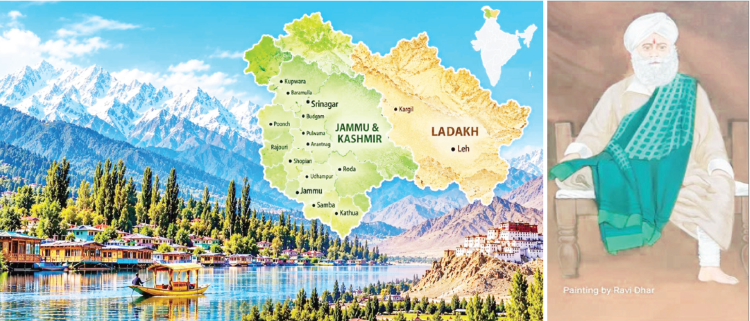
Kashmir’s intellectual heritage includes an extraordinary constellation of philosophers, poets, spiritual thinkers and literary critics who shaped the wider history of Sanskrit learning. Among them, Kṣemendra, an eleventh-century Sanskrit writer, occupies a distinctive place. He was not merely a poet who celebrated beauty or retold epic narratives. His works combined literary imagination with ethical reflection, using satire, narrative and literary criticism to examine human behaviour and social pretensions.
Kṣemendra is generally placed in the late tenth and first half of the eleventh century, with dates often estimated at 990–1070 CE. Although his precise chronology remains uncertain, his writings place him in a period when Kashmir was a major centre of Sanskrit scholarship, philosophical inquiry and literary production.
A Literary Mind Shaped by Kashmir
Kṣemendra belonged to a learned family. His father was Prakāśendra, while his son Somendra is associated with the transmission and framing of some of his works. Kṣemendra also refers to Abhinavagupta as a teacher or intellectual influence. The precise nature of their relationship is not fully documented, but the association places him within Kashmir’s celebrated intellectual milieu.
His literary interests extended across several branches of Sanskrit literature. Although he engaged with religious and ethical ideas, his particular strength lay in observing social behaviour, exposing pretension and examining the responsibilities associated with learning, wealth, status and religious identity.
His literary world included gods, kings and epic heroes, but also corrupt officials, boastful scholars, hypocritical ascetics and calculating opportunists. By bringing such social types into serious literary composition, he made everyday conduct a subject of sustained scrutiny.
His portrayals, however, are stylised literary constructions rather than transparent sociological records. Satire depends on exaggeration, caricature and established literary conventions. Kṣemendra’s descriptions must therefore be read as revealing the concerns and moral imagination of his age, rather than as straightforward accounts of every aspect of Kashmiri society.
Satire as a Mirror of Society
Works such as Deśopadeśa, Narmamālā, Samayamātṛkā and Darpadālana demonstrate Kṣemendra’s ability to use humour, irony and exaggeration to expose human weaknesses.
His satire was more than an exercise in ridicule. It frequently served as moral criticism, drawing attention to the gap between professed values and actual conduct. Greed, vanity, hypocrisy, deception and the misuse of social position recur throughout his literary world.
In Deśopadeśa, Kṣemendra presents admonitory observations and recognisable social types through pointed, often comic descriptions. Narmamālā similarly employs humour to expose questionable behaviour and social absurdity. Samayamātṛkā, a narrative centred on deception and sexual commerce, explores desire, calculated behaviour and social convention through a highly stylised story.
These works should not be treated as a unified political programme or a comprehensive account of social life. Their significance lies instead in the recurring critical impulse that connects them: outward respectability does not necessarily reflect inner virtue, and social standing cannot guarantee moral integrity.
Kṣemendra’s writings direct attention to the conduct of officials, intellectuals and religious figures, among others. They suggest that a society cannot be judged solely by its monuments, scholarly achievements or prestigious institutions. Its ethical character must also be assessed through the behaviour of those who exercise influence and claim authority.
The human weaknesses he portrayed—ambition, manipulation, vanity and the substitution of appearances for substance—remain recognisable. His satire thus offers contemporary readers a means of reflecting on conduct and accountability, even though the social structures and literary conventions of his time differed considerably from those of the present.
Darpadālana: The Anatomy of Human Arrogance
Among Kṣemendra’s morally oriented works, Darpadālana is particularly significant. Its title points to the subduing of pride, and its central concern is the tendency to mistake worldly advantages for evidence of personal superiority.
Kṣemendra examines distinctions associated with birth, wealth, learning, beauty, strength, generosity and religious accomplishment. He does not necessarily reject these qualities themselves. Rather, he questions the assumption that possessing them makes someone inherently superior or places them beyond moral scrutiny.
Wealth can disappear, beauty can fade, physical strength can decline and social position can be lost. Learning, too, becomes deficient when it produces conceit instead of discernment. The work emphasises humility and the impermanence of worldly advantages, themes that connect it with broader Indian moral and religious traditions.
The enduring lesson of Darpadālana is that character cannot be measured by status alone. Moral worth depends on how a person uses their advantages and whether success is accompanied by restraint, humility and integrity.
This perspective remains relevant in contemporary public life, where wealth, authority and personal achievement are often treated as measures of merit. Kṣemendra’s critique invites readers to distinguish genuine accomplishment from arrogance. Such a comparison is a modern application of his ethical concerns, rather than evidence that he anticipated contemporary social categories.
Aucitya: The Principle of Appropriateness
Kṣemendra’s importance extends beyond satire into Sanskrit literary theory. His Aucityavicāracarcā offers a major discussion of aucitya, a concept generally translated as propriety, fitness or appropriateness.
According to Kṣemendra, successful poetry depends on the proper relationship among its constituent elements. Words, emotions, characters, actions, situations and literary ornaments must suit one another. An expression may be elegant yet inappropriate to the character who speaks it; an emotion may appear unconvincing when it conflicts with the circumstances; and an ornament may weaken a composition if it is introduced without regard to the larger work.
Appropriateness is therefore not merely a technical detail. It helps establish coherence, plausibility and aesthetic effectiveness. Kṣemendra’s contribution should be understood within the wider history of Sanskrit poetics, where scholars debated the relationships among propriety, suggestion, style, rasa and literary ornament. His distinctive achievement was to give aucitya a particularly prominent and systematic place.
The principle also permits a broader ethical analogy. Intelligence without judgement can become arrogance, while authority without restraint can become oppressive. Words and actions acquire meaning through their circumstances and consequences. Yet this extension into public morality is an interpretive application of his literary theory, not a political doctrine explicitly established by the text.
His literary criticism and social satire nevertheless illuminate one another. Both examine the relationship between outward expression and underlying substance. In poetry, appropriateness creates aesthetic coherence; in moral life, the correspondence between professed values and actual conduct helps distinguish integrity from pretence.
The Storyteller of India’s Great Epics
Kṣemendra’s literary achievements were not confined to satire and moral instruction. His Rāmāyaṇamañjarī, Bhāratamañjarī and Bṛhatkathāmañjarī demonstrate his command of narrative compression and poetic adaptation.
These works condense expansive narrative traditions into shorter Sanskrit compositions. They are not merely neutral summaries: Kṣemendra selects, arranges and presents inherited material according to his literary purposes. His retellings of the Rāmāyaṇa and Mahābhārata participate in the continuing interpretation of India’s foundational epics, while Bṛhatkathāmañjarī represents his adaptation of the wider Bṛhatkathā narrative tradition, whose original form is no longer extant.
His work belongs to a long Indian tradition in which stories were repeatedly abridged, expanded and reinterpreted for new audiences. Kṣemendra’s importance therefore lies not only in preserving inherited narratives but also in reshaping them through selection and poetic presentation.
His range included Buddhist narrative in Avadānakalpalatā and Vaishnava themes in Daśāvatāracarita. These works demonstrate the breadth of his literary interests and his engagement with different religious traditions. While they do not establish a comprehensive programme of religious pluralism, they reflect the diverse intellectual environment in which Sanskrit literary production flourished.
Kashmir’s Intellectual Pluralism
Kṣemendra’s association with Abhinavagupta places him within one of the most productive periods of Kashmir’s intellectual history. Yet his contribution cannot be reduced to any single philosophical school or religious affiliation.
His writings encompass ethical instruction, satire, literary criticism, epic narrative and religious themes. They illustrate the coexistence and interaction of different literary and religious currents, including Shaiva philosophical inquiry, Sanskrit poetics, Buddhist narrative and Vaishnava devotion.
This diversity should not be mistaken for the absence of social tensions or sectarian boundaries. Rather, it demonstrates that Kashmir’s intellectual culture provided space for varied forms of literary and religious expression.
The region’s contribution to Indian thought must be understood not only through its major philosophers and religious movements but also through writers such as Kṣemendra, whose works brought together literary imagination, moral reflection and close observation of human behaviour. His corpus illustrates how intellectual traditions remain vital through debate, adaptation and critical engagement with inherited ideas.
Kṣemendra’s Relevance Today
Why should a Sanskrit poet of the eleventh century command attention today? His relevance lies not in assuming that his categories correspond directly to modern society, but in the ethical questions his works continue to raise.
Contemporary societies confront corruption, intellectual dishonesty, public hypocrisy and the misuse of authority. Wealth is sometimes mistaken for merit, publicity for achievement and religious display for moral character. Kṣemendra’s writings provide a framework for questioning such confusions, even though his social world was markedly different from ours.
His satires invite readers to consider whether institutions serve the public good, whether intellectuals uphold truth and whether those who claim moral authority practise the values they proclaim. These are questions contemporary readers may draw from his work, rather than institutional reform proposals explicitly formulated by the poet.
His concept of aucitya also offers a suggestive perspective on responsible public conduct. Judgement, proportion and sensitivity to circumstances matter in both speech and action. Authority should carry obligations, and public roles should be exercised with restraint. This is a modern ethical application of his literary theory, not a claim that he articulated a political doctrine of accountability.
Kṣemendra also reminds contemporary intellectuals of the responsibilities associated with learning. Literature can entertain while criticising, expose folly while offering instruction, and challenge complacency without abandoning artistic expression. His work encourages readers to examine the distance between public image and personal conduct.
The broader civic lesson is that scholarship and literature can contribute to public moral reflection by questioning injustice, challenging hypocrisy and resisting the uncritical acceptance of status. This interpretation connects Kṣemendra’s legacy with modern concerns without imposing the institutions or ideals of contemporary democracy on medieval Kashmir.
An Enduring Voice from Kashmir
Kṣemendra deserves recognition as one of medieval Kashmir’s most versatile literary figures. His achievement lies in the relationship his works establish between literary form, social observation and ethical reflection.
He was a storyteller who adapted epic traditions, a literary theorist who examined appropriateness, a moral writer who challenged arrogance and a satirist who exposed the distance between social pretension and ethical conduct.
His writings demonstrate that literature can do more than preserve stories or celebrate beauty. It can challenge complacency, expose deception and remind readers of values that social practice may neglect. No claim to wealth, learning, authority or sanctity should automatically place an individual beyond scrutiny.
For Kashmir, Kṣemendra forms an important part of the region’s intellectual history. For India, he represents a significant chapter in Sanskrit literature, literary theory and moral satire. For contemporary readers, his work offers a durable lesson: a civilisation’s greatness rests not only on the wisdom it produces but also on its willingness to examine its own follies.
Kṣemendra continues to speak across the centuries because he connects literary pleasure with ethical reflection. His works are neither a complete social history of medieval Kashmir nor a modern programme of reform. They are, however, enduring examples of how satire, narrative and literary criticism can make conduct, judgement and responsibility central to the experience of literature.
(The author is a Senior Advocate and a public intellectual)










[[comment.comment_text]]