Kerala fisheries dept to roll out high quality fish sales, home delivery through MIMI Fish Stores

 5 years, 3 months ago
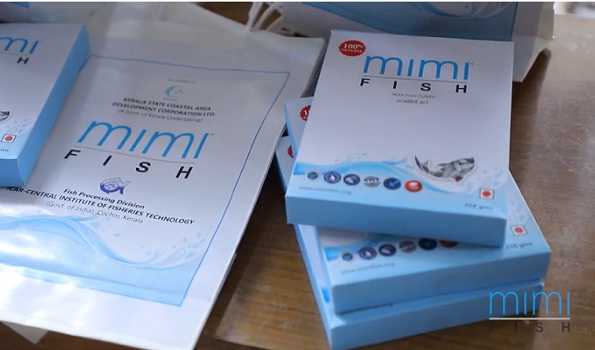
Thiruvananthapuram, In a first in the country giving the consumers complete access to the details of the fish they buy, MIMI Fish, a retail venture of the Kerala Fisheries Department, is all set to launch its sales outlets across the state and online home delivery service for supply of fresh fish and value-added products.
Consumers can buy their fish either directly from the nearest MIMI store or get home-delivered the order through the Mobile App-MIMI. The menu immediately on offer include fresh fish, dry fish, fish curry and fish pickles while more value-added products will soon be on the plate.
The unique project is implemented by Kerala State Coastal Area Development Corporation as part of it socio-economic initiative ‘Parivarthanam’. It is supported by the Central Institute of Fisheries Technology (ICAR-CIFT), a release said here on Monday.
As a prelude to its roll out, the website of MIMI Fish will be launched by Kerala Fisheries Minister Saji Cherian at a function in Kollam soon.
“The inaugural run of MIMI Fish will cover Kollam, Alappuzha and Pathanamthitta districts. It will be introduced in other districts and other parts of the country subsequently,” said Mr Roy Nagendran, Chief of Operations, Parivarthanam Project.
As MIMI Fish sets the highest priority on health of its customers, its products are collected, processed, packaged and stored to world-class standards and hygienic parameters. The consumer can trace all information of the fish they buy such as its origin, details of fishers involved in capture or production and their locations.
Besides the consumers and fishers, other main beneficiaries of this project are the engineering and degree dropouts, who get part time jobs of home delivery of MIMI products, and later, they would be given coaching for the courses they pursue to help them become graduates.
The fish that MIMI sells will be totally free from adulterating materials and follow the hygienic standards and protocols set by European Union and other advanced countries in processing, preservation and storage.
Fish is immediately chilled upon capture as per the technology developed by CIFT, which matches the European export standards.
Conforming to the socio-economic goals of ‘Parivarthanam’, Fishermen are ensured fixed price for their catch regardless of the time of landing, which means they would not have to rush and thereby save upto 70 per cent of the fuel cost.
All partner boats of MIMI are given individual RFID-tagged ice boxes, so that the end users get to know the date, time & place of capture of the fish and even the details of the fishermen who caught the fish, guaranteeing 100 per cent traceability.
The DC chillers are used in all the MIMI outlets with battery support, ensuring continuous power back-up even during power failures. The chillers have an option to be connected to solar power, which ensures uninterrupted power supply up to three days if electricity from the KSEB grid is not available. This helps maintain the quality of fish, the release said.
Other key features of the venture include installation of motion sensors in all MIMI stores and central storage room to get alerts about the presence of any rodent or insects. Also, CCTVs are installed in shops to see that only MIMI products are being delivered and sold.
Vehicles for transporting fish will have state-of-the-art refrigeration systems, so that the quality of the fish will not suffer during the transit, through all seasons.
The venture also comes as a big support to fishers and other stakeholders as it is part of the Parivarthanam project, launched by the Government of Kerala to address lives and livelihood issues of the fishery sector.
The project also promotes green energy and technologies and help the traditional fishery activities sustainable, the release added.
(Agencies)











[[comment.comment_text]]