EL NINO AGGRAVATES POLLUTION IN DELHI NCR

 an hour ago
The latest IMD study has found that north-west India has turned drier, while the southern peninsula has turned wetter due to overall rise in rainfall in past seven decades. The dry climate zone has expanded in north-west from one-fourth of the geographical area of the region to nearly one third due to the declining precipitation in this period. The dry zone in Uttar Pradesh is marching from west to east and the experts have cautioned that it would not only impact the paddy cultivation, but would change the sowing and harvesting timing of the crops. The variation in rainfall pattern, heatwaves, drought and wildfire in any region is quite complex and one of the reasons being the supercharging El Nino. Another study by Michigan University Scientists has shown that El Nino is aggravating with the human induced warming of the planet.
El Nino has been naturally occurring every 2 to 7 years, as the waters of tropical Pacific Ocean heats up impacting the weather pattern around the world. Among the strong El Nino patterns in past few decades, the current one which is informally known as “Godzilla” is brewing up to supercharge the weather around the world. A new study published in ‘Science’ has found that the burning of fossil fuels has been setting the strongest El Nino in the living memory.
Julia Cole a climate researcher in the University of Michigan has led the study, who says, “Our findings suggest El Nino can supercharge global warming and also global warming can supercharge El Nino – that is what we are seeing.” The climate phenomenon which brings a rise in global temperature further amplifies the worsening climate crisis. The year 2026 and even 2027 are projected to be hottest on record. The research has concluded that human caused global heating is making El Nino more intense. In future, whenever El Nino is predicted, we must be sure that its intensity would be severe and it would be a function of burning of fossil fuels.
The lead author Cole added, “We are seeing a trend of stronger El Ninos and the one we have now is consistent with that trend – it is not a fluke. We are seeing a shift where El Nino does not look like what it did prior to Industrial times. That is bad news for climate hazards and for people, particularly those who are badly impacted and yet have done little to cause climate change.”
In the warming world, past El Nino events in last three decades have provided extra acceleration causing rise in global temperatures. During the course of the study the scientists have analyzed the composition of large boulder like deposits of coral fossils found in Galapagos Islands. These islands are situated off the coast of main land Ecuador; the country that faced severe El Nino conditions causing the heating up of the surrounding water. The corals were dead about thousand years ago and the chemical compositions indicate the range of Sea surface temperature, when they were alive. The study found that El Nino remained stable, until industrialization begun about 150 years ago. The data from the study conclude that El Nino variability is 37% higher than what it used to be in pre-industrial era, indicating that the process has become more intense during last 40 years.
“After El Nino in 1982, we start seeing much more variability; its lot more extreme and looks like nothing in the previous thousand years”, said Cole. The other members of the study ruled out any random or naturally occurring cause for the acceleration. The finding has answered the question in the climate science, whether the global warming on account of fossil fuel burning is altering the strength of El Nino events. Another co-author of the study Samantha Stevenson-Karl, a scientist from University of California, Santa Barbara said, “It is a strong indication that climate change may already be amplifying El Nino events……If that’s true then really the large events like the one that seems to be brewing in the tropical Pacific right now might become more common in the future.”
In such a scenario, different regions of the globe, facing incidents of heat waves, wildfires, floodings, are being considerably impacted. El Nino getting more intense due to the weakening of the trade winds, the surface temperature of Western Pacific rise, bringing heavier rainfall and floods in southern USA and south America. Countries like Indonesia, Australia and India face drier conditions, impacting the food production considerably and pushing 50 million people worlds wide into hunger. The countries must undertake to adapt the event by stockpiling food. Indonesia’s wildfire this year has brought haze and smoke in the low atmosphere of neighboring countries like Singapore, Malaysia and Philippines. It is a recipe for severe health hazard. But the real solution to this would be to transition away from fossil fuels burning.
The south west monsoon in India is already suppressed, showing rainfall deficit in peninsular India and some regions of central Indian landscape. The recent rains in north India, across the Gangetic plain have wiped out the deficit, but has caused heavy flooding in the region. This is double whammy; the delayed monsoon in north India have brought down the agriculture sowing/ planting area, impacting the food production and has inflicted undue misery to the people as the regions have remained under flood water for over two weeks and damaging the standing crops.
Nearly 40% of the area of the country has faced the deficit rainfall situation especially in the regions across Maharashtra, Karnataka, Telangana, Andhra Pradesh, and a sizable portion of Rajasthan. State of Karnataka has declared 177 taluks out of 240 as drought affected taluks. Some more taluks are also likely to be added to the drought affected taluk list. State has taken precautions to maintain water in the reservoirs for drinking purposes till June 2027. While complying with the Tribunal’s directive, the water from Cauvery reservoirs have been released to Tamil Nadu. State has also released water from reservoirs in Krishna basin to Telangana. The water situation is quite stressful in the state.
Maharashtra government has imposed 10% water cut in all urban and rural local bodies from October 16 amid a deficient monsoon. They have also been asked to ensure that the treated waste water is used for gardening, construction and washing activities instead of fresh water. Industries have been directed to reuse or recycle at least 30% of the water they consume. Earlier on September 26, State government declared drought in 265 out of 358 taluks in 32 districts, accounting for 74% of the area of the state. State has also decided to maintain a buffer stock of 10% in each dam, besides the water for drinking purposes required till August 2027. Evaporation, silt and unauthorized extraction of water have also been considered in the calculation.
Across the country, underground waters have been pumped out to supplement the water need for paddy cultivation. In such a situation, the underground aquifers do not get recharged at the same pace, resulting in many borewells getting dried-up. Union Agriculture Ministry and the states have been running the awareness campaign for people to go for dry crops like maize and other millets, but it has not been successful on the ground. People must realize that the rainfall deficit cannot be made good by the government, cloud seeding is not a viable option. The paddy crops which are now ready for harvest in Haryana, Punjab, Uttar Pradesh and Madhya Pradesh the stubble burning can pose severe environmental and health hazards. People must adapt to the circumstances and go for millets instead of paddy.
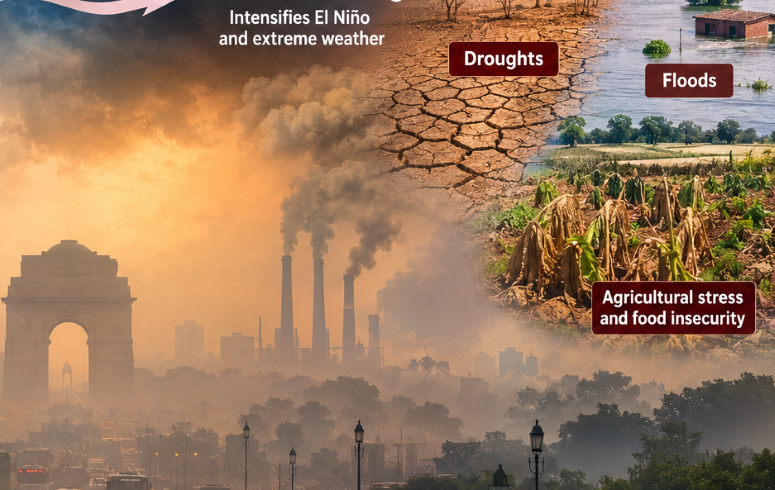
Let me also deal with the impact of weather conditions like El Nino and La Nina on the pollution across the country, especially in Delhi NCR. We are encountering winter pollution in Delhi NCR for nearly a decade now. A study was conducted to correlate the weather conditions with the pollution in the region. If we look back, we find 2022-23 Delhi pollution, was significantly mild, which coincided with the La Nina weather pattern. The study found that PM2.5 in 2022-23 was 30% down from the average of previous three years. As against this during 2022-23 PM2.5 in Mumbai spiked by 45%. The pattern dramatically reversed in 2023-24, which was El Nino year, when PM2.5 spiraled in the north of the country and fell sharply in peninsular India.
El Nino and La Nina conditions altered atmospheric circulation, PM2.5, transport pathways, and weather conditions to determine whether the pollution disperses or gets trapped. The report has explained how the atmosphere can behave differently under El Nino and La Nina years. The emissions remaining similar, pollutions can accumulate/ or carried away. One of the study’s authors Gufran Beig puts it, “This year’s El Nino is likely to be strongest on record. We just need to be aware that it can impact pollution patterns in India.”
The study explained the reasons for variation that in La Nina winter of 2022-23, stronger winds over north India helped disperse emissions from stubble burning and local sources. The circulation got altered, which bye-passed Delhi and surroundings and carried pollutants southwards, towards Mumbai and Thiruvananthapuram resulting in spike of PM2.5 levels. The atmospheric set up changed in 2023-24 winter, where winds under El Nino were weaker and remained stagnant over north India region. The stagnation favored the accumulation of PM2.5.
As the El Nino conditions are likely to prevail even in the first half of 2027, the agriculturists must also go for soil and moisture conservation measures on farm lands. The farm ponds must be rejuvenated to help conserving water. The inlet drains leading to the water bodies and agriculture lands must be cleared and the vegetation in the catchment must be preserved. More trees should be planted in the degraded areas of the catchments, which helps in cutting the run-off of monsoon water during rains and conserve the moisture. As El Nino is found to be supercharged by fossil fuel burning, the only long-lasting solution is to transition towards renewable and cleaner energy.
(The author, a former Head of Forest Force of Karnataka, is a regular TEW columnist on wildlife, environment, and governance issues.)










[[comment.comment_text]]