Preventing Mishaps During Puja Festivals: Lessons from the Chorbagan Tragedy

 an hour ago
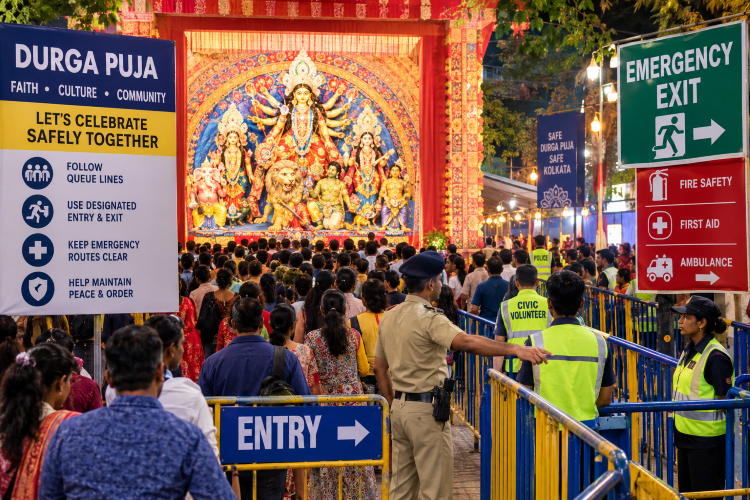
Durga Puja is among India’s grandest religious and cultural festivals. Its elaborate rituals, artistic displays and deep devotional significance have transformed it into an international celebration, with communities in major world capitals organising festivities alongside Diwali. Beyond its religious importance, the festival attracts tourists and showcases India’s rich cultural traditions.
In December 2021, Kolkata’s Durga Puja received international recognition when UNESCO inscribed it on the Representative List of the Intangible Cultural Heritage of Humanity. This recognition enhanced the festival’s global profile and strengthened its contribution to cultural tourism.
However, the growing scale of celebrations brings a serious responsibility: ensuring the safety of devotees. The Chorbagan tragedy in Kolkata is a grim reminder that religious enthusiasm must be matched by effective crowd management, adequate infrastructure and emergency preparedness.
Historical Roots and Evolution
The tradition of public Durga Puja celebrations in Bengal has a long history. Raja Kansh Narayan of Tahirpur is traditionally credited with organising a grand public Puja in 1576, reportedly for the welfare of his subjects. The practice subsequently spread across Bengal, becoming an important part of community life.
Public celebrations gained momentum in Calcutta during the early twentieth century. Bhawanipur is associated with the emergence of community-based Durga Puja around 1910. Over time, neighbourhood committees transformed the festival into a collective expression of faith, cultural identity and social participation. Many Puja committees in West Bengal now have histories extending over a century.
Rituals and Religious Significance
The ten-day festivities feature devotional recitations, including the Devi Mahatmya, commonly known as the Durga Saptashati, alongside traditional worship. Celebrations begin with Mahalaya, marking the transition from Pitru Paksha to Devi Paksha. Devotional recitations herald the arrival of Goddess Durga, who is believed to descend to earth to restore righteousness and vanquish evil.
On the sixth day, idols of Goddess Durga, Lakshmi, Saraswati, Ganesha and Kartikeya are ceremonially installed in the pandals. Worship continues over the following days, culminating in the principal rituals on Maha Navami. On Vijayadashami, the idols are taken out in processions for immersion, bringing the festivities to a close. While these traditions remain central to the festival, the manner in which celebrations are organised has changed considerably.
Changing Celebrations, Growing Challenges
Population growth, technological advancement and commercial competition have transformed the scale and design of Puja pandals. Many celebrations have evolved from religious and community gatherings into elaborate public spectacles.
Organisers compete to create distinctive themes, artistic installations and elaborate decorations. Pandals showcase architecture, sculpture, music, contemporary social issues and popular culture, attracting enormous crowds. In some cases, these attractions become as prominent as the religious observance itself.Creativity deserves appreciation, but it must not compromise public safety.
A popular pandal can quickly exceed its physical capacity, particularly when visitors arrive in large numbers within a short period. Commercial considerations and the desire to attract bigger crowds can aggravate the problem. Organisers must therefore balance artistic ambition with the festival’s religious significance and their responsibility to protect visitors.
Crowd Management: The Critical Test
Crowd pressure generally intensifies during the evenings and towards the final days of the festival. At popular pandals, queues can stretch across adjoining streets, obstructing traffic and restricting access for emergency vehicles.
When a crowd becomes too dense, even a minor disturbance can trigger panic. People may push towards exits, causing falls and crushing injuries. Rumours, sudden rainfall, fire or warnings about structural instability can turn a manageable gathering into a disaster.
At peak hours, volunteers may struggle to control the influx of visitors. Police and Home Guard personnel can also become overwhelmed when arrangements are inadequate or crowd movements turn unpredictable.
Prevention requires advance planning. Major pandals must have sufficiently wide approach routes, clearly marked entry and exit points, and separate routes wherever feasible. Exits must be adequate for the maximum expected crowd, and no narrow passage should become the sole escape route.
Drinking water, fire-fighting equipment, emergency lighting, first-aid facilities and accessible ambulances are essential. Organisers must maintain reliable communication with police, fire services and medical teams.
Crowd limits should reflect the actual capacity of the venue. Once that limit is reached, entry must be regulated or temporarily suspended. Real-time monitoring, clear signage and timely public announcements can help prevent dangerous congestion.
What Led to the Chorbagan Tragedy?
The stampede at Chorbagan Sarbojanin Puja Samity in Kolkata reportedly claimed 18 lives and left more than 25 people injured. Some of the injured were reported to be in critical condition.
Initial accounts pointed to several possible contributing factors: a narrow lane, a single exit, sudden rainfall and an announcement warning that the pandal might collapse. These circumstances may have triggered panic, sending people towards a restricted escape route. Reports also raised concerns about the effectiveness of private security personnel and the availability of ambulances.
The precise sequence of events and the responsibility of individual agencies must be established through a thorough investigation. Nevertheless, the reported circumstances underline a fundamental principle: a venue that cannot ensure safe evacuation should not accommodate a large gathering.
Any warning of structural danger must trigger a controlled evacuation supervised by trained personnel. Confusing announcements, unclear instructions and inadequate evacuation arrangements can aggravate panic instead of containing it.
The tragedy also highlights the need for independent safety inspections before major public events. Structural stability, electrical installations, fire hazards, emergency exits and access for rescue services must be checked. Compliance should be verified, not merely assumed.
Accountability Must Lead to Prevention
The tragedy has shocked Kolkata and shaken the confidence of devotees, organisers and the wider public. It should prompt cultural organisations elsewhere to review their safety arrangements.
The reported arrest of seven persons may be an important step in the investigation, but arrests alone cannot prevent similar incidents. Nor should inquiries end with recommendations that are never implemented.
Responsibility must be established, and those found culpable should face appropriate legal consequences. Authorities must also examine systemic failures involving permissions, inspections, crowd estimates, deployment of personnel and emergency-response arrangements.
Puja committees should prepare written disaster-management plans, conduct evacuation drills and assign specific responsibilities to trained personnel. Police and civic authorities must assess crowd risks before granting permissions and enforce safety conditions throughout the festival. Organisers should coordinate with nearby hospitals and emergency services before celebrations begin.
The reported ex gratia assistance of ₹2 lakh for each deceased person and ₹50,000 for each injured person also merits reconsideration. While such assistance provides immediate relief, it may be inadequate to meet medical expenses, rehabilitation costs and the long-term loss of family income. Support should take account of the severity of injuries, continuing treatment and the needs of affected families.
Faith Must Be Accompanied by Responsibility
Durga Puja represents devotion, artistic achievement, community solidarity and the triumph of good over evil. Its international recognition should inspire pride, but also greater responsibility.
No celebration can be considered successful if devotees are injured or families lose loved ones because basic precautions were neglected. Safety cannot be treated as an administrative formality or an expense to be minimised. It is an obligation shared by organisers, civic authorities, police and the public.
The Chorbagan tragedy must serve as a warning, not merely a moment of collective grief. Its lessons must translate into enforceable safety standards, transparent accountability and effective emergency preparedness at every major public gathering.The true spirit of a festival lies not only in devotion and celebration, but also in protecting every life that comes together to honour it.
(Author, a retired civil servant, formerly served as the Chief Secretary in the state government of Sikkim. He can be reached on email: alok.secyskm@gmail.com)








[[comment.comment_text]]