Beyond Farakka: Rethinking Bihar’s Water Security

 an hour ago
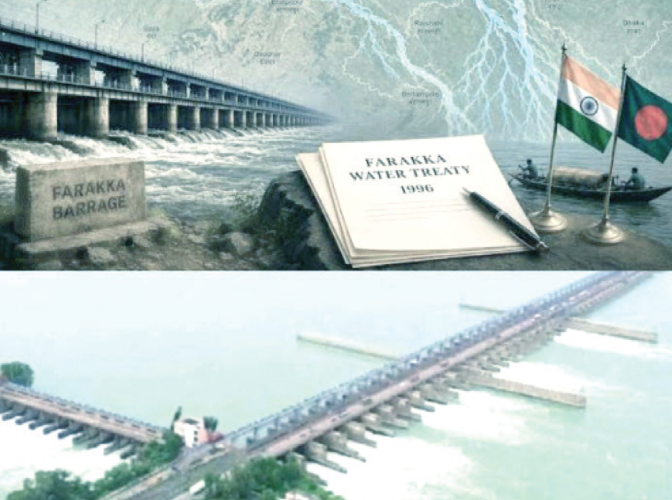
The proposed renewal of the India-Bangladesh Ganga Water Treaty has brought the issue into sharper focus. Signed on December 12, 1996, the thirty- year agreement is due to expire in December 2026
The floodwaters recede in Bihar, but the problem of floods does not. Fields remain buried under sand and silt, riverbanks erode, villages are displaced and public money is spent on relief and rehabilitation. Summer brings a different crisis: shortages of drinking water, irrigation and groundwater. This coexistence of abundance and scarcity in a state blessed with an extensive river network is not merely a natural paradox; it is also a test of water governance.
The proposed renewal of the India-Bangladesh Ganga Water Treaty has brought the issue into sharper focus. Signed on December 12, 1996, the thirty-year agreement is due to expire in December 2026. Bihar has sought adequate recognition of its requirements for drinking water, irrigation and industrial development in any future arrangement. For a state with a population of nearly 140 million, water security is no longer confined to agriculture. It is closely linked to development, employment and quality of life.
At a seminar on ‘Ganga Water Treaty and Bihar’s Water Security’ in Patna on October 30, 2026, Chief Minister Samrat Choudhary inaugurated the deliberations. An important conclusion was that Bihar’s concerns cannot be reduced to whether India should release more or less water to Bangladesh. Water allocation, floods, sedimentation, river dynamics and drainage are interconnected, but each requires solutions at different levels of governance and river-basin management.
Besides the Ganga, rivers such as the Ghaghara, Gandak, Kosi, Burhi Gandak, Son, Punpun and Mahananda influence large parts of Bihar. Several originate in, or have catchment areas extending into, Nepal and the Himalayas. The state’s water security is therefore inseparable from international river relations, Centre-state coordination and integrated river-basin management. Bihar’s voice must be heard in treaty negotiations, but the agreement alone cannot resolve all its water-related problems.
Under the 1996 treaty, the available flow of the Ganga at Farakka is shared between India and Bangladesh in ten-day periods, with entitlements determined by different levels of river discharge during the dry season. Over three decades, demographic pressures, agricultural needs, industrial activity and climatic conditions have changed substantially. The original parameters need a fresh assessment. Bihar must establish how the utilisation and allocation of Ganga waters will affect its drinking water supply, irrigation potential and industrial ambitions, now and in the years ahead.
At the seminar, water expert Dr Vinod Tare observed that many of Bihar’s problems were essentially domestic. The treaty concerns the sharing of Ganga waters downstream of Farakka, whereas floods, siltation and drainage difficulties within Bihar require coordinated intervention by the Union and state governments. Cooperation with Nepal is equally indispensable. Padma Shri awardee Umashankar Pandey stressed the need to prioritise Bihar’s requirements and strengthen water conservation. National Water Award recipient Kishore Jaiswal referred to the agreements of 1977 and 1996, arguing that Bihar’s interests had not received adequate consideration during the negotiations leading to the latter treaty. He called for the state’s requirements to be incorporated into any future agreement. Dr Awadhesh Pratap, invoking principles of international river law, observed that India could not completely obstruct the natural flow of a transboundary river, but must safeguard the legitimate requirements of its own citizens.
Former Chief Engineer-in-Chief Ishwar Chandra Thakur urged policymakers to place the water needs of industry, agriculture and southern Bihar at the centre of the development debate.
The Farakka Barrage was built primarily to maintain water flow in the Hooghly and preserve the navigational utility of Kolkata Port. A feeder canal, approximately 42 kilometres long, was also constructed. During the 1950s and 1960s, West Bengal engineer Kapil Bhattacharyya raised concerns about the project’s possible consequences. His apprehensions deserve rigorous scientific examination today. Changes in river flow, sediment deposition and bank erosion upstream and downstream of Farakka need systematic study. Yet attributing every flood in Bihar to the barrage would be simplistic. Himalayan sediment loads, the natural behaviour of rivers, embankments and other human interventions must also be examined before conclusions are drawn.
Bihar’s history of flood management offers a lesson: embankments do not fundamentally alter a river’s character. Senior river expert Dinesh Mishra notes that the issue was discussed at a flood conference in Patna from November 10 to 12, 1937. Dr Rajendra Prasad pointed out that numerous embankments built by private organisations, the Railways, district boards and local bodies obstructed the natural drainage of floodwaters. Railway lines and roads, too, often functioned as artificial embankments. Water accumulated on one side while the other remained relatively unaffected; inadequate bridges and culverts further impeded drainage. He suggested removing unnecessary embankments, beginning with railway infrastructure and district-board roads, and asked engineers to devise practical solutions.
At the same conference, Bihar’s Chief Engineer, Captain G. F. Hall, also identified embankments as a major contributor to flood-related difficulties. He argued that shallow floods spreading naturally across the landscape could sometimes cause less damage than concentrated floods that devastated villages and crops, driving communities towards hunger and displacement. Despite these early warnings, embankments became the principal instrument of flood control after Independence.
Dr Rajendra Prasad later visited the Kosi region from October 17 to 24, 1954, appealing for public participation in flood-control efforts. The foundation stone of the Eastern Kosi Embankment was laid on January 14, 1955, and he laid that of the Western Kosi Embankment on March 22, 1955. A system whose potential disadvantages had been discussed in 1937 thus gradually became the dominant approach to flood management.
Figures compiled by Dinesh Mishra indicate that the total length of river embankments in Bihar, about 160 kilometres in 1955, is now estimated at nearly 3,700 kilometres. Official estimates of the flood-prone area, according to his compilation, have risen from around 2.5 million hectares in 1954 to approximately 6.9 million hectares today. Changes in measurement methodology must be considered; these figures alone do not prove that embankments caused the entire increase. They nevertheless raise a necessary question: despite their massive expansion, how effectively have drainage and protection for vulnerable communities improved?
Flood management requires a fundamental reassessment. Alongside repairing and strengthening existing embankments, the government must restore traditional drainage channels, remove encroachments from natural watercourses and protect villages located within embanked areas. Road and railway projects must provide adequate bridges and culverts for the unhindered passage of floodwater. Its safe evacuation is as important as preventing destructive inundation of settlements and farmland.
Cooperation with Nepal is indispensable. The catchment areas of the Kosi and Gandak extend into Nepal, where rainfall, landslides and changes in river discharge directly affect Bihar. Regular hydrological data exchange, effective early-warning systems and joint scientific investigations should become institutional priorities. Large dams and high-storage projects cannot be treated as universal remedies. Their social, environmental and economic consequences require comprehensive assessment; no dam can guarantee permanent freedom from floods.
Water security must also mean reliable availability and equitable distribution in the dry months. Traditional systems such as ponds, ahar-pyne networks and community water bodies need revival. Groundwater recharge and water-efficient irrigation deserve greater attention. Southern Bihar, where drinking water and irrigation shortages become acute in summer, requires special consideration. Industrial allocation must not come at the expense of farmers and local communities. The state should prepare a long-term water budget covering available resources, consumption patterns, groundwater conditions and future requirements.
For India and Bangladesh alike, the Ganga is a lifeline sustaining agriculture, drinking water supplies and livelihoods. Bangladesh depends heavily on the river for its agricultural economy and water security. The treaty debate must not become a confrontation between the two countries. Transparency in hydrological data, regular monitoring, assessment of climate-change impacts and institutionalised cooperation offer a sustainable way forward. At the same time, the legitimate requirements of states within India’s river basins must be adequately represented in national water policy.
Bihar’s demand is not to deprive another country of its rightful share. It is to secure recognition of its own legitimate needs in the treaty framework and national water policy. The state government must present an evidence-based document to the Union Government covering drinking water, irrigation, industrial consumption, environmental flows, flood management and sedimentation. Equally important is an honest review of Bihar’s own river-management policies and administrative priorities.
The renewal of the Ganga Water Treaty offers Bihar an opportunity to articulate its interests with clarity. But if the debate remains confined to the arithmetic of water-sharing, the longstanding problems of floods, siltation and inadequate drainage will persist. Bihar needs a comprehensive water policy that prevents floodwaters from becoming a recurring curse, ensures availability during dry months and respects the natural character of its rivers.
Ultimately, equitable sharing of the Ganga’s waters will have meaning only when decisions take account of the river’s ecological cycle and the millions whose lives depend on it. Water diplomacy must go beyond international agreements to embrace ecological responsibility, cooperative federalism and social justice. For Bihar, the real measure of a successful treaty will not simply be how much water crosses an international boundary, but whether its people can live with greater security, dignity and certainty in a land shaped by rivers.
(The author, a senior journalist of Bihar, is a known commentator on governance, development, and diversity issues.)





[[comment.comment_text]]