“When Reason Fails, Books Are Torn Apart”

 22 minutes ago
Why Such Disdain for Books?
Sonia Gandhi’s book is also subject to criticism. An autobiography is not the last word on history; rather, it is a document of the author’s experiences and viewpoint. Examine its facts, contest its conclusions, and provide proof of its errors.
India observes National Book Week from November 14 to November 20. It is a National Book Trust effort that aims to promote a culture of reading, emphasise the value of books, and turn libraries into thriving hubs of information and intellectual conversation. Its message is straightforward: Read, comprehend, ask questions, and develop your ideas. Books are more than just written words on paper; they are society's collective memory and civilisation's conscience.
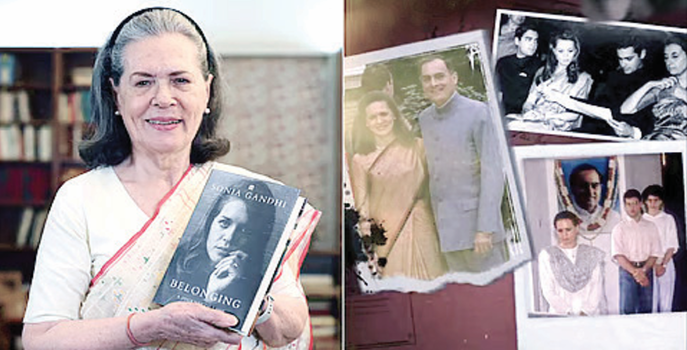
However, it is ironic that copies of former Congress president Sonia Gandhi's autobiography, Belonging: A Journey of Love, are being torn apart and tossed into trash cans this same week as a sign of ideological disagreement. Some appear to view the book's public humiliation as an ideological accomplishment, while others are posting pictures of themselves reading it. This contrast represents the gap between a culture of reading and the intolerance of opposing ideas, not just different reactions.
Sonia Gandhi's book is also subject to criticism. An autobiography is not the last word on history; rather, it is a document of the author's experiences and viewpoint. Examine its facts, contest its conclusions, and provide proof of its errors. However, tearing up a book does not refute an idea or a single fact.
Intellectual impoverishment is the desecration of a book; disagreement is intellectual freedom. Instead of shredding pages and revealing the weaknesses in your own thinking, defeat ideas with reason.
When Ideas Threaten, Books Burn!
In India, opposition to books is not new nor exclusive to any one philosophy. The Satanic Verses by Salman Rushdie was prohibited from being imported in 1988. Rare manuscripts were damaged at Pune's Bhandarkar Oriental Research Institute in 2004 as a result of demonstrations against James Laine's Shivaji: Hindu King in Islamic India. The Three Hundred Ramayanas essay by A. K. Ramanujan was taken out of the University of Delhi's curriculum in 2008. Such a Long Journey by Rohinton Mistry was removed from the Mumbai University curriculum in 2010, and The Hindus: An Alternative History by Wendy Doniger was put on hold after a legal settlement in 2014.
Religious or right-wing organisations are not the only ones with a propensity to stifle opposition. Copies of Premchand'sRangbhoomi were set on fire in 2004 as a protest against terminology tied to caste. Perumal Murugan, a Tamil author, was forced to announce that he would stop writing after his book Madhorubagan (One Part Woman) was burnt. The freedom of expression was later affirmed by the Madras High Court, which noted that "if you do not like a book, throw it away."
These instances resulted from a variety of situations, including publication settlements, violent protests, the removal of works from academic courses, and prohibitions. However, they all have the same attitude, which is the conviction that one's ideology alone is the ultimate truth and the refusal to accept the existence of ideas that contradict one's own convictions.
Censorship, intimidation, or fire should never be used as a response to disagreement, regardless of one's views. There must be logic, discussion, and refutation.
Afraid of Books, Defeated by Ideas!
It is a fundamental right to disagree with a book, but no ideology can rationally justify dehumanising or destroying it. A book is a part of our shared intellectual legacy and does not belong to any one political party or ideology. Reason, evidence, and time must be used to determine its value rather than organisations or ideologies dictating what people should or shouldn't read.
"There is more than one way to burn a book," wrote Ray Bradbury in Fahrenheit 451. Not only can books be destroyed by burning them, but they can also be effectively suppressed by keeping people from reading them, purposefully ignoring them, and inciting hostility toward them. These days, cameras and social networking gadgets are new tools for destroying books.
"Where they burn books, they will ultimately burn people too," warned German poet Heinrich Heine. This is not just a caution against burning books but also against the perilous spread of intolerance, when the repression of ideas finally becomes an attack on human liberty.
According to John Milton's Areopagitica, a book is the invaluable lifeblood of a great mind. In actuality, a book contains human consciousness, experience, and mental fortitude—much more than just paper and ink.
Recall that a book's concepts cannot be destroyed by breaking it apart. It merely highlights the incapacity of people who disagree with it to respond to them rationally.
Libraries: Where Ideas Breathe Free
It's simple to toss a book in the trash can. However, are the concepts included in its pages also erasable? " Who controls the past controls the future; who controls the present controls the past," wrote George Orwell in 1984. This is not just a cautionary tale about manipulating history but also about the desire to embrace or reject concepts based on ideological convenience.
Libraries are not private collections owned by ideologies, castes, political parties, or faiths. They are public areas where democratic coexistence of ideas is required. Gandhi's detractors, Nehru's ideological rivals, and Marx's philosophical detractors must all have a place. A library's purpose is to introduce readers to the variety of human thought, not to spread a particular ideology.
Ideological policing, not knowledge, is fostered by a library that exclusively maintains concepts of conformity. Each reader is entitled to read, contrast, challenge, and reach their own conclusions. Don't stop reading and comprehending a book just because you don't agree with its arguments.
The real measure of democracy is how bravely we listen to and tolerate individuals who disagree with us, rather than how respectfully we adopt views that suit us. People who throw books in the trash may not realise that history, not the trash can, is where ideas ultimately end up.
Disagree, Don’t Destroy!
These examples are not meant to be used to support one incident over another or to apply a uniform standard to all disputes. Every book, demonstration, and court case has a unique background. Beneath them all, however, is a common threat: the book becomes the first target of a group that starts to view its ideological, religious, or social ideas as the ultimate truth and rejects the validity of any contrary viewpoint. Regardless of one's worldview, the tendency to stifle dissent is ultimately detrimental to free speech and knowledge.
The opposition to Sonia Gandhi's Belonging must therefore be considered within this larger framework. Contest the book's facts, examine its contents, provide evidence to support its findings, and, if required, write a follow-up book. However, dismantling it or tossing it in the trash and labelling it as intellectual resistance simply serves to reinforce the very intolerance we have consistently denounced in others.
For individuals who purchase books only to publicly criticise them, there is also a simple question: why purchase the book in the first place if you vehemently disagree with its ideology? Why donate it to a public library if reading it made you disagree? It's possible that another reader found it, agreed with its reasoning, or scrutinised its factual assertions. A book might have served as the catalyst for a more extensive intellectual discussion. By destroying it, you've killed not just a book but also the potential for someone else to learn from it. Throwing away a book that you bought with your own hard-earned money is a waste of resources and reason, not an ideological success.
Nalanda’s Ashes, Our Forgotten Lessons
Organising book fairs, giving speeches, or encouraging people to read are not enough to fully capture the significance of National Book Week. Its goal won't be achieved unless we have the patience to read opposing viewpoints and the guts to refute them with well-reasoned arguments. Books encourage us to reflect rather than demanding our consent. Protecting the freedom to read a book, disagree with it, condemn it, and write a response is exactly what makes a democracy mature.
However, it appears that the ashes of Nalanda Mahavihara have not taught us much. Nalanda was far more than just a university; it was once regarded as one of the world's greatest centers of learning. Centuries of knowledge, philosophy, science, medicine, and scholarly exchange fostered this vibrant intellectual civilisation. This wonderful heritage was severely damaged by the invasions and devastation that occurred in the later half of the twelfth century. One of the worst intellectual tragedies in Indian history is still the memory of its libraries being destroyed by fire. The remains of Nalandaserve as testimonies to the loss endured by a civilisation that lost a significant portion of its intellectual cosmos, in addition to serving as proof of buildings that previously stood.
The ashes of Nalanda serve as a reminder that when books burn, more than just the pages are destroyed; generations' worth of knowledge, research opportunities, and future directions are also lost. Destroying a centre of learning can change a society's intellectual trajectory and historical continuity; it is more than just a building collapsing.
Let Ideas Live, Not Books Burn
The concepts contained in a book are not destroyed by tearing it up, but the limits of our own comprehension are undoubtedly diminished when we choose not to read it. Book burners may cause a stir for a while, but ideas can only be overcome by more innovative ones.
The hand that rips apart a book is ultimately trying to put out the torch of knowledge, regardless of the ideology. And long before it burns the books of others, a society that converts disagreement into fire rather than argument is destroying its own intellectual future.
(Author a doctorate in laws, is a senior lawyer, columnist, and civil society activist.)






[[comment.comment_text]]