Banaras: A Civilisation Under Pressure
 18 minutes ago
Among those Persian wanderers were Seikh ‘Alī Hazān Lazīn Lāhizī (1692 1766), who declared, “I shall not depart, for worship places rise at every turn,” and who found his final breath beneath Kashi’s sky, his tomb now a modest stone in Lallapur. Ghulām Ḥusain Khān (1151 1221) left a detailed account of the city’s literary pulse, while ‘Alī Ibrāhīm Khān (1784) recorded the tangled histories of its peoples
“Banaras rā kase gufta ki Chīn ast,
Hanūz az Gang chīnash bar jabīn ast."
(Who said Banaras is just another word for 'Beauty'? Look closely, the Ganges still carries a frown of ripple-wrinkles upon its brow.)
In 1827 Mirza Ghalib lingered in Banaras, his heart catching the glimmer of the Ganges and the flicker of temple lamps, later shaping them into the verses of Chiragh e Dair. Yet Ghalib was not the first Persian- Urdu to feel Kashi’s pull. From the sixteenth to the eighteenth century, poets and scholars crossed the Himalaya’s shadow to sit in its libraries, to hear the rustle of Sanskrit scrolls, to taste the bittersweet perfume of love stories that rose from the confluence of Hindu and Muslim hearts.
Among those Persian wanderers were Seikh ‘Alī Ḥazān Ḥazīn Lāhizī (1692 1766), who declared, “I shall not depart, for worship places rise at every turn,” and who found his final breath beneath Kashi’s sky, his tomb now a modest stone in Lallapur. Ghulām Ḥusain Khān (1151 1221) left a detailed account of the city’s literary pulse, while ‘Alī Ibrāhīm Khān (1784) recorded the tangled histories of its peoples. Their words survive, inked on fragile pages, a testament that the city’s soul has never been silenced.
The love story that Vinesh Kashmīrī and Fitri Kumi wove into a modern volume is but another thread in Kashi's communal and civilizational inheritance, a tender echo of the many voices, traditions, and imaginations that have shared its ghats for centuries. In those days, Kashi’s wealth was measured not in gold but in wisdom, in the soft glow of lanterns that lit scholars’ tables, in the quiet liberation that rose with each mantra.
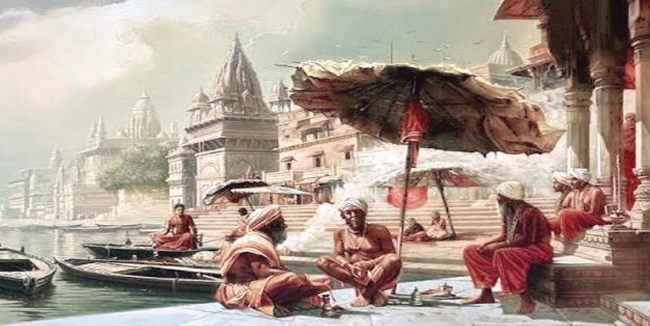
In the hush before dawn, when the Ganges still clings to the night’s chill, Kashi awakens like a wounded sage—its breath a trembling chant, its streets a lattice of whispered prayers. It was here, at the fringe of the ancient city, that the Buddha first unfurled his teaching, his words falling upon the sand as fragile as a moth’s wing. Not far away, the Jain Tirthankara Parshvanatha once walked these banks, his silence a mirror for those who would later kneel before the same river. The syllable “Om,” that single breath of Hindu thought, has reverberated through these alleys for countless generations, each echo a reminder that the divine is never far from the mortal.
Yet these references are not merely literary ornaments. Together, they point to a Kashi whose fundamental assets were wisdom, knowledge, light and liberation. The question, then, is whether these values continue to shape the Varanasi of the Smart City era.
A city that drew the Buddha, Jain thinkers, Hindu philosophers, Persian poets and generations of seekers possessed something more enduring than wealth or architecture. It possessed a civilizational confidence, a capacity to absorb different voices without losing its own centre.
The challenge today is not development itself. Roads, flyovers, industrial corridors and urban infrastructure are necessary for a growing city. The deeper question is whether development has been accompanied by the preservation of the intellectual, cultural and ethical foundations that made Kashi unique.
Reports of shrinking public spaces, concerns over environmental degradation, the neglect of libraries and the growing commercialization of everyday life raise uncomfortable questions. Can a city remain the "City of Light" if its institutions of learning fade into the background? Can concrete alone preserve what centuries of scholarship, faith and cultural exchange once created?
Kashi’s Development: At What Cost?
The scale of incidents taking place in Kashi is difficult to capture in numbers; perhaps an entire newspaper would be needed to document them. Kashi is not an ordinary parliamentary constituency. It is represented by the Prime Minister, naturally attracting greater public expectations and international attention. People expect it to be better governed than other constituencies. But what is the biggest attraction of Kashi today?
Is it a ₹280-crore ropeway project that is still not operational, the demolition of historic temples, or the construction of corridors without sufficient thought for the city's historical essence? Recent media reports about an illegal arms factory are particularly disturbing. During a police raid, officers were fired upon and a policeman was injured.
This is not an isolated development. Police reports have referred to several operations in which illegal arms-manufacturing units were sealed. In another development, restaurants, reportedly operating under the influence of politically connected people, including those alleged to have links with ruling-party figures, came under raids following complaints of illegal activities. A police constable was also reportedly suspended for allegedly helping a cannabis smuggler escape. If such activities are flourishing in the Prime Minister's constituency, the question is unavoidable: what is happening to law enforcement?
The proposed Anand Kashi Township project is expected to involve the demolition of 78 structures. The multimodal terminal project around Tengra has also raised concerns, with villagers facing land acquisition. The Ramnagar port is proposed to be connected to the railway network through Jeev Nathpur, and surveys are reportedly progressing rapidly. Meanwhile, a bridge over the Varuna has also been proposed, with a tender reportedly advertised for ₹13 lakh. Sweet shops have faced raids, with adulterated products reportedly recovered. Is this the condition of a city being presented as a model of development?
The question is not whether Kashi needs infrastructure. It does. But is reckless development the only way to restore the city's importance, or is it simply creating a new market? Kashi is known for its narrow lanes, chanting of shlokas, natural ghats, temple architecture, music, dance gharanas, fairs and intellectual traditions. Its identity extends far beyond universities and religious tourism. Yet the city increasingly appears to be moving towards high-rise buildings, malls, commercial food outlets and politically influenced academic discourse. Where are we taking this historic city, and is this really how history is made?
The question of land grabbers becomes even more serious when allegations involve influential political figures, including state ministers. Reports have also raised questions about a railway contractor's firm in connection with suspected GST evasion of approximately ₹4.25 crore. At the same time, small businessmen in Delhi have reportedly received GST notices demanding tax and penalties running into crores. If the government is so vigilant about tax compliance, how do such alleged irregularities continue under its own administrative watch?
The Varanasi Development Authority was established to facilitate planned development and provide better civic facilities. Yet repeated complaints and allegations of corruption have raised serious questions about its functioning. How have such networks become so fearless despite police action and administrative investigations?
There have also been allegations involving local political leaders and officials. In October 2026, ENT professor Dr Shravan Kumar Singh accused UP Minister Ravindra Jaiswal of encroaching on his land and obstructing access; the minister's office denied the allegation. Other reported cases include a ₹50-crore land-fraud investigation and the July arrest of a GST deputy commissioner in a bribery case.
These allegations require impartial investigation, not political protection. Meanwhile, pollution, traffic congestion, pressure on sewage systems and the growing burden of pilgrimage are making ordinary life increasingly difficult. Religious activity cannot come at the cost of education, public health and citizens' everyday needs. The slogan, “Maa Ganga has called us”, cannot answer every question about governance.
The role of government is to provide opportunities that enable citizens to develop their potential towards higher human objectives. Governance cannot be reduced merely to the creation of roads, corridors, ports and other material infrastructure. Its purpose is equally to nurture conditions that promote learning, culture, creativity, ethical conduct and intellectual growth.
The real question is: who will take responsibility for Kashi's condition? A city that gave India centuries of wisdom, culture and intellectual richness deserves much more than corridors, buildings and commercial projects. It deserves a model of governance that strengthens human capabilities, preserves civilizational heritage and creates conditions for intellectual and cultural flourishing.
The Soul of Kashi at Stake
In 1986, Abdul Bismillah wrote the celebrated novel Jhini Jhini Bini Chadariya, portraying the extremely difficult lives of Banarasi saree weavers (Julahas/Bunkars) decades after Independence. A substantial section of Varanasi's population depended on this traditional occupation, yet these artisans struggled to earn two meals a day despite numerous Central Government welfare schemes. The very community that gave Kashi its distinctive identity through the art of weaving Banarasi sarees remained deprived of its legitimate needs. Among the many things for which this city is known, the Banarasi saree remains inseparable from its cultural identity.
The novel tells the story of Hazi Katan and Girija Prasad, who accumulated considerable wealth selling sarees, while the actual weavers continued to struggle, earning barely Rs 90 a day. Matin, another character, is unable to support his family, particularly when his wife is suffering from tuberculosis. The novel exposes the failures of the system and successive governments, whose jumlas and promises rarely translate into tangible welfare. Despite numerous schemes and assurances, the condition of the poor remains captured in a familiar irony: a common man can sell mangoes but cannot afford to eat them.
Perhaps, as the double-engine government's development narrative takes shape, these realities have received little attention from policymakers.
What, ultimately, has development delivered to Kashi? A ropeway, but for whom? Parking facilities charging a minimum of Rs 100 per hour, beyond the reach of ordinary people. Even a cup of tea costs at least Rs 15 amid rising commercial pressures. Streets remain congested, police issue traffic challans, adulterated food is sold even in reputed shops, and residential neighbourhoods are increasingly converted into commercial spaces through homestays.
In such circumstances, how can we continue to speak of Kashi as the city of liberation, wisdom, light and salvation? Everything seems to be moving towards one destination: the marketplace. Whether this model of development can sustain itself remains unanswered.
Politics may survive on jumlas, but knowledge and wisdom never do.
The sight of 500 motorcycles raises questions about the journey from Karmabhoomi to Janmabhoomi. Many of us may not even know the actual circumstances prevailing in Karmabhoomi. Whatever the media reports and political narratives project, what we witness on the ground is deeply distressing, disappointing and saddening for human civilisation.
Kashi hitherto distinctly known for its culture, wisdom and enlightenment, is no more so; instead it has become a city like any other. It is no more a place to generate idea and philosophy rather a new culture of grabbing , holding and deceiving to gain profit has been assumed. The intrinsic goal of human has shifted to exterior ostentatious life. City has become intolerant to reason and rationality and in assimilating new ideas. There is a need to balance various elements essential to perpetually sustain human life.
(Author is a senior journalist and Managing Ed itor of TEW.)





[[comment.comment_text]]