From Pal Do Pal to Har Ek Pal, M.S. Dhoni Retires from Cricket.

 an hour ago
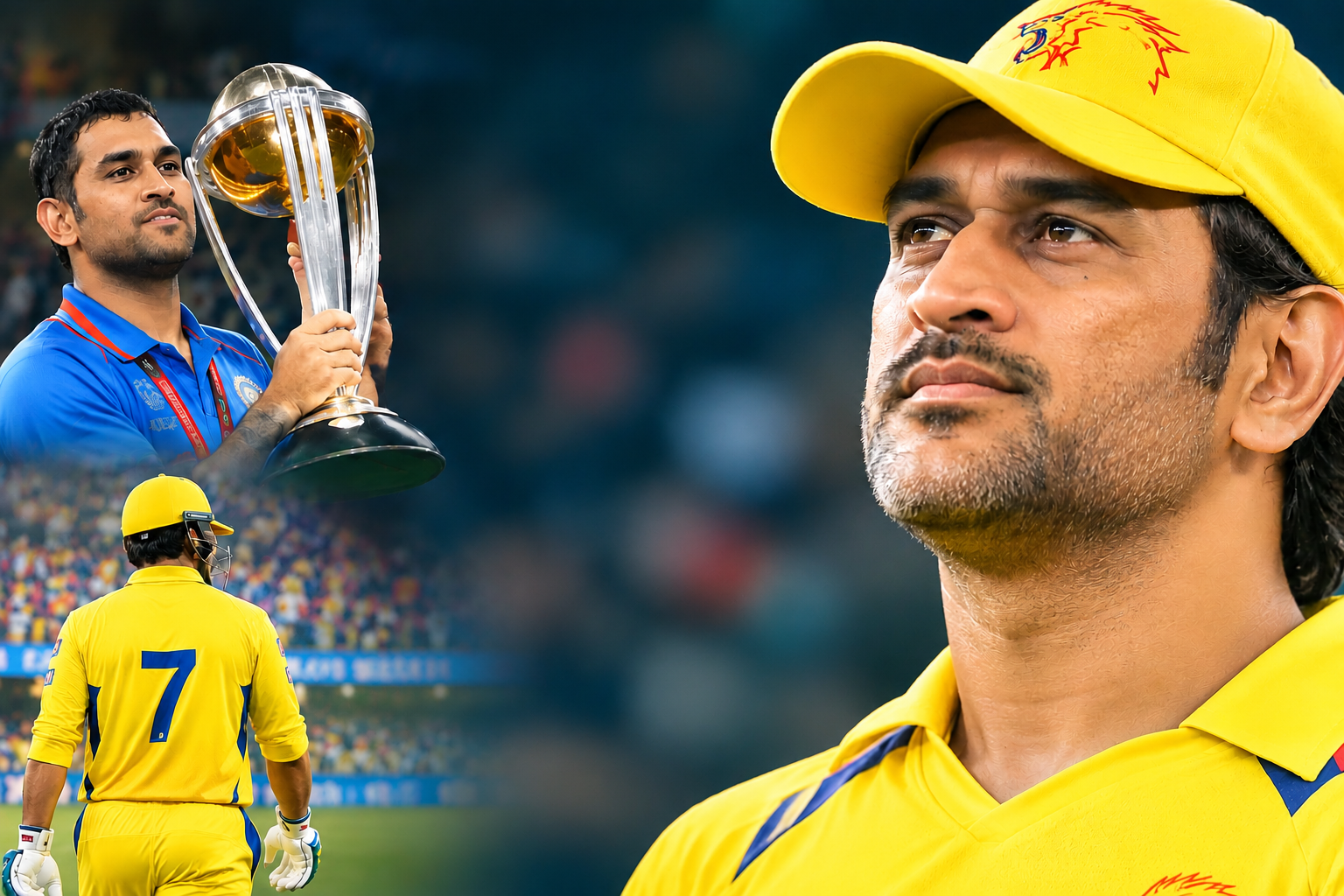
On 15 August 2020, at 7:29 in the evening, Mahendra Singh Dhoni told the country he was finished with international cricket. There was no press conference, no farewell Test and no speech. He posted a montage on Instagram, set it to a Hindi film song about a poet of a moment or two, and asked to be considered retired. India understood the hint and grieved anyway.
On Tuesday, six years later, he did it again, and the symmetry was too exact to be accident. Hours after Chennai Super Kings announced that he had retired as an IPL player and would return as the franchise’s mentor, Dhoni posted another montage and another version of the same song. This time the line was “Main Har Ek Pal Ka Shayar Hoon”: I am a poet of every moment. His caption said the fans had proved him wrong and that no song could be better for accepting it.
Six years ago, he was “Pal Do Pal”. Today he is “Har Ek Pal”. Between the two sits the argument of this editorial. Dhoni did not merely outlast his own modest expectations of how long India would remember him. He designed the exit, the timing and the soundtrack himself, and that choice, more than any trophy, is his final lesson to Indian sport.
The facts of the day have been quickly told. CSK’s announcement arrived on the IPL 2027 retention deadline, when all ten franchises had to submit their lists to the BCCI. Dhoni’s name was on the released side, at the Rs 4 crore he had been retained for as an uncapped player. According to Rupa Gurunath, the franchise’s co-owner, the decision was his own. On a video call, as chief executive Kasi Viswanathan read out the names to be released, Dhoni interrupted and asked that his be among them. The room, by her account, was stunned. Dhoni had not played a single match in 2026, sidelined by calf and thumb injuries, and his last appearance came in May 2025 in a defeat against Rajasthan Royals in Delhi. The retirement, in other words, formalised something the scoreboard had already told us.
The timing of the 2020 announcement was itself a small piece of theatre. It came on Independence Day, with a time stamp in the caption, 1929 hours, and without a word of explanation, and Suresh Raina, his closest companion in yellow, followed him out within minutes. The cricketing world, which had spent a year debating whether Dhoni would play the next World Cup, discovered that the debate was over only when he chose to end it. Nobody was consulted, and nobody, in the end, was surprised.
What is remarkable is not that he stopped. It is that he stopped before anyone could stop him. Indian sport has a long tradition of its heroes being eased out, dropped by committee or lingering until the applause turns to sympathy. Dhoni has refused that script at every turn. In December 2014 he walked out of Test cricket in the middle of a series in Australia, minutes after facing reporters in Melbourne without a word about it. In 2020 he left the international game more than a year after his last match for India, the heartbreaking semi-final loss to New Zealand at the 2019 World Cup. And now he has asked to be released from a franchise that would gladly have kept him a little longer. Three exits, three times on his own terms.
It is worth remembering how improbable the starting point was. Dhoni arrived from Ranchi, a city that sent very few cricketers to the national side, and without the polish of the metropolitan academies. His technique was unorthodox and his instincts were his own. He made his India debut in December 2004, and within a few years he was captain of a team that had just endured a miserable 2007 World Cup. Few expected him to succeed. He then won the first T20 World Cup in 2007, the 50-over World Cup in 2011 and the Champions Trophy in 2013. No other captain has won all three ICC trophies. Under him India also rose to the top of the Test rankings. The statistics are not decoration here. They are the evidence that a small-town cricketer reshaped what a national captain could look like.
The numbers keep making the case. Across 350 ODIs, 90 Tests and 98 T20 internationals he scored more than 10,700 ODI runs at an average above 50, most of them batting at Nos. 5 to 7, where the job is to rescue or to finish rather than to decorate. He made 829 dismissals behind the stumps. In the IPL he led CSK to five titles and, with them, two Champions League T20 crowns, and scored more than 5,000 IPL runs across a journey that spanned 19 years. Those who watched him know the statistics undersell him. A finisher is measured by the moment, not the average: the tight chase, the last over, the calm that made a crowd of tens of thousands believe the match was already won.
That calm, the thing the nation called “Captain Cool”, was always more strategy than temperament. He seemed to know that panic is contagious and that composure is too. He trusted young players with long runs when others demanded instant results. He made the unfashionable decision, famously promoting himself above a more celebrated batter in the 2011 final, and then finished the chase himself. He treated captaincy not as a stage but as a service. When the moment passed, he stepped back so the next man could take the field. It is fitting that his final role at CSK is a mentor’s, a job that is the same craft with the camera turned away.
None of this means the later years were beyond criticism. Critics have asked, with some justice, whether Dhoni stayed in the IPL a season or two longer than his form warranted, and whether the affection of the crowds made the decision harder for the franchise than it should have been. In April 2025, with retirement rumours swirling around his parents’ visit to Chennai, he answered that he took things one year at a time. It was a characteristically evasive reply, and a reminder that his generosity to fans sometimes came at the expense of clarity. But it is also true that no team ever seemed worse off for having him in its dressing room, and that the final exit, when it came, arrived with a dignity that eludes most careers.
Which brings us back to the song. In 2020, the line about a poet of a moment or two sounded modest to the point of fatalism, here is a man who believed his place in memory would be brief, who thought the game’s attention would move on. The tributes from teammates, rivals and fans that followed his announcement showed otherwise, but he had been willing to believe it. Six years later, “Har Ek Pal” reads as a reply. It is not triumph, which would not be like him. It is an acknowledgement, the quiet kind, that he had misjudged the arithmetic. The affection was not for a moment or two, not for the 2011 six or the 2007 final over or any single innings. It was for the long ordinary hours of watching him think.
It is also worth noting how rarely Dhoni speaks in public on his own account. He is among the least active of India’s great sportsmen on social media; his Instagram feed has often gone years between posts, and an occasional video of him driving a tractor on his Ranchi farm has been enough to set the internet alight. That scarcity is part of the point. When Dhoni posts, it is an event, and when he posts a song, it is a statement. A man who gives so little away is read closely for every clue, and the two song choices are the clearest clues he has ever left.
That is, perhaps, why the Instagram post matters more than the CSK statement. Franchise announcements are institutional language: transition, guidance, next generation. Dhoni’s post is personal in the only way he allows himself, through an image and a tune rather than through an explanation. He still does not narrate. He lets the song speak, and trusts the audience, once again, to understand. For a man who has been described as an enigma for two decades, this is as close to a confession as we are likely to get. It says he knows what he meant to people, and that he is grateful.
What does Indian cricket inherit? First, a template for leaving. The best athletes do not wait to be told when to go; they go when their sense of the game and their sense of themselves agree. Second, a model of leadership that distrusts noise. The captain who wins by being least rattled has become a standard that every dressing room now measures itself against. Third, a commercial and cultural phenomenon, “Brand Dhoni”, whose value, according to marketing analysts, may only rise as access to him grows scarcer, much as it did for Tendulkar and Federer. How the man handles being a figure rather than a player will be the next, and quieter, chapter.
For CSK the loss is real and the transition will be hard. Ruturaj Gaikwad has captained the side since 2024, but the franchise’s identity has been inseparable from Dhoni’s since 2008, apart from the two seasons it spent suspended. N Srinivasan has said there is no CSK without MS Dhoni, and the mentor’s role is a way of keeping that sentence true without asking a 45-year-old body to carry it. The challenge now is for the team to learn from him without leaning on him, which is the hardest lesson any mentor teaches.
Tuesday did not end Dhoni’s cricket story so much as it closed the playing chapter of it. He retired from Tests in 2014, from international cricket in 2020, and from the IPL as a player in 2026, and each time the goodbye came with a hush where others would have placed a fanfare. The fans, for their part, have refused to be quiet. Within 35 minutes the post had drawn more than two million likes, a number that may matter less than what it signals: for a man who spent his career asking everyone else to stay calm, the nation has insisted on being moved.
In the end, the two songs are less a pair of titles than a before and an after. Pal do pal was the modest forecast of a man who never assumed the future belonged to him. Har ek pal is the verdict of a country that decided otherwise. Dhoni has said as much himself, in the only language he trusts. The poet of a moment or two turned out to be the poet of them all, and the final line belongs, as it always has, to the people watching.
(The author, currently pursuing a Master’s degree in Journalism from Maharaja Sayajirao Univer sity of Baroda, is the founder of blogging site: dumpyourthoughts.wordpress.com)




[[comment.comment_text]]