Criticism vs. Character Assassination

 2 months, 2 weeks ago
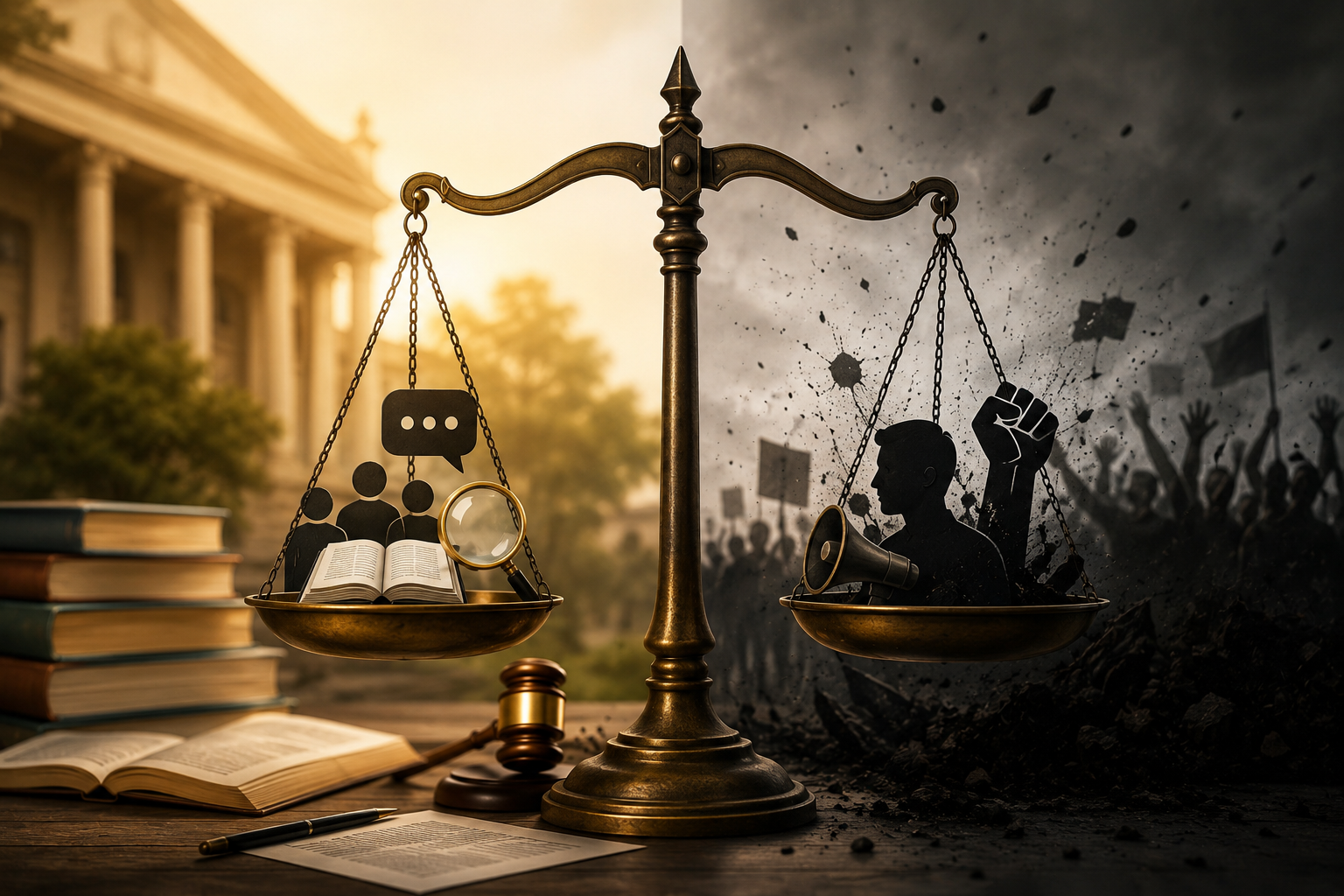
Everyone who holds public office or influences public life in a democracy must be receptive to criticism. Democracies endure because people have the guts to pose challenging issues rather than because they are admired without question. However, the goal of criticism is to fairly and intellectually honestly assess a person's beliefs, policies, choices, and legacy rather than to bring them into disrepute. Absolute virtue or absolute depravity cannot be embodied by any human being. Even the greatest leaders in history had both unquestionable flaws and remarkable accomplishments. Therefore, genuine criticism recognises shortcomings and gives credit where credit is due without glorifying or demonising.
When prejudice takes the place of critique, the issue arises. At that moment, the desire to prove someone guilty at all costs takes precedence over the search for the truth. Private lives are brought into the political rhetorical courtroom when public judgements do not supply enough ammo. That is character assassination, not criticism. In the end, public personalities should be evaluated on their public behaviour, the policies they supported, the institutions they established, and the contributions they made to their country, not on the flaws in their private life. Converting personal failings into political tools is a sign of intellectual bankruptcy rather than historical research. Character assassination is democracy's moral defeat; criticism is its strength.
Has anyone ever seen members of the US Congress get applause for making fun of the personalities of Abraham Lincoln or George Washington? Does South Africa use Nelson Mandela's personal life as political fodder? During election campaigns, does France publicly degrade the heroes of the French Revolution in order to glorify democracy? Most likely, the answer is no. Mature democracies recognise that nations are founded on generations of sacrifice, vision, institutions, and ideals rather than just the current rulers. India needs to develop the same level of political maturity.
The most challenging periods of Britain's history are not ignored. Winston Churchill's colonial policies continue to be the focus of intense historical analysis and persistent criticism, especially his part in the Bengal Famine. He is mostly held accountable by many historians for one of the twentieth century's greatest human catastrophes.
However, there is no personal abuse in the British Parliament. It assesses Churchill by looking at his choices, policies, historical data, and well-reasoned arguments. A mature democracy is characterised by its demand for responsibility without resorting to character assassination. Therefore, a straightforward question requires a straightforward response: Does Churchill receive personal attacks from the British Parliament? Without a doubt, the answer is no.
However, India seems to be entering an unpleasant era where historical discussions are increasingly being replaced by attacks on historical personalities. Ideological differences are no longer deemed adequate. Until a national figure is personally attacked, political competition frequently appears to be lacking. The fact that this rhetoric is no longer limited to social media and political gatherings is even more unsettling. It has now reached the Parliament of India, the Republic's highest democratic forum.
The frequent demonisation of Jawaharlal Nehru has become a disturbing political trend in recent years. Language that compromises both legislative decorum and the nation's respect for its own history is frequently used, whether on social media, at political rallies, in televised discussions, or even within Parliament itself.
But one thing needs to be crystal obvious. There is room for criticism of Jawaharlal Nehru. No democratic leader should ever be exempt from criticism. His foreign and economic policies, how he handled China, how he handled Kashmir, his tendency toward centralisation, and many other choices are all worthy of serious discussion. They should be discussed, in fact. Continuous reevaluation based on facts, logic, and evidence—rather than political expediency, bias, or passion—is the fundamental goal of history.
No government, no leader, and no national symbol can be exempt from examination in a democracy. It is not only a democratic right but also an intellectual duty owed to history itself to critically examine Jawaharlal Nehru's economic policies, foreign policy, approach to China, handling of Kashmir, vision of socialism, or any of his political decisions. Only when history is interpreted with both respect and scepticism does it take on significance. However, there is a boundary that must never be crossed: criticism turns into character assassination the instant it rejects logic and proof.
Unfortunately, the public debate in India is gradually losing that line. These days, political discussions focus more on individuals than on policy. Adjectives are used more often to support arguments than documents. Research is no longer used to address complex historical problems; instead, sarcasm, mockery, and personal insults are used. This is a symptom of intellectual poverty rather than a sign of democratic confidence.
The goal of character assassination is to ruin someone's reputation; the goal of criticism is to find the truth. Questions are raised by criticism; preconceptions are delivered as verdicts by character assassination. Character assassination aims to get retribution on history, whereas criticism aims to comprehend it. Character assassination seeks praise, while criticism demands proof. Character assassination relies on prejudice and catchphrases, but criticism is based on facts and logic. One makes progress by arguing, while the other makes noise. Historical vilification and historical reassessment are not distinct approaches of interpretation; rather, they are diametrically opposed. Because of this, all developed democracies embrace harsh criticism of their leaders but do not allow them to be used as political props.
It should be encouraged if Nehru's political choices are now the subject of intense discussion. After all, the core of historical research is reevaluation. However, history falls way too far into propaganda when the conversation moves from policy to private life, from governance to personal implication, and from recorded facts to dehumanising labels. The manipulation of public memory takes the role of the search for the truth.
Where does such a civilisation end? is the deeper question. Who will be the next target tomorrow if disparaging Nehru's character is now politically acceptable? Will skewed interpretations of Mahatma Gandhi's private life lead to his dismissal? Is isolating convenient moments from Sardar Patel's legacy going to weaken him? Will political expediency also cause Dr B. R. Ambedkar's stature to rise or fall? Will Jayaprakash Narayan, Subhas Chandra Bose, Ram Manohar Lohia, Deendayal Upadhyaya, and Bhagat Singh all ultimately fall prey to the same damaging political rhetoric?
Indian democracy's collective memory is its greatest asset, not just its Constitution. This memory links us to the 1857 uprising, takes us to the Dandi March, lets us experience the suffering of Jallianwala Bagh, and introduces us to the Constituent Assembly members who maintained an unwavering respect for one another despite their strong ideological differences.
Go through the Constituent Assembly's processes. Jawaharlal Nehru and Dr B. R. Ambedkar disagreed on a number of issues. Nehru and Sardar Patel couldn't agree on a number of important issues. Purushottam Das Tandon, Rajendra Prasad, Syama Prasad Mookerjee, and Maulana Abul Kalam Azad all represented different and frequently conflicting perspectives on India. However, their arguments were of such high calibre that disagreement never resulted in shame. They disagreed on concepts without disparaging people. That was the moral code of Indian democracy, not just parliamentary manners.
How far we have strayed from the customs of an established democracy. A political opponent's defeat is no longer deemed sufficient in today's world; instead, there is a growing desire to destroy the historical underpinnings of that opponent. Ideas were once contested. These days, personalities are broken down. History was once studied. History is now used as a weapon. This threatens not just a single political figure but also the moral underpinnings of Indian democracy.
Every country needs to keep in mind that its architects were never perfect. Mahatma Gandhi was not perfect. Jawaharlal Nehru was not perfect. Dr B.R. Ambedkar and Sardar Patel also did. They were people, not gods. However, these were not your typical people. They put aside their own aspirations to make decisions that shaped a country, frequently at their own expense. Their judgements should be carefully examined using documentation, evidence, and reasoned discussion, but political expediency should never come at the expense of their dignity.
Jawaharlal Nehru is no longer the only one facing this problem. It has to do with the democratic culture that will dictate how India chooses to interact with its own history. Mahatma Gandhi, Sardar Patel, Dr. B.R. Ambedkar, Bhagat Singh, Subhas Chandra Bose, or any other person who contributed to the formation of the Republic may be targeted by the same culture tomorrow if disparaging remarks about one nation-builder become politically acceptable today. Coups rarely cause democracies to fall apart suddenly; instead, language corruption causes them to deteriorate over time. The dignity of institutions quickly starts to vanish along with respect in public debate.
It is crucial to realise that appreciating a national leader does not mean endorsing all of their policies. On the other hand, criticising their choices does not give anyone the right to openly disparage their character. Mature democracies assess decisions, policies, and ideas rather than the inherent value of the people who created them. They do not mock history; instead, they reevaluate it.
Nehru's humiliation in Parliament is more than just a slight to a past prime minister. It is an insult to a whole generation that, through sacrifice, hardship, and hope, established the groundwork for an independent India. Nehru is more than just a historical figure; he embodies a whole era. A society eventually loses the entire book of its national memory when it starts pulling apart chapters of its own history. A nation is strengthened by disagreement with its past because it becomes more intellectually honest. When history is disregarded, a country loses its memory.
The history of any country is never shown in black and white. It has both high points of remarkable success and low points of serious errors: triumphant moments and unsuccessful ones. The goal of history is to honestly comprehend the extent of each person's contributions as well as the boundaries of their judgement, rather than to canonise or vilify them.
Because of this, developed and civilised civilisations evaluate their nation-builders using records, proof, and logic rather than derogatory remarks, catchphrases, or bias. They see the distinction between openly denigrating a statesman's character and criticising his policies, just as there is a difference between surgery and murder. While the other destroys, the first aims to heal. One enhances a society's moral well-being, while the other weakens the conscience that democracy is based on.
(Author a doctorate in laws, is a senior lawyer, columnist, and civil society activist.)









[[comment.comment_text]]