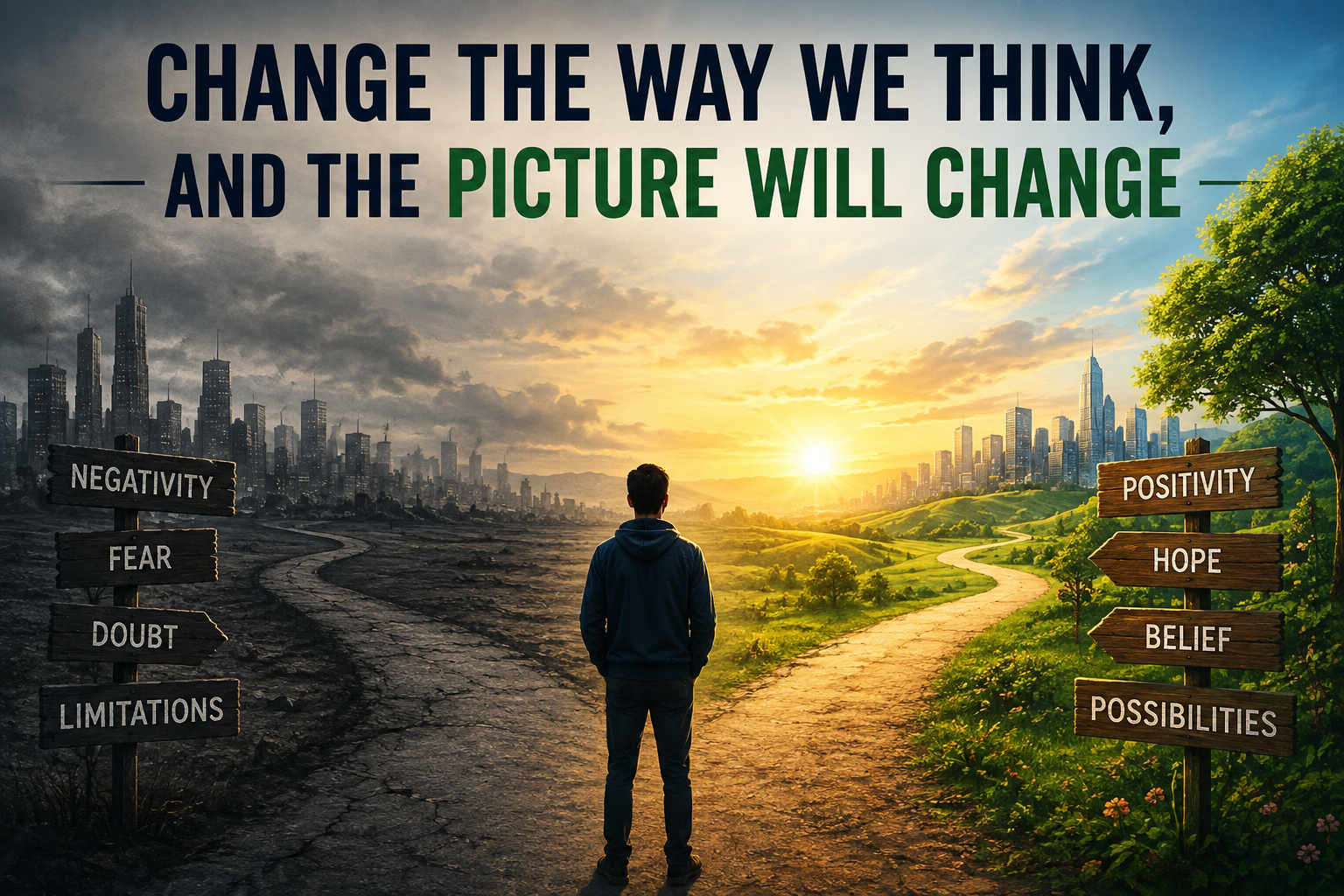
Change the Way We Think, and the Picture Will Change

 1 month, 4 weeks ago
Look at India today. At this juncture in our journey, the biggest question is not what the country is like, but what our thinking is like.
We often say, “The country must change,” “The government must change,” or “The system must change.” But pause for a moment and ask: Who runs the system we want to change? It is we—the people. The same people who vote, who obey or break the rules, and who ultimately determine the direction of society.
So why should we always look for responsibility outside ourselves?
The real change begins here. Transformation does not begin outside; it begins within. Until a person changes his or her own thinking, ideas, habits and mindset, meaningful change in the world around us is impossible.
Understand India Through the Heart
To understand India, one must understand it through the heart. To understand India merely through Parliament, politics or elections would be to look at it through an extremely narrow lens.
India lives in its villages, in the sweetness of its dialects, in the depth of its traditions and in the wisdom of its saints. India is not merely a geographical territory; it is a living consciousness that has flowed continuously for thousands of years.
This is the India that remains united even after being torn apart and does not abandon humanity even in difficult times. Countless calamities have struck it and countless invasions have taken place, yet the soul of India has never been completely destroyed.
That is its real strength—its spirit. This spirit is not confined to any one religion, caste or language. It is a living example of unity in diversity.
To understand India, we need to understand its emotions more than its statistics and read its life more than its books.
The Real Problem Is Not the World, but Our Thinking
The question today is not whether the world has changed. The real question is: Has human thinking changed?
Greed, arrogance, violence, discrimination and the hunger for power are still present. Only their methods have changed. Earlier, these tendencies operated within limited spaces; today, technology and social media have multiplied their reach.
Earlier, a wrong idea might have remained confined to a village. Today, it can spread across the world within minutes. Earlier, spreading a lie required considerable effort; today, a single click can take it to millions.
So understand this clearly: technology is not the problem. The problem is the direction in which we use it. If our direction is wrong, even the most advanced technology can become an instrument of destruction.
We have transformed the external world at extraordinary speed, but forgotten to transform the world within us. This imbalance is one of the greatest challenges of our time.
India’s Ancient Answer Is Still Relevant
India understood long ago that the greatest discovery is not outside us, but within us.
Kabir, Tulsidas, Meera and Guru Nanak expressed the same fundamental truth in different ways: look within yourself.
Kabir taught that before entering a temple or mosque, one must purify the mind. Tulsidas suggested that Rama is not merely somewhere outside us, but lives in the purity of our feelings. Meera made love itself an expression of the divine. Guru Nanak placed service and humility at the heart of life.
This way of thinking has helped India rise again and again after periods of upheaval. When society becomes fragmented, reconstruction remains possible as long as the consciousness within the individual remains alive.
The British Era and the Question of Our Thinking
When the British arrived, they did not merely change the system of governance; they also influenced the way Indians thought.
The great question at the time was: Should India become modern by abandoning its roots? Should it adopt Western ideas completely or preserve its own traditions?
India ultimately chose a path of balance.
Gandhi, Swami Vivekananda and Rabindranath Tagore all emphasized that modernity and Indianness were not necessarily opposites. Gandhi spoke of self-reliance, Vivekananda of self-confidence, and Tagore of humanism.
They reminded us that genuine progress is that which allows us to move forward without losing our roots.
After Independence, the Question Remains
Today, we are politically free. But is our thinking equally free?
Is development merely about money and consumption? Are bigger cars, taller buildings and faster internet the only measures of success? Is distancing ourselves from our language and culture a sign of progress?
If so, then this is not development but a new form of mental slavery.
When we lose our identity, we become merely consumers rather than creators.
What Does the World Expect from India?
The world today is struggling with war, tension, the climate crisis and growing inequality. At such a time, people are looking towards India as a source of a different way of thinking.
“Vasudhaiva Kutumbakam”—the world is one family—is not merely a slogan. It is a philosophy of life. It tells us that the entire world is one family.
But this idea will have meaning only when we practise it rather than merely repeat it. If we discriminate within our own society, then our claim of global unity becomes hollow.
What Is Real Development?
Development is not merely GDP or the construction of bigger buildings.
If material prosperity is accompanied by loneliness, inequality and anxiety, can it truly be called development?
The real question is: Is the human being actually becoming better, or are only his or her comforts increasing?
If an individual possesses everything but has no peace, that development remains incomplete. If a society has wealth but lacks trust, it is a weak society.
Technology Is Only as Good as the Thinking Behind It
Today, we are entering the age of artificial intelligence and advanced technology.
But remember: technology does not determine the direction; human beings do.
If human thinking is not sound, even AI can be directed towards harmful purposes. Therefore, technology must advance alongside ethics and values.
Kabir and Vivekananda remain as relevant today as ever because they spoke not about machines, but about the human soul.
It Is Time to Question Ourselves
India today stands at a crossroads where it must ask itself some fundamental questions:
Who are we?
Where are we going?
And what do we want to become?
Do we want to be merely consumers, or also creators?
Do we want to remain merely followers, or become leaders and guides?
The answers to these questions will determine our future.
Change Does Not Come Only from the Top
History tells us that great change never comes merely through governments.
It first takes place within individuals and then spreads through society.
If people do not change, the idea of changing the world remains only a dream. Laws can be changed, but habits do not change until thinking changes.
Awakening Is the Real Transformation
India does not need to be reinvented as much as it needs to be awakened.
Its strength already exists. What is needed is to recognize it.
Bhakti taught us the power of connection and devotion. The great periods of social and cultural awakening gave us self-confidence. And today, we have another opportunity to rediscover ourselves.
In the end, the message is very simple:
Before trying to change the country, change the way you think.
Because when our thinking changes, the country will begin to change on its own.




[[comment.comment_text]]