Bharuch’s Sujani: A Rare Handloom Tradition in Need of Recognition and Revival

 2 months, 2 weeks ago
On Handloom Day, our country’s textile heritage is celebrated with joy and pride. But unfortunately, even as we prepare to cheer and pay tributes, many great handicrafts fall silent. Bharuch district is the home of Sujani weaving, done on specialized handloom, one such rarely unearthed craft thatgoes unnoticed by the society intended to preserve it.
Sujani is not a simple quilt weaving. It is surely proof for the skills and discipline of the artisans, as well as the knowledge passed-down from the previous generations. The process of Sujani involves the traditional technique of handloom which deserves to be held accountable. The preservator of the craft heritage of India, should not forget the name Sujani.
A heritage that is slipping away
Sujani of Bharuch is tradition that ought to have been a pride. It is something very casually used by the people. It has beengranted the status of a GI product, yet its status is so insecure that it drives one to feel ironic about the whole situation. A craft can be correctly certified but still be neglected socially. That is the tragedy of Sujani.
Practiced by a select few craftsmen, this ancient art form seems to be heading towards extinction. Young people consider this type of work too labour-intensive and low-paying. That's not only a job change; it is a process of cultural de-development. When an artisan parts with his trade, he does not just cease to work; he takes with him not only memories but an entire way of life.
The tragedy is deeper because Sujani is not a craft that lacks merit. It lacks visibility. It lacks consistent demand. It lacks the design support and market imagination that could help it survive in a changing world. In a country that speaks so often of “vocal for local,” crafts like Sujani continue to wait for that promise to become real.
The loom as an instrument of genius
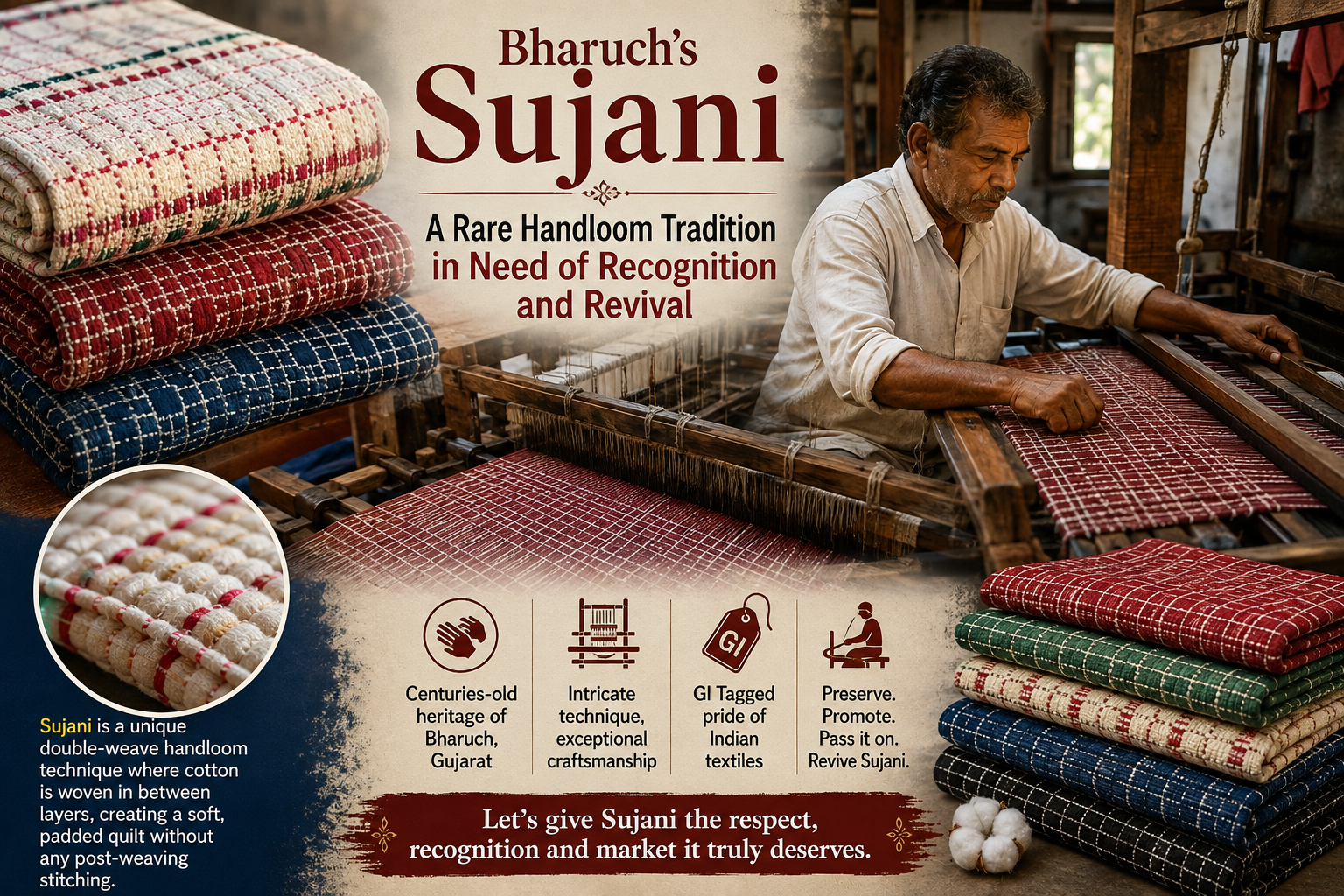
The uniqueness of Sujani lies in its exceptional technique in weaving. The process is not an ordinary process of weaving but a double-weave process characterized by the insertion of cotton during weaving which fills small squares of the woven product, giving rise to a padded quilt without any kind of post-weaving stitching. The softness, in fact, is determined at the very first stage of weaving.
Perhaps what you may regard as merely trivial information is something that showcases extensive skill in artistry. Not only does the artisan make fabric, they create warmth and texture and translates it into shape by means of weaving. As for Sujani, weaving here is more than just a handwork technique the loom in sujani is a tool as well as a tool for imagination.
The fabric is reversible, double-faced, made with multiple warp and weft yarns. Even its traditional colour palette white, red, green, brown, blue and black speaks of restraint, balance and an older aesthetic sensibility. A traditional Sujani quilt is not flashy. It is grounded, dignified and deeply human. Its beauty lies in precision, not display.
Why neglect is unacceptable
The falling apart of the heritage of Sujani is not limited to artisans alone. It is a cultural demise. When a beautiful art form falls from grace due to lack of awareness and ineffective design changes, it shows how far we have fallen in appreciating our own riches.
The marketplace is known to appreciate that which comes in quickly, is in vogue and is cheaply produced. In the case of Sujani, this could not be truer. The company stands for slow making, craftsmanship, and high-quality handmade items. Today, with standardization of products taking over from the above-mentioned characteristics, Sujani presents another conception of value, based on time, handling, and tradition.
In order for a craft to survive, emotion alone is not enough for it to thrive. It’s up to individuals who patronize the craft to be proactive. Designers must work in a sensitive manner. Organizations must provide help to artisans as know-how instead of charity. And the law should stop regarding the craftsperson’s work as just an ornament. Sujani needs to be treated with respect in the market, and not only during events.
A needed push forward
This is why the work of Ms. Pooja Patel is significant. Ms. Pooja Patel, a local resident under the guidance of Prof. Madhu Sharan has taken it up as the Ph.D. research topic at the Maharaja Sayajirao University of Baroda. She collaborates with these skilled craftspeople to showcase Sujani weaving to an audience beyond its local community, experimenting with the elements to provide a range of products suitable to the present market and consumers.
Ms. Pooja has made simple but important arguments in favour of this handloom art, stating that it needs to be preserved for which consumer appreciation towards this culturally rich heritage is necessary. Further, it is reiterated that innovations in design and market linkages need to be improved, thusartisans will be able to explore larger consumer market for their craft while preserving its essence.
That is exactly the kind of thinking Sujani needs, thepartnership. Not nostalgia, but strategy. Not occasional admiration, but sustained public support.
Thus, on the occasion of Handloom Day, Sujani must not merely be referred to as a side note in the context of the craft heritage of Gujarat. It should be understood as a warning about the tendency for exceptional crafts to disappear if we ignore them, as well as a promise that with proper appreciation these crafts can survive. The Sujani of Bharuch is not looking for applause. It is looking for its rightful place in the living culture of the country.
(The author, currently pursuing a Master’s degree in Journalism from Maharaja Sayajirao University of Baroda, is the founder of blogging site: dumpyourt-houghts.wordpress.com)










[[comment.comment_text]]