Underage Driving: A Preventable Threat on India’s Roads
 an hour ago
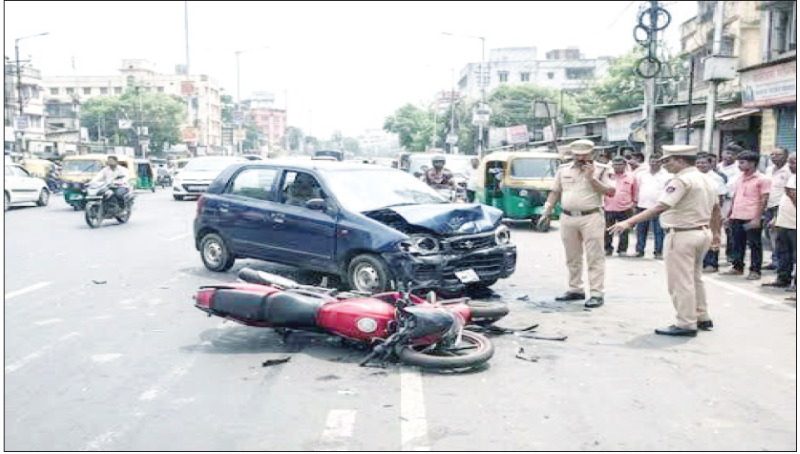
A recent case involving the 17-year-old son of an Accident Claims Tribunal judge has once again brought this issue into sharp focus. The teenager allegedly drove a Mercedes-Benz into the scooter of Jaybalakrishnan, a 55-year-old street food vendor in Kochi, killing him.
India’s road safety crisis is not merely a consequence of poor infrastructure, traffic congestion or inadequate enforcement. It is also a reflection of reckless driving, disregard for the law and a disturbing tendency among some parents to allow underage children to take the wheel. When privilege overrides responsibility, innocent road users pay the price, sometimes with their lives.
A recent case involving the 17-year-old son of an Accident Claims Tribunal judge has once again brought this issue into sharp focus. The teenager allegedly drove a Mercedes-Benz into the scooter of Jaybalakrishnan, a 55-year-old street food vendor in Kochi, killing him. The accident occurred early in the morning. The minor was arrested and subsequently granted bail by the Juvenile Justice Board, reportedly in view of the absence of any previous criminal record. He faces allegations of culpable homicide not amounting to murder and rash and negligent driving.
A case was also registered under Section 199A of the Motor Vehicles Act, which provides for action against the guardian or vehicle owner when a motor vehicle offence is committed by a minor. The provision prescribes imprisonment of up to three years and a fine of ₹25,000, besides cancellation of the vehicle’s registration for 12 months, subject to the applicable legal provisions. Reports suggest that the boy had been allowed by his father to drive without a valid licence.
The case raises an uncomfortable question: how can a parent entrusted with upholding the law permit a minor to operate a car on public roads? The position of the parent makes the issue particularly sensitive, but the principle involved must be universal. Neither wealth nor professional status should confer immunity from accountability.
The victim’s family has demanded the arrest of the father as well as the suspension of the judge, expressing concern that his position could influence witnesses. The police reportedly acted amid protests by the victim’s children. Kerala’s Home Minister has maintained that the law must not distinguish between the rich and the poor.
The identity of the minor must be protected in accordance with juvenile justice law. However, the principle of protecting a child’s identity should not become an excuse for obscuring the accountability of adults. The law must be applied fairly, transparently and without regard to social standing.
When the Young Take the Wheel
Underage driving is an increasingly disturbing phenomenon, particularly in affluent neighbourhoods of metropolitan cities and state capitals. Cars and two-wheelers are sometimes placed in the hands of teenagers who lack the legal eligibility, training and maturity required to drive safely. Such incidents may go unnoticed when no serious injury occurs, but the absence of immediate consequences should not be mistaken for harmless behaviour.
India’s roads are already dangerously congested, accommodating a bewildering mix of cars, buses, trucks, motorcycles, scooters, cycles, pedestrians and stray animals. In this challenging environment, even an experienced driver must exercise constant caution. An inexperienced teenager driving without a licence can turn an ordinary journey into a fatal encounter.
According to the figures cited for 2024, India recorded approximately 1.83 lakh road accidents resulting in deaths. The scale of the tragedy is staggering: road crashes claim hundreds of lives every day. Driver-related errors, including speeding, distraction, dangerous overtaking, drunk driving, fatigue and disregard for traffic signals, are among the major factors contributing to road accidents. Poor road conditions and unsafe pedestrian practices can further increase the risks.
Underage driving adds another avoidable danger to an already alarming situation. It is particularly irresponsible when parents knowingly allow their children to drive because they regard it as a mark of independence, confidence or social privilege.
A Pattern of Tragedies
Several incidents reported in Delhi illustrate the consequences of this recklessness.
In March 2024, a 17-year-old polytechnic student allegedly driving a car fatally ran over a woman in Ghazipur and injured nine other people. That same month, three people were reportedly seriously injured in Geeta Colony when a car driven by a minor struck them. In December 2024, a 17-year-old allegedly hit several people, including a seven-year-old boy, in Adarsh Nagar.
The victims have included children barely old enough to walk. In Alipur, an 18-month-old boy playing outside his home died after being run over by a car allegedly driven by a 15-year-old. In another heartbreaking incident, a 15-year-old reportedly driving a Hyundai Venue crushed an infant girl in Paharganj on March 31, 2025.
These are not merely statistics or isolated news reports. Each incident represents a family suddenly plunged into grief, a child deprived of a future and a household potentially stripped of its principal breadwinner. The consequences extend far beyond the immediate scene of a crash.
What makes such tragedies particularly distressing is that many are preventable. A child who is not legally eligible to drive should never be given access to a vehicle for use on public roads. Parents who facilitate such driving cannot escape their moral responsibility by describing it as youthful enthusiasm or an innocent mistake.
One Law for the Privileged and the Poor
Another concern is the perception that money and influence can affect the course of justice. Vehicles involved in accidents may be seized during investigations, but their subsequent release can generate questions about whether procedures are being applied consistently. Meanwhile, vehicles belonging to less influential people may remain in police compounds for prolonged periods.
Such perceptions undermine public confidence. The police and investigating authorities must follow transparent procedures in the seizure, inspection and release of vehicles, ensuring that evidence is preserved and that no accused person receives preferential treatment.
The law already provides a framework for holding guardians and vehicle owners accountable when minors commit motor vehicle offences. What is required is consistent enforcement, prompt investigation and a clear message that providing a vehicle to an underage driver is not a trivial parental lapse.
Schools, residential welfare associations and local authorities can also contribute by discouraging underage driving and reporting dangerous practices. Parents must understand that purchasing an expensive car for a teenager does not make that teenager capable of handling it responsibly.
Headlights That Endanger Lives
Underage driving is not the only preventable hazard on Indian roads. Excessively bright headlights, improperly aligned LED lamps, decorative lighting and the misuse of high beams can seriously impair the vision of oncoming drivers.
Modern lighting technology can improve visibility when properly designed and used. However, excessively intense or poorly adjusted lights can dazzle motorists, particularly those riding two-wheelers or cycling on inadequately illuminated roads. A momentary loss of visibility can result in a head-on collision, a sudden fall or a vehicle veering off the road.
Regulatory authorities must ensure compliance with prescribed vehicle-lighting standards and take action against illegal modifications and the improper use of high beams. Drivers, too, must recognise that road safety takes precedence over appearance and fashion.
A vehicle is not a display of status; it is a machine capable of causing grave injury when operated carelessly. Technological advancement must serve practical needs and prevailing road conditions rather than become an instrument of ostentation.
Road Safety Requires More Than Awareness Campaigns
India has observed National Road Safety Week in January for decades, yet the persistence of fatal crashes suggests that awareness campaigns alone are insufficient. Road safety requires sustained enforcement, driver education, safer infrastructure and a change in public attitudes.
Speeding, mobile-phone use while driving, drunk driving and failure to observe traffic rules must attract consistent penalties. Helmet use among two-wheeler riders and the wearing of seat belts must become non-negotiable habits. Licensing procedures must ensure that drivers possess the necessary competence before they are permitted on public roads.
Equally important is the enforcement of the minimum legal driving age. Parents who knowingly permit minors to drive must face the consequences prescribed by law. Vehicle owners should not be allowed to evade responsibility merely because the person behind the wheel is their child.
The government must also strengthen road engineering, pedestrian facilities, lighting, traffic management and enforcement against dangerous vehicle modifications. Compensation for accident victims and their families should be processed fairly and without unnecessary delay. For a family that loses its principal earner, prolonged legal proceedings can compound an already devastating tragedy.
The Responsibility Begins at Home
Road safety is a collective responsibility, but the first lesson must begin at home. Parents cannot demand discipline from society while disregarding the law within their own households. Allowing a minor to drive is not an act of trust or affection; it is an irresponsible decision that places strangers at risk.
The deaths of innocent pedestrians, roadside workers and young children should compel us to reconsider our casual attitude towards traffic violations. Every road user has a right to travel without fearing that another person’s recklessness will destroy their life.
India needs stronger enforcement, accountable institutions and responsible citizens. Above all, it needs a social understanding that the privilege of owning a vehicle carries an obligation to use it lawfully and safely.
A single moment of negligence can devastate several lives. No journey is worth that price, and no display of wealth or status can justify it. The real measure of progress is not how powerful our vehicles have become, but how responsibly we use them.
(Author, a retired civil servant, formerly served as the Chief Secretary in the state government of Sikkim. He can be reached on email: alok.secyskm@gmail.com)






[[comment.comment_text]]