Nepal’s Incomplete Democracy: Caste Hierarchies Confront Gen-Z Pressure

 1 year, 1 month ago
Nepal’s multiparty democracy, restored in 1990 and declared a federal democratic republic in 2008, promised broad inclusion across its diverse society. Yet, more than three decades later, power remains heavily concentrated in the hands of hill Brahmin and Chhetri elites. Madhesis, indigenous peoples, Dalits, and women still suffer from systematic underrepresentation.
Meanwhile, a young and digitally connected generation is becoming increasingly impatient, demanding that democracy deliver not just elections but fairness, representation and accountability. Recent protests and surveys show that Nepal is at a tipping point—its traditional caste-based power structures face serious challenge, and how they respond may decide whether Nepal’s democracy remains truly “incomplete” or finally begins to realise its promise.
Nepal’s elite capture of power is obvious in its leadership. Since 1990, all 13 prime ministers have hailed either from Brahmin (10) or Chhetri (3) hill communities. Despite making up roughly 35 percent of the population, no Madhesi has ever served as prime minister. Indigenous communities, who constitute about 37 percent of the population, are represented in the parliament but rarely in any decision-making leadership position. Dalits (approx. 13 percent) and women similarly remain marginalized—however many symbolic quotas or constitutionally mandated seats exist, substantive influence remains elusive.
This political reality coexists with strong indicators of youth dissatisfaction. A survey by Friedrich-Ebert-Stiftung Nepal, “Young People, Politics and Elections” (2024), which sampled 1,080 young people (18-40 years old) nationally, found that less than 40 percent believed the country was moving in the right direction, while about two-thirds thought it was going wrong. The same survey reported that 83 percent of respondents felt political parties or leaders were chiefly occupied with their own petty or personal interests. Youth in socially and economically disadvantaged provinces — particularly Madhesh, Karnali, Gandaki — were especially critical.
The survey also showed that although young people are more politically aware, that has not translated fully into active participation. Many reported that they would prefer “new and fresh” candidates, even if those candidates are unlikely to win. Voting turnout among youth was variable: in the 2022 local elections and provincial/federal elections, youth participation increased, especially at local levels, but many young people did not vote due to logistical obstacles (e.g. lack of voter ID cards).
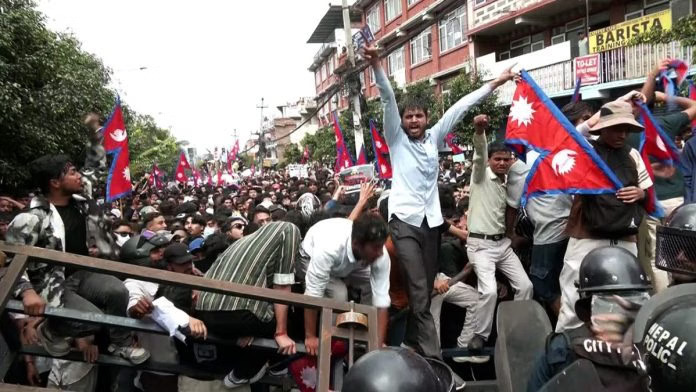
Beyond surveys, the recent “Gen-Z protests” of September 2025 offer vivid evidence of how grievances have escalated into mass mobilization. These protests were triggered by a government ban on 26 major social media platforms (including Facebook, X [formerly Twitter], YouTube etc.), but rapidly turned into broader anti-corruption, anti-nepotism, and pro-transparency demonstrations.
At least 19 people were killed when police fired on protesters, with more than 1,300 people injured across the country. Over time, death toll estimates rose (51 in some reports), reflecting the intensity of the confrontations. Parliament was stormed, multiple buildings set ablaze; the government lifted the social media ban, and the prime minister resigned.
These events showcase three key realities: first, youth are no longer content with symbolic representation; second, digital restrictions are being perceived as threats to voice, not just regulation; third, when protests escalate, force tends to become part of the state response, with deadly consequences.
Nepal is not alone in this struggle. Across South Asia, youth disillusionment, caste and class exclusion, and dynastic politics are common features, but the intensity and forms differ. In Bangladesh, protests like the “Monsoon Uprising” (July 2024) saw youth turning to Facebook and other digital platforms to contest authoritarian overreach, corruption, and social stagnation. Researchers found that online symbols, memes, and collective identity played a powerful role in mobilization. In India, though not recent protests of the same scale, there are continuing debates about caste inequality, reservation policies, and the dominance of political dynasties; and surveys show that many young Indians distrust political parties, considering them corrupt or self-serving. In Pakistan, youth support for populist, outsider, or anti-status-quo leaders has grown.
What sets Nepal’s episode apart is how swiftly a social media-policy issue fused into a broader political eruption, how widespread the youth demand, and how visibly violent the government’s response was.
The coalescence of youth grievance around corruption, nepotism, economic opportunity, and exclusion is particularly dangerous for stability if ignored. In Nepal’s case, social media bans triggered not only protests but also demands for systemic change: people want political accountability, reforms in leadership, more voice for marginalized communities.
The surveys show youth believe that political parties do not reflect public concerns: large majorities say leaders act in their own interest rather than those of citizens. For example, in the FES survey, only about 42 percent of youths felt political parties and leaders represent concerns of grassroots people; almost half disagreed. Almost 3 in 4 youth said they would vote for new/fresh candidates even if they stand no chance of winning.
At the same time, Nepal’s constitutional and policy structures do provide some tools for inclusion: quotas for women, reserved seats for marginalized groups, decentralised governance (local and provincial), and the National Youth Policy. Surveys show these are valued by many youths, but implementation is uneven. Youth in provinces like Madhesh, Karnali etc. often feel left out in practice even if nominal rights exist.
Administrative hurdles—lack of voter cards, political party gatekeeping for candidacy, lack of access to resources—remain.
Economically too, youth frustrations are real. Unemployment, limited opportunity in rural areas, and the need to migrate for work are longstanding challenges.
Though precise national survey figures on unemployment by caste and region are patchy, anecdotal and qualitative studies (including youth-led movements) repeatedly cite joblessness as among the top concerns along with corruption and fairness. In the FES survey, “economic prosperity,” “education,” “health,” and “good governance” were among the top‐ranking priorities for youth.
Nepal thus stands at two diverging paths: one where old elites double down, offering cosmetic reforms and token appointments, preserving caste hierarchies; the other where democracy deepens, with marginalized communities gaining real influence, youth becoming part of decision-making, and governance becoming more transparent and accountable.
If youth expectations are met—improved representation, meaningful policies related to jobs, education, rights—then Nepal can consolidate a more legitimate democratic order. If not, the risk is alienation, frequent protest cycles, and possibly destabilization.
In conclusion, Nepal’s experiment with democracy has been vigorous but incomplete. Data from recent large-scale youth surveys shows widespread dissatisfaction with leadership and direction, combined with strong appetite for change.
The Gen-Z protests are not isolated events, but symptomatic of deeper systemic grievances. Comparative regional examples show that while many democracies in South Asia struggle with exclusion, Nepal’s moment is distinct in magnitude and immediacy. Whether its political elite adapt—or are forced to—remains to be seen. But the evidence makes one thing clear: democracy without inclusion is no longer accepted without question in Nepal.
(Writer, a Ph.D. in Sociology, is a well-recognised author and columnist. For past over three decades, he has served in various administrative and academic capacities at Banaras Hindu University.)






[[comment.comment_text]]