Politics of Language: Uniting Against Hindi “Imposition”

 1 year, 3 months ago
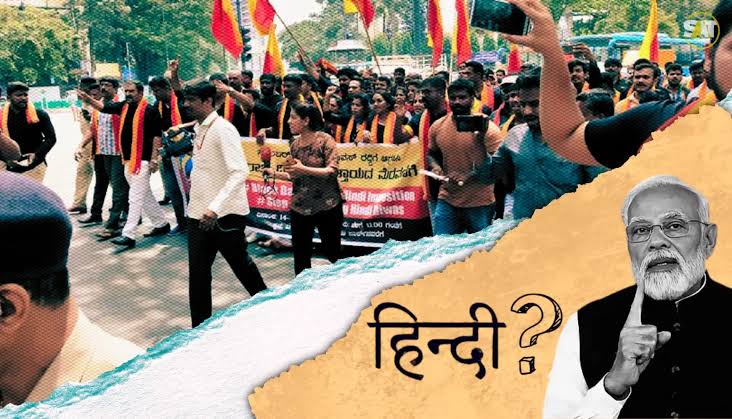
Language is an indispensable and powerful tool in politics, deeply intertwined with the formation, governance, and spirit of a state. Language in politics is far more than just a means of communication; it actively shapes public opinion, frames issues, constructs political identities, and mobilizes support. it is in this context that Tamil Nadu Chief Minister M.K. Stalin’s warm welcome to the reunion of Uddhav Thackeray and Raj Thackeray, hailing their joint stance against the three-language policy in Maharashtra as a significant victory in the broader fight against what he terms "Hindi imposition” holds immense significance.
Stalin, who leads the DMK and has been a leading voice in opposing the National Education Policy's three-language component, views the Maharashtra government's withdrawal of orders on its implementation as a vindication of his state's long-standing struggle for linguistic rights.
The Thackeray cousins, Uddhav Thackeray (Shiv Sena - Uddhav Balasaheb Thackeray) and Raj Thackeray (Maharashtra Navnirman Sena), publicly shared a stage for the first time since 2005 at a 'Voice of Marathi' rally. This event celebrated the Maharashtra government's reversal on the three-language policy, which had drawn fierce opposition. The cousins embraced and declared that their past "distance" had been eliminated, showcasing a united front on a key linguistic issue.
In a post on X, Stalin criticised the Union Government for allegedly acting "lawlessly and anarchically" by linking funds to the adoption of Hindi as a third language in Tamil Nadu schools. He noted that the BJP, despite being in power in Maharashtra, was compelled to retract its policy due to public outcry.
Stalin particularly praised the powerful oratory of Uddhav and Raj Thackeray, highlighting Raj Thackeray's pointed questions regarding the third language taught in Hindi-speaking states like Uttar Pradesh and Rajasthan, and challenging the rationale behind "imposing" Hindi on progressive non-Hindi speaking states.
Raj Thackeray had also questioned why Hindi had not facilitated economic progress in Hindi-speaking states, leading to migration to non-Hindi speaking regions. Further, Stalin criticized the Centre for its "vindictive stance" of withholding Rs 2,152 crore in funds under the integrated education scheme (Samagra Shiksha Abhiyan) from Tamil Nadu, linking it directly to the state's refusal to implement the new education policy.
Language remains a potent tool for political mobilization. Regional parties often champion their local languages, sometimes in opposition to the central government's language policies, to consolidate their political base. The unity of regional forces to protect their language and culture is absolutely a fair proposition, but to weaponise the same against Hindi, which is national official language under Article 343 (1) of the Constitution, or for that matter any other language, is engaging into a dirty populist politics. India, a nation of unparalleled linguistic diversity with over 1,600 mother tongues and 22 officially recognized languages, presents a fascinating symbolism of our cultural diversity. Regional parties by no means should be encouraged to play with the diverse, inclusive and syncretic culture of world’s largest democracy.




[[comment.comment_text]]