CEC Kumar’s Ultimatum to Rahul Gandhi: Threat, Defiance, or Duty?

 1 year, 1 month ago
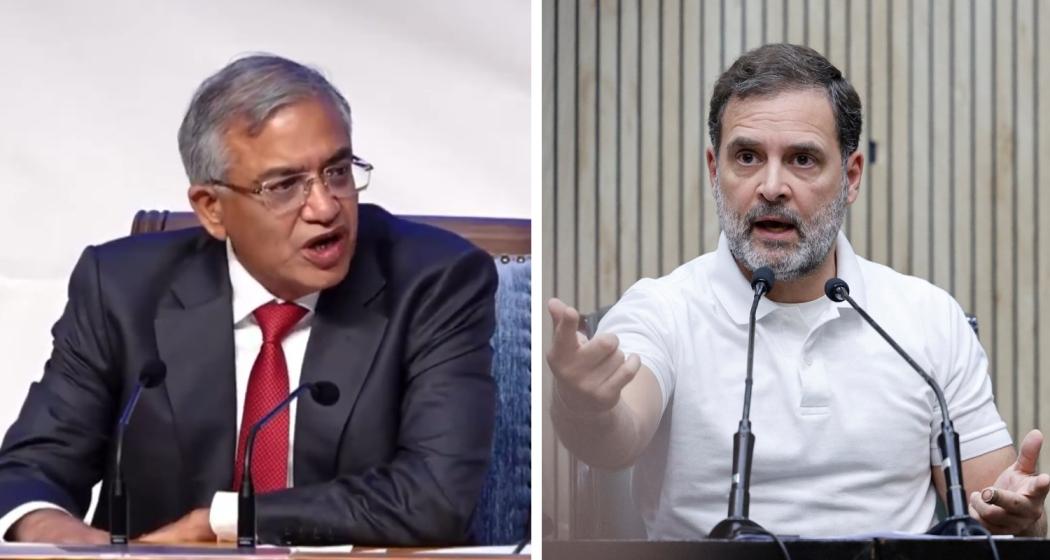
Chief Election Commissioner (CEC) Gyanesh Kumar's statement at the press conference on 17 August 2025, giving Lok Sabha Leader of Opposition (LoP) Rahul Gandhi seven days to submit an affidavit substantiating his electoral roll “vote theft” allegations or publicly apologise, has triggered a national controversy. Critics question whether the CEC has violated protocols, crossed ethical “red lines,” and exposed himself to parliamentary action—including possible impeachment.
This analytical piece examines:
- Whether the CEC’s remarks constitute a threat, defiance, or insubordination.
- If the CEC has breached constitutional boundaries by issuing a public ultimatum.
- The legal avenues for parliamentary scrutiny, such as show-cause notices or impeachment.
- The wider consequences for democratic institutions and norms.
The Statement: Context and Content
CEC Gyanesh Kumar, flanked by two Election Commissioners, directly challenged Rahul Gandhi to provide, within seven days, credible proof of his “vote theft” charges in the form of a sworn affidavit—or apologise, as his claims would otherwise be considered baseless. Kumar stated, “There is no third option,” and declared that misleading voters with false allegations is a subversion of the Constitution. He referenced the Election Commission's strict protocols for correcting voter rolls and emphasized that post-deadline allegations are strictly “political statements”.
This intervention follows opposition claims of large-scale deletions and irregularities in Bihar’s voter list, stoking pre-existing tensions about ECI impartiality.
The Appointing Power: LOP’s Role and Its Significance
Since the Supreme Court’s landmark decision in 2023, the process for appointing the CEC and Election Commissioners involves a Selection Committee comprising the Prime Minister, a Union Cabinet Minister, and the Leader of Opposition (LoP) or largest opposition party leader in the Lok Sabha.
While the President formally makes the appointment, the LoP’s endorsement plays a direct role in the process. This institutional arrangement is designed to reinforce the ECI’s independence and safeguard it against majoritarian excess or executive overreach.
Thus, when the CEC issues an ultimatum to a Selection Committee member—especially one representing the opposition—it is inherently fraught territory. It invites the question of hierarchy versus parity and the expectation of mutual respect between constitutional offices.
Did the CEC Cross the “Red Line”?
CEC Kumar’s combative tone, singling out a Leader of the Opposition and prescribing an ultimatum (“affidavit or apology”), goes beyond the Election Commission’s normal practice of impersonal, procedural communication. By framing Rahul Gandhi’s statements as “subversion of the Constitution” and “lies,” and demanding a binary outcome, Kumar may have appeared to threaten, defy, or disrespect an appointing authority.
However, from the ECI’s standpoint, the CEC justified the demand as a shield for electoral processes and public faith in India’s democratic machinery. He maintained that baseless allegations undermine the voter’s credibility and Election Commission’s trustworthiness.
Legal Recourse: Can Parliament Act Against the CEC?
Whether this oversteps constitutional bounds depends on whether the CEC’s language and conduct violate norms of office, amount to “misbehaviour” or incapacity as defined under relevant statutes, or injure the dignity of Parliament and its members.
No statutory provision currently allows Parliament to issue a “show-cause notice” to the CEC directly for statements made in a press conference. Parliamentary convention generally would expect a formal petition or privilege motion for matters impinging upon institutional dignity, but such actions are rare and largely symbolic.
Impeachment: The Process and Grounds
The CEC’s removal is governed by Article 324(5) of the Indian Constitution, prescribing identical grounds and procedures as for a Supreme Court Judge. Removal must be predicated on “misbehaviour or incapacity” and conducted via an elaborate, quasi-judicial process:
- A notice of motion for removal must be signed by at least 100 Lok Sabha or 50 Rajya Sabha members.
- The motion, if admitted by the Speaker/Chairman, leads to an inquiry by a committee comprising a Supreme Court Judge, a High Court Chief Justice, and a distinguished jurist.
- If the committee finds grounds to sustain charges, two-thirds majority approval in both Houses and Presidential assent are required to complete the removal.
India’s opposition (I.N.D.I.A. bloc) is considering an impeachment motion against CEC Kumar, although precedent shows such initiatives face procedural obstacles and political contest.
Threat, Defiance, or Justified Response?
1. Arguments for Threat/Defiance
- Direct ultimatum to a LoP who is an appointing authority reflects disregard for institutional parity.
- Publicly demanding an apology or affidavit could be construed as coercive and infringing upon an opposition leader’s parliamentary privilege or freedom of expression.
- The combative and moralizing tone suggests possible bias or lack of decorum, weakening confidence in the ECI’s impartiality.
2. Arguments for Justified Response
- The CEC may have a duty to defend electoral integrity and prevent misinformation.
- If allegations are unsubstantiated, the CEC is entitled to seek either proof or withdrawal, upholding public trust in the EC and the electorate.
- Election Commission rules do provide avenues and timeframes for challenging electoral rolls, and ignoring procedures undermines due process.
-Legal and Constitutional Consequences
- The bar for “misbehaviour” or “incapacity” is very high; not every breach of etiquette or questionable language meets the threshold for removal.
- Political pressure for impeachment may be a symbolic warning, but legally, mere strong words by the CEC may not amount to impeachable conduct.
- Were the CEC to refuse meaningful engagement with parliamentary oversight, or repeatedly act with shown malice, that may warrant deeper inquiry.
What Does This Mean for India’s Democratic Institutions?
CEC Gyanesh Kumar’s remarks have sparked critical debate on the conduct of constitutional authorities. While the LoP plays a key role in the CEC’s appointment, the Election Commission enjoys constitutional insulation from political retaliation to preserve its independence.
The current controversy highlights the fine line between forthright institutional defence and the risks of personalized confrontations that erode mutual respect. Parliament’s option to pursue impeachment exists, but the legal threshold remains high. The episode should prompt greater reflection on constitutional boundaries, democratic etiquette, and institutional checks—and perhaps a reassertion of norms governing the behaviour of both elected representatives and office-holders.
India’s democratic vitality depends not just on rules and processes, but on the restraint and dignity with which its institutions interact and defend their remit. The outcome of this clash will have far-reaching implications for public perceptions of both the ECI and the political opposition, and the ultimate health of the Republic.
(Author is a former member of the history faculty at St. Xavier’s College, Mumbai.)










[[comment.comment_text]]