The Actor Who Carried the Theatre Within Him

 2 hours ago
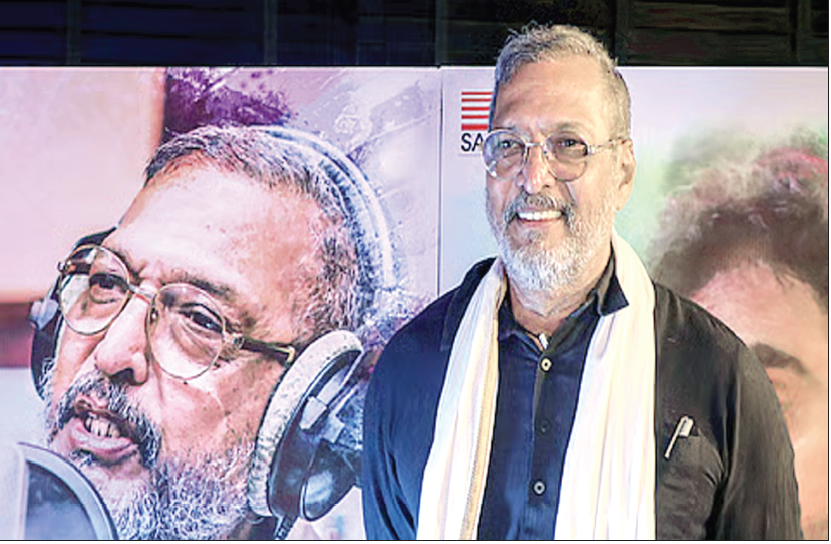
Some actors merely enter a frame. Nana Patekar inhabited it. Whether he played a gangster, a policeman, a soldier or a grieving father, one sensed that the man had lived a whole life before the camera found him. With his passing at 75, Hindi and Marathi cinema have lost one of the last great actors forged in a room full of strangers, in real time, with no second take to redeem a faltering moment.
Born Vishwanath Patekar in Murud-Janjira, he studied at the Sir J.J. Institute of Applied Arts and rose through Marathi theatre, where the stage was a school of discipline as much as of performance. That tradition is steeped in literature. It reveres the written word, treats the pause as an instrument, and demands that an actor command a hall without a microphone or a close-up. Patekar absorbed all of it, and when he arrived in cinema with Gaman in 1978, he carried that grammar with him.
His most conspicuous inheritance was his mastery of dialogue. Patekar never merely delivered a line, he wielded it. He could stretch a syllable until it quivered, then sever a sentence mid-breath and let silence finish the thought. Few actors in Hindi cinema have understood rhythm so instinctively.
A speech might begin in a murmur and end in a thunderclap, and the audience leaned in at the murmur because it sensed what was gathering behind it. That is the unmistakable mark of the stage. A theatre actor has no editor to repair his timing, so he learns to hear a room breathe, and Patekar always seemed to be listening to an audience, even in an empty studio.
Then there was the intensity, which the casual viewer often mistook for volume. In truth, his finest work was frequently restrained and coiled, a slow simmer that made one dread the boil. In Parinda he was menacing and magnetic, a performance that earned him a National Award. In Krantiveer, the fury of an ordinary man turned incendiary brought him the National Award for Best Actor. In Prahaar, which he also directed, he channelled his own military discipline into a film about duty and rage.
Years later, in Ab Tak Chhappan, he portrayed an encounter specialist not as a swaggering hero but as a weary, morally ambiguous man, and in doing so set the template for how the Hindi screen would depict the policeman for a generation.
What distinguished Patekar from the merely forceful was that his characters seemed thoroughly lived-in. Stage actors repeat a role night after night and must therefore discover fresh truth in unchanged words, and that habit shows. His men carried histories, old grudges, private sorrows, a favoured way of sitting, a weariness in the shoulders. Even in the comic roles of his later years, such as the endearing don Uday Shetty in Welcome, there lay a worn gravity beneath the laughter that made the humour land harder. He could be funny precisely because he was never frivolous.
Nor did he ever become a conventional star, which was, paradoxically, his great strength. He disdained the machinery of celebrity, spoke with notorious candour, and appeared perpetually indifferent to being liked. That bluntness occasionally cost him, and his temper made headlines more than once. Yet it also kept his work incorruptibly honest. In an industry that prizes polish, Patekar was gloriously unvarnished, and audiences trusted him for it.
The same conviction guided his life beyond the screen. Through the Naam Foundation, his support for farmers’ families and his bond with the armed forces, including his honorary army rank and service during the Kargil period, he treated compassion as an obligation rather than a publicity exercise.
And yet, for all his Bollywood renown, Marathi theatre and cinema remained his spiritual home. This is why Natsamrat feels less like a role than a homecoming. In Mahesh Manjrekar’s 2016 film, adapted from Kusumagraj’s celebrated play, Patekar played Ganpatrao Belvalkar, a towering Shakespearean stage actor who retires at the zenith of his fame and discovers that the thunder of applause is poor preparation for the hush of ordinary life. It is the story of a man who has lived so long inside other people’s words that he has forgotten how to live in his own.
To watch Patekar in that role was both uncanny and deeply moving. Here was a man who had devoted his life to the stage and the screen, portraying a man undone by existence beyond the spotlight. He did not render Belvalkar as grandeur alone. He gave us a figure at once vain and tender, obstinate and bewildered, and finally broken.
The great soliloquies, which a lesser actor might have reduced to showpieces, became confessions. One could scarcely tell where the character’s heartbreak ended and the actor’s understanding of his own profession began. For many admirers it remains his finest hour, and it now carries a poignancy he could never have intended.
His honours, among them three National Film Awards and the Padma Shri, tell only part of the story. His true legacy is a standard: proof that a performance can be built from breath, pause, conviction and fearlessness, and that the austere discipline of the stage is the finest teacher an actor can have.
The curtain has fallen. But his voice will go on resonating through every theatre and cinema that still believes an actor’s task is to make us feel something true.
(The author, currently pursuing a Master’s degree in Journalism from Maharaja Sayajirao University of Baroda, is the founder of blogging site: dumpyourthoughts.)




[[comment.comment_text]]