NEPAL DEVASTATION - DEVELOPED NATIONS MUST OWN RESPONSIBILITY

 an hour ago
Historical emissions of greenhouse gases have set different regions of the planet on warming at differing pace. Himalayas are warming at twice the pace; the average global temperature is rising. The disproportionate impact of global carbon emission on Hindukush Himalaya highlights a severe global climate injustice, which requires immediate emission cuts by developed nations, China included, as well as providing funds for the loss and damage.
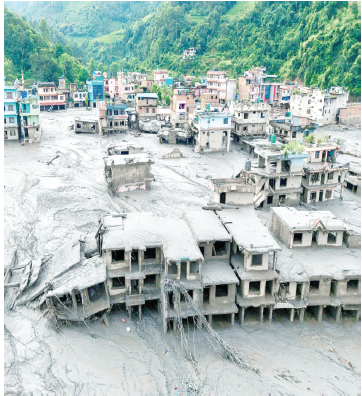
Hindukush Himalaya spans over 3500 km length, across eight countries from Afghanistan to Myanmar and Nepal accounts for an average of 850 km stretch covering nearly one quarter of entire area. Due to quicker warming, entire mountain range is experiencing flash floods, landslides and an increased risk of glacial lake outburst floods. A catastrophic glacier collapse on 26th August that triggered an estimated 50,000 cubic meter of ice and rocks at an altitude of 5200 meter above the Mean Sea level to have a vertical fall of 1.2 km and generating an energy of 50,000x920x1200x9.8 Joules = 540960000000 Jule = 541 Giga Jules. The flowing water with rocks, uprooted trees and other debris with such high energy at 4000 meter above the mean sea level gained even more energy and velocity as it passed downhill river course and flood plains. 100 km downhill when water with debris passed through flood plain of Trishuli River, its speed can be known from the expression square-root of twice the product of loss of altitude and acceleration due to gravity, which is 250 meter per second = 900 km per hour. It created devastation in many districts of Nepal; Rasua and Nuakot districts took the brunt. It washed away thousands of people, thousands of buildings, many km of roads and more than a dozen hydro-power stations creating panic and emergency.
WMO and NOAA in one of the latest bulletins have said that human activity has raised the concentration of greenhouse gases in the atmosphere. The gases retain heat and increase the planet’s average surface temperature; the warming however does not distribute heat evenly. Oceans warm more slowly than land, high latitudes respond differently from tropics, and regional changes in snow, ice, air pollution and atmospheric circulation, accelerate/ temporarily restrain local warming. Land and ocean combined, the average rise in global temperature is .2 degrees Celsius per decade since 1982. As against this, Europe’s and Asia’s per decade warming rate is .5 and .4 degrees Celsius respectively. Arctic, Antarctica and Himalayas, the three landscapes dominated by ice glaciers are warming two to three times faster than the average global rise in temperature. The phenomenon is known as ‘Arctic amplification’ and it begins with the loss of sea ice.
Himalayas, too, is experiencing decreasing snowfall. The length of period, snow stays on the ground is snow persistence, which is recorded to be the least in 2024-25 winter. Four of the last five winters have shown below average snowfall. Less snow increases the risk of droughts, forest fires and glacial lake outbursts. We have seen forest fire during 2025-26 winter in Jammu Kashmir, Himachal Pradesh and Uttarakhand causing harm to young regeneration of trees species and wild fauna. Permafrost is also reported to be receding in the region, thus exposing more ground for absorption of solar radiation. Snow and glaciers are known to reflect 80% of solar radiation, while soil and water reflect only 20% and absorb 80%. The melting of glaciers and loss of ice and snow cover, thus accelerate warming the Himalayan region with twice as fast pace as the rest of the world.
As glaciers are depleting and glacier lakes are growing, scientists have observed that nearly 900 glaciers are precariously hanging. We have not learnt lessons from 2021 Chamoli disaster in Uttarakhand, when 20,000 cubic meters of ice in an avalanche crashed in Rishiganga washing away Tapovan project of NTPC, along with more than 300 humans, and several kms of roads and bridges. Sikkim also suffered a tragedy in October 2023 when there was glacial burst in south Lonak lake.
China’s mindless constructions in Tibetan region and dumping debris in waterways and river courses in Langtang Lirung areas of Tibet is in utter disregard of advisories issued by scientists and experts. In April 2015, Nepal was devastated in a powerful earth quake, when more than 9000 people had perished. The region is seismic prone, and the interference with nature in terms of infrastructure and hydropower development is the recipe for frequent and more destructive devastations.
Yet, China is building Medog hydro-power station, a massive 60,000 MW project on lower reaches of Yarlung Tsangpo, where the river takes sharp U-turn, before entering India’s Arunachal Pradesh. Chinese geologists have conducted a study and found an active Faultline beneath World’s largest hydropower project, which could affect the structural stability of dams, roads, bridges, tunnels and even reservoir area. And to protect Indian territory of Arunachal Pradesh and Assam from any accidental flooding, India is coming up with a balancing reservoir at Dibang hydroelectric project in Arunachal Pradesh. All these are happening in seismic prone areas. There are big gaps between development and environmental opinions. Countries are consistently exhibiting lack of understanding and lack of sensitivity. China should reconsider such big interference with nature and stop bullying lower riparian states.
The rescue and relief undertaken by Nepalese government in recent devastation, with the assistance of India, China and Australia has been extraordinary. At least four bodies have been pulled out of mud and slash on the 9th and 10th day of the operation. Nepalese PM Balendra Shah has scheduled to attend 81st UN General Assembly, where Bhote Koshi Trishuli disaster is to anchor his push for climate justice, reconstruction assistance, and stronger international protection for Himalayan region. Earlier, Nepalese Foreign Minister was scheduled to attend the session.
The devastation disturbed the Cabinet members of the government and Foreign Minister accused China, US and India, the three largest emitters of greenhouse gases in recent years and held them accountable for the tragedy. He should relax and think over. Himalayas are not unsettling due to burning of oil, gas and coal in recent few years. The disaster is due to historical burning of fossil fuel and US, EUs, Russia and Japan are to be held accountable. And if there is any other country to be added to this, it is China, which is approaching a cumulative emission equivalent to that of US.
Hydro power projects are unsustainable in fragile Himalayas and are death traps for persons working there. We have seen in Nepal, how rescuers could not enter the tunnels of these projects even after clearing huge debris and mud. Let us learn from this tragedy and countries must ensure that the opinions of experts and international bodies are not ignored.
(The author, a former Head of Forest Force of Karnataka, is a regular TEW columnist on wildlife, environment, and governance issues.)











[[comment.comment_text]]