Gaza: The Question Mark Over the “Civilised” World
 an hour ago
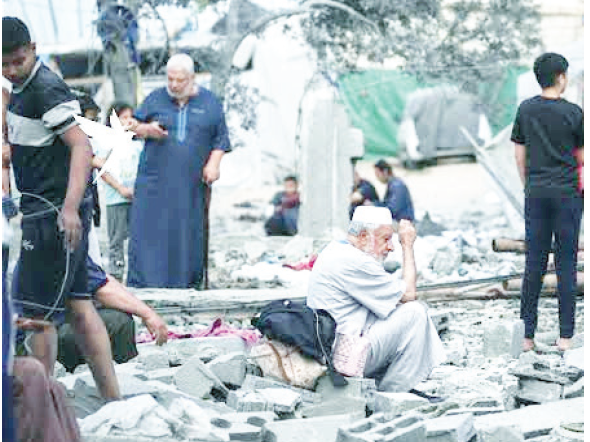
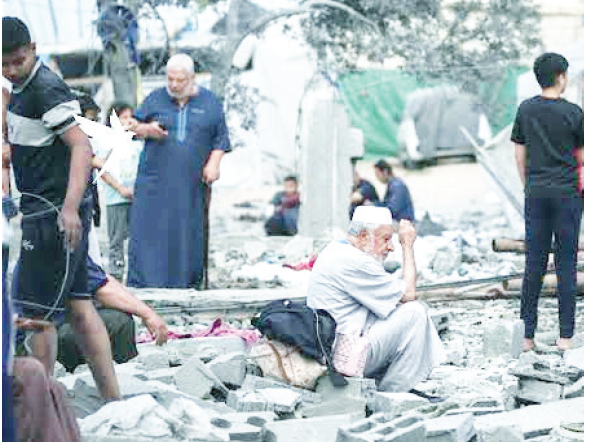
There are moments in history when statistics become too large to comprehend and suffering too prolonged to ignore. Gaza is such a moment. For three years, a civilian population has been bombed from the air, driven from one precarious shelter to the next, starved of medicine, fuel and safety, and stripped of the infrastructure that makes ordinary life possible. Women have buried husbands and children. Children have lost parents, homes, schools and, in countless cases, the very possibility of childhood. Hospitals have tried to function without the means to do so.
More than 73,000 Palestinians have been killed since 7 October 2023, and the number alone no longer captures what has happened. The question before the world is now who is responsible, who stood by, and whether the international order built on the ashes of the Second World War, with its solemn promise of “never again”, still has the will to protect civilians when the victims have no geopolitical power. That is the deeper tragedy of Gaza: not only the killing, but the revelation of how little the world was prepared to do to stop it.
Behind the Numbers
Since 7 October 2023, at least 73,400 Palestinians have been reported killed by Israeli military action, and some tallies now exceed 75,225. At least 10,000 more are presumed missing beneath the rubble of destroyed buildings. Among the documented dead are more than 18,450 children and at least 12,400 adult women, according to Gaza’s health authorities and the Palestinian Central Bureau of Statistics.
The burden has fallen most heavily on those least able to defend themselves. The UN human rights office has found that women and children account for up to 70 per cent of those killed in residential buildings. Even these figures may understate the loss, because researchers writing in medical journals such as The Lancet warn that deaths from unrecorded trauma, starvation, disease and the collapse of the healthcare system are not fully counted.
Nor did the killing stop with the ceasefire announced on 10 October 2025. According to Gaza’s Ministry of Health, as reported by the UN Office for the Coordination of Humanitarian Affairs, another 1,431 Palestinians had been killed and 5,026 injured by the end of September 2026, with 81 further deaths added once identification details were approved. A ceasefire followed by more than a thousand funerals is not peace. It is a pause in the headlines.
Yet these numbers are not abstractions. Behind every figure is a human being: a child whose school vanished beneath concrete, a mother searching for medicine, a father carrying the remains of his family, an elderly person displaced yet again, a newborn arriving in a world where hospitals struggle to provide the basics. Bombing has not been the only weapon, either. Repeated displacement, ruined homes, restricted humanitarian access and shortages of essentials have turned daily existence into a struggle for survival, and in September 2026 UN agencies were still reporting shortages of fuel and equipment that crippled healthcare and aid operations. Gaza is not simply another military confrontation. It is a humanitarian catastrophe with grave legal and moral consequences.
A War With Authors
This was not a natural disaster. It was a campaign directed by a government and carried out by its air force and army. Israel argues that it is necessary to protect its citizens and destroy the armed groups that attacked them, and the attacks of 7 October 2023 on Israeli civilians were a grave crime that no one should minimise. But no atrocity licenses another. International humanitarian law does not lapse because a state says it is fighting terrorism, and the presence of armed fighters among civilians does not dissolve the duty to distinguish between combatants and civilians and to take every precaution to protect human life.
Israel does have the right to protect its people. The real question, however, is whether the methods it has used can be reconciled with the law when civilians are killed on this scale and civilian infrastructure is destroyed again and again. The International Criminal Court has already taken a step toward an answer, issuing arrest warrants for Prime Minister Benjamin Netanyahu and former defence minister Yoav Gallant on allegations of war crimes and crimes against humanity. Those are allegations, not verdicts, and both men are entitled to answer them before judges. But a world that claims to believe in accountability must ask why those named in the warrants have not been brought before a court, and why some governments have hosted rather than challenged them.
The Genocide Question
Nowhere is the legal argument more contested than over a single word. “Genocide” carries extraordinary legal and historical weight and should never be used lightly. But neither should it be avoided because it is politically uncomfortable. South Africa has brought proceedings against Israel before the International Court of Justice under the Genocide Convention. In January 2024 the Court ordered Israel to take every measure within its power to prevent acts falling within the Convention, including killing members of the protected group, causing serious bodily or mental harm, and deliberately inflicting conditions of life calculated to bring about its physical destruction in whole or in part. In May 2024 it reaffirmed those measures and added others concerning Rafah. UN investigators have since accused Israel of genocide, a charge Israel firmly rejects.
It must be said plainly that the ICJ has not yet ruled on the merits, and it would be dishonest to pretend otherwise. But a provisional order from the world’s principal judicial organ is no trivial diplomatic paper. It is a legal warning that the protection of Palestinian civilians could not wait, and it was issued while the killing continued.
The United Nations and the Crisis of Credibility
The failure is not only legal; it is institutional, and nowhere is that clearer than at the United Nations, whose deepest weakness Gaza has exposed. The organisation can document suffering, issue appeals, pass resolutions, count the dead, record displacement and describe destroyed infrastructure. But when the political will to enforce the law is absent, documentation becomes an archive of helplessness. The Security Council exists to respond to threats to international peace and security, yet on Gaza it has been repeatedly paralysed by great-power rivalry and the veto.
The result is a perception spreading across the Global South and far beyond: that international law is strongest against the weak and weakest wherever the powerful or their allies are involved. That perception is corrosive. It damages not only the credibility of the United Nations but the legitimacy of the entire rules-based order, because the world becomes ungovernable once people conclude that “rules-based” means rules for others.
Washington’s Responsibility
That perception leads directly to Washington, because no capital carries heavier responsibility. The United States is Israel’s principal military supplier and its shield at the Security Council, where its veto has blocked ceasefire resolutions. A state cannot arm a campaign, protect it from collective action, and still present itself as a neutral mediator or as the guardian of international law. Washington lectures others on civilian protection, sovereignty and the laws of war, then exempts its closest partner from the standard it demands of everyone else. Every such double standard is a gift to those who argue that human rights are merely a weapon of the strong.
To be fair, Washington did help broker the October 2025 ceasefire, and that deserves acknowledgement. But a ceasefire that leaves more than a thousand dead is not a guarantee of protection. The question for the United States is simple: if these are your values, why were they suspended in Gaza?
A Ceasefire Cannot Become a Licence for Forgetting
A ceasefire should mean that civilians can finally breathe. It cannot become a diplomatic curtain behind which continuing suffering disappears from international attention. UN reporting through 2026 kept recording casualties, displacement and insecurity despite the ceasefire framework. A ceasefire, in truth, is not a piece of paper. It must mean protection, unobstructed humanitarian access, medical care and safe shelter. It must mean that children can sleep without expecting another explosion to destroy their lives. Anything less turns the word into another broken promise.
The Children Who Pay the Highest Price
Nowhere is that broken promise more painful than in what is happening to Gaza’s children. A war can destroy buildings in months; the destruction of a childhood can last a lifetime. Children who survive bombardment may carry physical injuries, psychological trauma, displacement and the loss of their parents, while their schools have vanished and their teachers have been killed or scattered. UN reporting in September documented the deaths and injuries of children, including very young children and a pregnant woman and her unborn baby, as humanitarian agencies warned that Gaza’s fragile health system remained under severe pressure.
What becomes of a generation that grows up learning that the world watched its suffering but could not, or would not, stop it? That question should trouble every government, because children do not inherit our diplomatic excuses. They inherit the consequences.
The Arab World and the Cost of Silence
The Arab world, too, deserves hard scrutiny. Arab governments face real calculations: security dependence on Western partners, economic pressures, formal ties with Israel, and fear of regional escalation involving Iran and its allies. But caution is not a policy for catastrophe, and statements, summits and communiqués are no substitute for action. Arab states hold genuine instruments of diplomatic, economic and political pressure. The question their own citizens are asking is why those instruments have been used so sparingly while an Arab and Muslim population was being destroyed within sight of their borders. History will not accept “complicated” as an answer, and neither will the young people who watched.
Yet responsibility does not belong to Arab capitals alone. It belongs to Washington, Brussels, Moscow, Beijing, New Delhi and every government that professes belief in international law. Gaza is not a Middle Eastern problem. It is a test of the entire international system.
The Verdict of History
History will not remember only the missiles that were fired. It will remember the governments that knew, the diplomats who spoke, the resolutions that were passed, and the limits of what the world was willing to do. The dead cannot be resurrected, but further deaths can still be prevented. The international community can demand genuine humanitarian access, insist on the protection of civilians, support independent investigations and the work of the ICC and ICJ, end arms transfers that fuel violations, and work toward a political settlement that gives Palestinians security, dignity, rights and a credible path to self-determination while guaranteeing security for Israelis.
But if the world fails to act, the alternative is frightening. If civilian protection depends on geopolitical power, universal human rights become little more than an aspiration. If international law applies differently according to who is being bombed, the order is not truly rules-based. And if the United Nations can document the destruction of a civilian population yet remains politically incapable of preventing it, then the institution needs reform, not because the idea of the United Nations has failed, but because humanity still needs the principles for which it was founded.
Gaza therefore poses a question larger than Israel and Palestine: can humanity still agree that every civilian life has equal value? If the answer is yes, Gaza cannot be allowed to become another chapter of statistics, statements and diplomatic condolences. The dead cannot speak. The children who survived will. And history will ask what the world did while Gaza burned.
References
1. UN Office for the Coordination of Humanitarian Affairs (OCHA), occupied Palestinian territory, Humanitarian Situation Updates on Gaza, 2025–2026 (casualty figures since the 10 October 2025 ceasefire; fuel, equipment and health-care shortages, September 2026). https://www.ochaopt.org
2. Gaza Ministry of Health, casualty reports, October 2023 to October 2026, as relayed by OCHA.
3. Palestinian Central Bureau of Statistics (PCBS), press release for International Women’s Day, 8 March 2026. https://www.pcbs.gov.ps/portals/_pcbs/PressRelease/Press_En_IntWomenDay8032026E.pdf
4. UN Office of the High Commissioner for Human Rights (OHCHR), reporting on civilian casualties in residential buildings in Gaza. https://www.ohchr.org
5. International Criminal Court (ICC), press release on the arrest warrants for Benjamin Netanyahu and Yoav Gallant, 21 November 2024. https://www.icc-cpi.int
6. International Court of Justice (ICJ), Application of the Convention on the Prevention and Punishment of the Crime of Genocide in the Gaza Strip (South Africa v. Israel), Orders of 26 January 2024 and 24 May 2024. https://icj-cij.org/case/192/summaries and https://icj-cij.org/node/204091
7. UN Independent International Commission of Inquiry on the Occupied Palestinian Territory, press release, 16 September 2025. https://www.un.org/unispal/document/israel-has-committed-genocide-in-the-gaza-strip-un-commission-finds-16sep25/
8. UN Security Council, meeting coverage on draft resolutions on a Gaza ceasefire vetoed by the United States, 2023–2025. https://press.un.org
(Author, a Kashmiri sociologist, is a writer, -researcher, and columnist. His research Interests Include Kashmir Affairs, South Asian Politics, Human Rights, and Public Policy issues.)





[[comment.comment_text]]