A memoir that unsettles the political establishment

 2 days, 12 hours ago
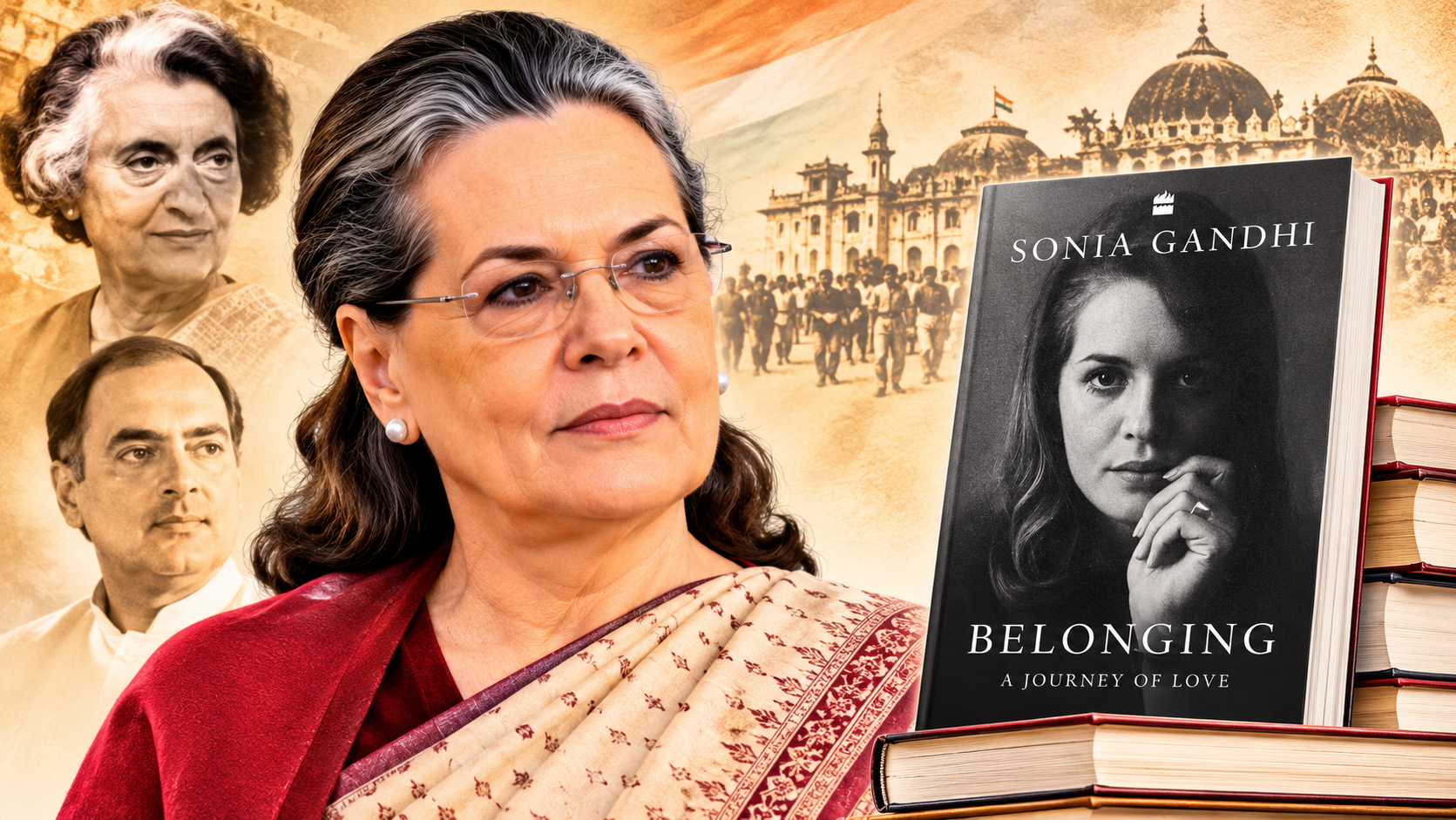
There has hardly been a book in recent times which has created as much curiosity and demand as the one penned by Sonia Gandhi. Between personal grief and political confrontation, Sonia Gandhi’s long-awaited memoir challenges the dominant narrative of contemporary India, reopens uncomfortable chapters of history and exposes the anxieties surrounding dissent, identity and the politics of belonging.
The arrival of Sonia Gandhi’s Belonging: A Journey of Love, published by HarperCollins India on November 10, 2026, has become one of the most talked-about literary and political events in recent Indian publishing. Few political memoirs have generated such anticipation, controversy and public curiosity even before reaching the bookshops. Within days of its release, the book had attracted extraordinary crowds, brisk sales across major cities and prominent positions on online bestseller rankings. It has also provoked an unusually sharp response from the Bharatiya Janata Party (BJP), whose leaders have been quick to challenge its political interpretations and historical recollections.
The excitement surrounding the 544-page memoir, however, cannot be explained merely by the celebrity of its author or the continuing relevance of the Nehru-Gandhi family. Its significance lies in something considerably larger: a woman who has spent decades being scrutinised, criticised, caricatured and discussed by others has finally chosen to narrate her own story.
Sonia Gandhi has long been one of the most consequential yet enigmatic figures in Indian politics. She has exercised enormous political influence without cultivating the conventional public persona of a mass political leader. She has guarded her private life, avoided frequent interviews and rarely offered extended explanations of her political decisions. Consequently, the memoir represents an unusual opportunity to understand the personal experiences, political calculations, ideological convictions and emotional burdens behind a public life that has shaped Indian politics for nearly three decades.
Yet Belonging is not simply an exercise in personal recollection. It is also a political intervention, an interpretation of modern Indian history and, in several passages, an unmistakable indictment of the direction in which the country has travelled.
The curiosity surrounding a guarded public figure
The book’s extraordinary appeal begins with its author. Sonia Gandhi has occupied an exceptional position in Indian public life since entering active politics in 1998. Born in Italy, she married Rajiv Gandhi in 1968 and entered a family whose political history was inseparable from the evolution of independent India.
The assassinations of her mother-in-law, Indira Gandhi, in 1984 and her husband, Rajiv Gandhi, in 1991 transformed her personal circumstances and eventually drew her into politics. Her subsequent emergence as Congress president, her stewardship of the United Progressive Alliance (UPA), her role in the formation of the governments led by Dr.Manmohan Singh and her decision not to become prime minister in 2004 made her one of the most influential political figures of her generation.
But the woman behind this political trajectory remained largely inaccessible. Her Italian childhood, marriage, adjustment to Indian society, relationship with Indira Gandhi, experience of motherhood, family tragedies and private political anxieties were rarely discussed at length.
The memoir promises to bridge that gap. It revisits her childhood in Italy, her years in Britain, her meeting and marriage with Rajiv Gandhi, her transition into Indian society and the extraordinary personal losses that accompanied her family’s political journey.
Her recollections of losing her first child, the assassination of Rajiv Gandhi, the emotional consequences of political violence and her own battle with breast cancer introduce a deeply personal dimension that conventional political biographies often fail to capture.
The appeal is therefore not confined to Congress supporters. Readers interested in modern Indian history, political personalities, the Nehru-Gandhi family and the private consequences of public power have compelling reasons to pick up the book.
From a private life to the centre of political history
One of the memoir’s principal strengths is its attempt to connect individual experience with national events.
Sonia Gandhi’s life intersects with some of the most consequential and traumatic episodes in post-Independence India: the Emergency, Operation Blue Star, the assassination of Indira Gandhi, the anti-Sikh violence of 1984, the assassination of Rajiv Gandhi, the Babri Masjid demolition and the subsequent transformation of Indian politics.
Her account of Operation Blue Star and its aftermath offers an intimate perspective on the insecurity and fear experienced by the Gandhi family. Her recollections of the assassination of Indira Gandhi and the subsequent violence in Delhi provide an intensely personal dimension to a national tragedy.
Equally significant are her reflections on Rajiv Gandhi’s assassination in May 1991. The loss of her husband was not merely a private bereavement. It altered the political future of the Congress and, eventually, the trajectory of her own life.
The memoir is particularly interesting when it examines the relationship between political responsibility and personal suffering. It suggests that the public often sees political families through the prism of authority, privilege and ambition, while overlooking the emotional costs of living under constant political scrutiny and the threat of violence.
This is where Belonging becomes more than a chronicle of the Gandhi family. It offers a perspective on the human consequences of India’s turbulent political history.
The political controversy that preceded publication
Perhaps the most consequential development surrounding the book was the change of publisher from Penguin Random House India to HarperCollins.
The original publishing arrangement collapsed after disagreements over proposed editorial changes and deletions. Reports indicated that passages concerning Prime Minister Narendra Modi, the RSS, communal tensions, minority rights and India’s contemporary political situation had become subjects of disagreement.
Sonia Gandhi subsequently suggested that the original publisher was uncomfortable with the book’s criticism of the government. Penguin, however, disputed the suggestion that political pressure was responsible, maintaining that the disagreement arose from editorial and fact-checking discussions.
The distinction matters. It would be premature to declare that the manuscript was censored or that the publisher acted under government pressure without conclusive evidence. Nevertheless, the controversy raised legitimate questions about the environment in which politically sensitive books are published in India.
The transfer to HarperCollins, followed by the November 10 release, transformed what might otherwise have been a major publishing event into a national political talking point. The controversy became an advertisement in itself. Every disagreement over a proposed deletion increased the curiosity about what the author had written and why certain passages had become contentious.
There is an important irony here. Attempts to negotiate or limit controversial material may have inadvertently amplified public interest in the very arguments that some critics wanted toned down. The book’s eventual publication thus acquired significance beyond its contents: it became a test of editorial independence and the freedom to publish politically uncomfortable opinions.
Why the BJP is so uncomfortable
The BJP’s reaction is revealing, although it should not automatically be interpreted as evidence that the book has threatened its political standing. The party has a legitimate right to contest historical interpretations and challenge allegations made by a political opponent. But the speed and intensity of its response suggest that Belonging has touched several politically sensitive subjects.
The first is the ideological contest over the meaning of India. Sonia Gandhi presents a vision rooted in constitutional secularism, pluralism, diversity and the accommodation of different religious and cultural identities. She contrasts this with what she regards as the ideological project of the RSS and the political direction pursued under Narendra Modi.
Her criticism is not confined to personalities. She questions the ideological foundations of the present political establishment, its treatment of minorities, its approach to federalism and its relationship with democratic institutions.
She also writes about the Modi government’s handling of parliamentary accountability, the China border situation, the Pulwama attack and the alleged use of political manoeuvres to destabilise elected state governments. Her argument is that India’s democratic institutions and constitutional conventions have come under increasing strain.
The second source of discomfort is her direct challenge to the BJP’s political narrative about the Congress and the Nehru-Gandhi family. For years, the BJP has made the Gandhi family’s political inheritance, alleged dynastic entitlement and historical failures central to its criticism of the Congress. Sonia Gandhi’s memoir attempts to reclaim the narrative by presenting the family’s history through personal experience, political context and a different interpretation of events.
The third concerns her treatment of the demolition of the Babri Masjid in December 1992. The BJP has accused her of approaching the subject through electoral considerations and what it calls vote-bank politics. Its spokesperson C.R. Kesavan has attacked the book as an attempt to sanitise the historical record of the Congress and the Nehru-Gandhi family.
The party has also challenged her accounts of the Emergency and the 1984 anti-Sikh violence, questioning whether the memoir adequately acknowledges the responsibility of the Congress leadership.
These are not trivial disagreements. The Emergency and the 1984 violence remain among the darkest chapters in Congress history. No credible political memoir can expect to escape scrutiny over them.
Yet there is a distinction between critically examining a politician’s account and dismissing it because it challenges the preferred historical narrative of the ruling establishment.
The BJP’s objections have ensured that the memoir is being discussed not merely as a personal account but as another battleground in India’s continuing ideological conflict.
The question of belonging: identity, acceptance and prejudice
The title itself is perhaps the most revealing aspect of the book. Belonging: A Journey of Love is an attempt to address a question that has followed Sonia Gandhi throughout her public life: what makes someone belong to a country?
Her Italian birth has repeatedly been used by political opponents to question her Indianness, despite her decades-long association with India, her marriage into an Indian family and her participation in the country’s democratic life.
The controversy over her foreign origins has frequently overshadowed substantive debates about her political record. Her critics have often treated birthplace as a permanent disqualification, as though citizenship, commitment, constitutional rights and decades of public service cannot overcome the accident of birth.
The memoir challenges this assumption. It suggests that belonging is not simply inherited through geography or ancestry; it is also constructed through relationships, experiences, shared suffering, cultural participation and a conscious attachment to a country.
There is a wider democratic argument here. India is a constitutional republic, not an ethnic or cultural inheritance reserved for people born within a particular geographical or religious identity. The right to belong cannot be determined by political convenience.
However, the argument also raises an interesting question about the distinction between personal belonging and political legitimacy. Sonia Gandhi’s emotional attachment to India is one matter; her political decisions, leadership and record must be evaluated independently. The former deserves recognition, but it cannot substitute for accountability on the latter.
This is an important distinction that the memoir’s admirers and critics alike would do well to recognise.
The merits: an intimate and unusually candid political memoir
The most compelling quality of Belonging is its willingness to expose the personal dimensions of a life lived under extraordinary public scrutiny.
Its accounts of bereavement, motherhood, family relationships, political violence and illness give the narrative emotional depth. The recollections of Rajiv Gandhi are especially important because they restore the human being behind the political leader and husband whose assassination altered the course of Indian politics.
The book also offers valuable insights into Indira Gandhi, whose public image was dominated by authority, political determination and controversy. Sonia’s recollections provide a more intimate picture of her mother-in-law, including the loneliness and pressures associated with exercising political power.
Another merit is the author’s perspective on the experience of women in politics. Her reflections on the isolation of women leaders, including a conversation with Hillary Clinton in 2012, touch upon a reality that is frequently obscured by the apparent authority of women occupying powerful positions. Political power does not necessarily translate into personal freedom, companionship or emotional security.
The memoir’s account of Sonia Gandhi’s decision to decline the prime ministership in 2004 is also significant. That decision has been variously described as sacrifice, political calculation and an exercise in strategic judgement. Her own recollection is valuable because it provides an opportunity to understand how she interpreted the decision and the circumstances surrounding it.
The reader may not necessarily accept every explanation, but hearing the participant’s account is indispensable to a fuller historical assessment.
Finally, the memoir’s political passages deserve attention because they place contemporary developments within the author’s experience of an India that has undergone substantial ideological and institutional transformation.
The limitations: where the memoir invites scepticism
For all its merits, Belonging is not beyond criticism. Indeed, its greatest strength—its intensely personal perspective—is also the source of some of its limitations.
A memoir is inevitably selective. It represents an individual’s recollections, interpretations and understanding of events, not an impartial historical record. Sonia Gandhi writes as a participant in, and beneficiary of, the political establishment she describes. Her account must therefore be read with an awareness of the personal and political interests that inevitably shape political autobiography.
The treatment of the Emergency is a particularly important test. Indira Gandhi’s decision to suspend civil liberties, imprison opposition leaders, impose press censorship and undermine democratic institutions cannot be adequately explained away by reference to political isolation or personal pressures. The Emergency was a grave assault on constitutional democracy. Its historical significance demands unequivocal acknowledgement.
Similarly, the account of the 1984 anti-Sikh violence requires particular scrutiny. Nearly 3,000 people were killed in Delhi following Indira Gandhi’s assassination. The failure of the state machinery, the complicity of political functionaries and the prolonged denial of justice remain matters of profound national importance.
Sonia Gandhi describes the violence as a tragic and shameful chapter and refers to the failure of officials to prevent it. However, her defence of Rajiv Gandhi against allegations of complicity and her recollections concerning the delayed deployment of the Army inevitably invite further examination.
Her account cannot replace the findings of commissions, judicial proceedings, documentary evidence and the testimony of survivors. Nor can personal recollection settle contested historical questions.
There is also the question of the Nehru-Gandhi family’s own political legacy. The Congress’s centralisation of power, dynastic succession, corruption allegations, organisational decline and failure to renew its leadership are subjects that deserve more than an explanation through the hostility of political opponents.
Sonia Gandhi’s leadership was consequential, but it was not infallible. The Congress’s failures during the UPA years, its electoral setbacks and its inability to build a sustainable organisational structure cannot be attributed exclusively to the BJP or the RSS.
The memoir would have been more compelling had it subjected its own political inheritance to the same searching scrutiny that it applies to its ideological opponents.
Its criticism of the Modi government is often forceful, but readers would also benefit from more detailed engagement with the Congress’s own institutional shortcomings and the lessons drawn from them.
In other words, Belonging is a valuable first-person account, but it should not be mistaken for the final word on India’s political history.
What made it a bestseller within days?
The book’s phenomenal reception deserves attention in its own right. Its popularity is the product of several factors working together. First, there is the extraordinary public curiosity surrounding Sonia Gandhi. A politician who has rarely spoken extensively about her private life has finally offered a substantial account of her personal and political journey.
Second, the memoir concerns a family whose history is deeply intertwined with the history of independent India. The Nehru-Gandhi family’s political successes, tragedies, controversies and internal relationships have fascinated generations of readers.
Third, the controversy surrounding the change of publisher created an unprecedented pre-publication publicity cycle. The prospect of editorial disagreements involving references to the Prime Minister, the RSS, communal relations and the government’s record naturally encouraged readers to discover what the book actually contained.
Fourth, the memoir appeals to audiences across the political spectrum. Congress supporters want to understand their leader’s thinking; BJP supporters and critics want to examine her allegations; historians and political observers are interested in the recollections of someone who witnessed several defining moments of contemporary Indian history. Even readers with little interest in party politics may find the personal narrative compelling.
Finally, the timing is important. India is experiencing an intense debate over nationalism, secularism, constitutional institutions, minority rights and the character of its democracy. A memoir that addresses these questions through the experiences of one of the country’s most recognisable political figures was almost certain to attract attention.
The scale of the initial response is striking. Bookshops in Delhi reported substantial first-day sales, with some stores receiving hundreds of copies and buyers queuing to purchase the memoir. Retailers in other metropolitan cities also reported strong demand. The book appeared at the top of Amazon India’s bestseller rankings.
However, an important distinction must be made: bestseller rankings and reports of brisk sales are not the same as audited nationwide sales figures. The publisher and online platforms have not released comprehensive sales data establishing the precise number of copies sold. It is therefore more accurate to describe the memoir as an exceptionally successful launch than to declare, on the basis of a few days’ sales, that it has already become the country’s biggest political bestseller.
Nevertheless, the enthusiasm is unmistakable.
A political memoir that has become a test of democratic openness There is another dimension to the controversy that extends beyond Sonia Gandhi herself. The memoir has revived questions about the freedom of writers, publishers and intellectuals to examine the record of those in power. The dispute with the original publisher, irrespective of the precise reasons behind it, has brought the relationship between editorial independence and political sensitivities into public discussion.
In a healthy democracy, criticism of the government should not be treated as an act of hostility towards the nation. Nor should the recollections of a political opponent automatically be dismissed as propaganda.
The BJP is entitled to contest Sonia Gandhi’s interpretations of the Emergency, the 1984 violence, the Babri Masjid demolition and other historical events. Congress leaders, in turn, must accept scrutiny of their own record. The proper response to disputed recollections is evidence, historical research and public debate—not personalised attacks or attempts to discredit the author on the basis of her birthplace.
The BJP’s strong reaction may partly reflect the fact that Sonia Gandhi has chosen to speak directly on issues that have become central to its ideological and electoral politics. Her memoir contests the BJP’s interpretation of the Nehru-Gandhi legacy and advances a contrasting vision of India’s political and constitutional identity.
But it would be equally simplistic to suggest that every criticism of the book is politically motivated. Some of the objections concern legitimate historical questions that deserve serious consideration.
Ultimately, the value of a democratic society is measured not by the absence of disagreement but by its ability to accommodate competing accounts of history without intimidation.
An important document, but not the last word on history
Belonging: A Journey of Love is an unusual political memoir because it attempts to bring together three distinct narratives: the story of a woman who crossed continents for love, the story of a family repeatedly devastated by political violence, and the story of a country whose political identity has undergone a profound transformation.
Its emotional passages are among its strongest. Its recollections of political events are valuable because they offer the perspective of an important participant. Its defence of pluralism and constitutional secularism gives it contemporary relevance.
Yet its silences, selective recollections and limited engagement with the Congress’s own failures prevent it from becoming a definitive historical account. The reader must distinguish between personal testimony, political argument and independently established historical fact.
There is also an irony in the book’s title. Sonia Gandhi has spent decades seeking acceptance in a country where her origins were repeatedly invoked to question her legitimacy. Yet the political controversy surrounding her memoir demonstrates how difficult it remains for India to reconcile its constitutional commitment to diversity with the politics of cultural and national identity.
Perhaps the book’s most important contribution is that it forces this question into the open.
Sonia Gandhi has finally moved beyond being the subject of other people’s narratives to become the author of her own. Her memoir does not settle the arguments surrounding her political legacy, nor should it. It offers an opportunity to revisit them with greater historical detail and a more human understanding of the experiences behind public decisions.
Whether readers emerge more sympathetic to Sonia Gandhi or more critical of her political legacy, Belonging deserves to be read and debated.
(Mr. Hasnain Naqvi, a former member of the history faculty at St. Xavier’s College, Mumbai, is a senior TEW columnists.)







[[comment.comment_text]]