Beyond Bankipur

 2 months, 3 weeks ago
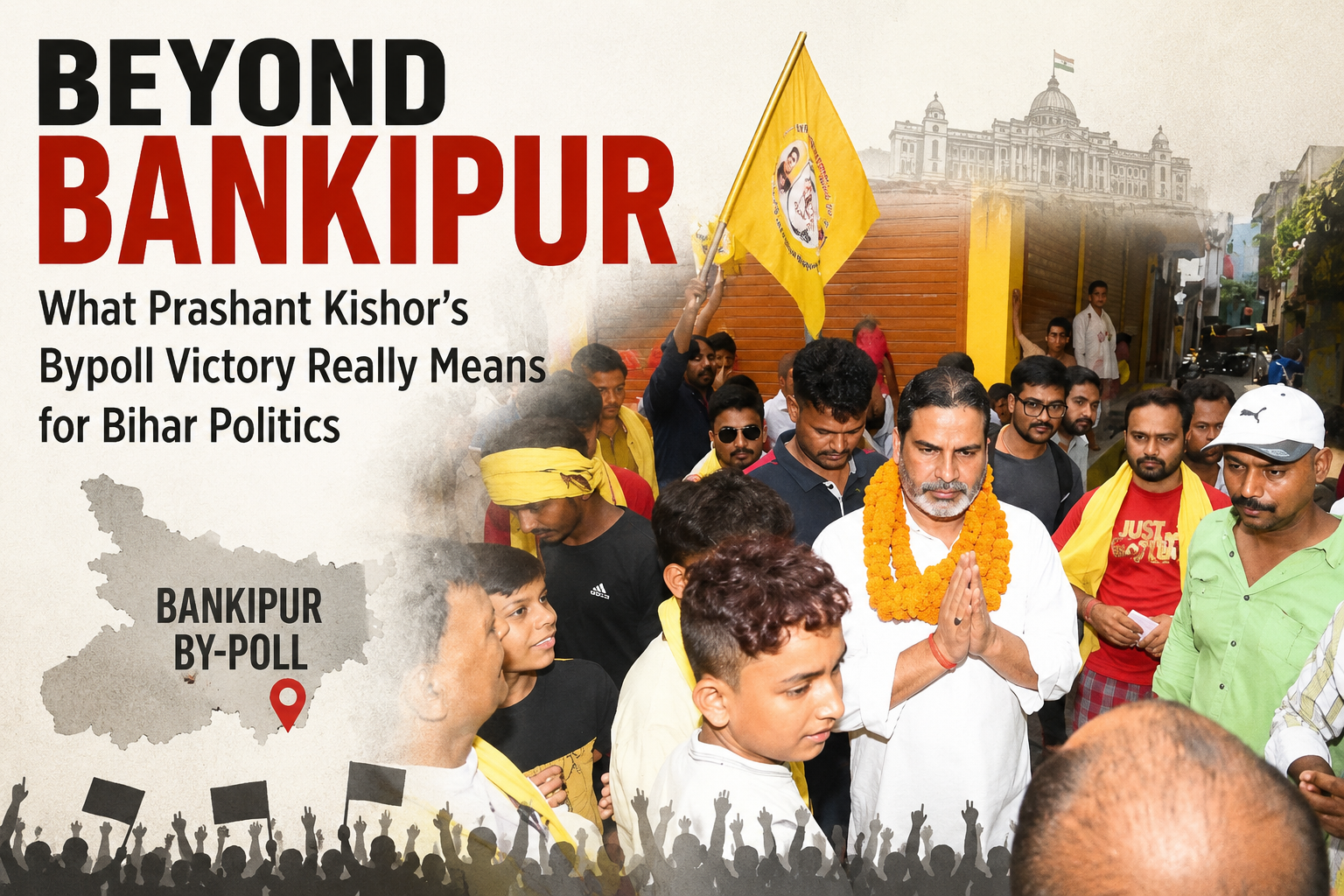
Prashant Kishor's victory in the Bankipur Assembly bypoll has instantly been elevated from a constituency-level result to a national political narrative. Within hours of the Election Commission declaring that the election strategist-turned-politician had wrested the prestigious Patna seat from the BJP by nearly 19,000 votes, television studios, political commentators, and social media analysts began treating the outcome as a referendum on the ruling party's standing in Bihar.
The temptation to derive sweeping conclusions from a single electoral contest is understandable. Politics thrives on symbolism, and Bankipur offers plenty of it. A BJP fortress for nearly three decades, the constituency was represented by Nitin Nabin, now the party's national president, who had comfortably retained the seat across four successive elections. For Prashant Kishor, winning such a constituency is undoubtedly a personal and political milestone.
Yet, the more important question is not whether Bankipur matters—it certainly does—but whether it tells us anything fundamentally new about Bihar's political landscape.
The answer is more nuanced than the immediate post-result commentary suggests.
Much of the analysis surrounding Kishor's victory has centred on four broad explanations: lingering anger over the NEET-2026 paper leak controversy, public outrage following the police shooting of Bharat Bhushan Tiwari in Bhojpur, resentment against the Centre's UGC guidelines introduced earlier this year, and an increasingly widespread perception that the BJP's organisational feedback mechanism has weakened.
Each of these issues undoubtedly carries political significance. The student-led protests over examination irregularities mobilised an otherwise disengaged section of urban youth. The Bhojpur shooting generated emotional outrage extending beyond district boundaries. The controversy surrounding higher education reforms unsettled sections of the academic community. Simultaneously, murmurs within BJP circles about weakening grassroots communication have persisted for well over a year.
However, none of these developments emerged because of the Bankipur bypoll. They predated the election by weeks or even months.
The NEET protests had already become a defining political issue before polling began. The Bharat Bhushan Tiwari incident occurred in June. Opposition to the UGC guidelines had been visible since January. Even discussions about organisational disconnect within the BJP had surfaced long before the election campaign entered its final phase.
Had the BJP narrowly retained Bankipur, these very issues would still have existed. Analysts would simply have interpreted them differently, arguing that despite mounting dissatisfaction, the party's electoral machinery had managed to withstand public anger. The underlying political realities would have remained unchanged.
This illustrates one of electoral politics' oldest analytical traps: allowing outcomes to determine explanations rather than allowing evidence to shape conclusions.
Bankipur itself demands careful contextualisation.
The constituency recorded a turnout of just over 34 percent, substantially lower than the participation witnessed during the Assembly election held only months earlier. Such reduced turnout is characteristic of bypolls across India, where motivated voters—often those wishing to register dissatisfaction—participate more actively than the broader electorate.
Equally significant is Prashant Kishor's unique political profile.
Unlike many first-time party founders, Kishor entered electoral politics with extraordinary public recognition built over more than a decade as India's most sought-after election strategist. His personal brand enjoys visibility that far exceeds that of Jan Suraaj as a political organisation. Voters may therefore distinguish between supporting Prashant Kishor as an individual candidate and endorsing Jan Suraaj as the party they wish to govern Bihar.
History offers numerous examples where charismatic individuals succeeded in bypolls without their organisations subsequently translating that momentum into statewide victories. Conversely, several parties have lost high-profile bypolls before comfortably returning to power in general elections.
Bypolls often function less as judgments on governance and more as opportunities for voters to communicate dissatisfaction without immediately altering government.
This does not diminish Kishor's achievement. Defeating an entrenched political establishment in one of Bihar's most prestigious constituencies requires organisational discipline, candidate credibility, and effective campaign management. It also demonstrates that Jan Suraaj possesses the capacity to convert public curiosity into electoral success under favourable circumstances.
The challenge, however, begins now rather than ending with Bankipur.
Winning one urban constituency differs fundamentally from constructing a statewide political organisation capable of contesting 243 Assembly seats. Sustaining volunteer networks, developing district-level leadership, building caste coalitions, financing campaigns, and converting issue-based support into durable electoral loyalty remain formidable tasks. Bihar's political history is filled with promising regional movements that struggled once confronted with the realities of statewide mobilisation.
For the BJP, meanwhile, the lesson is neither mysterious nor entirely unexpected.
If organisational communication has weakened, if young voters feel alienated, if educational reforms have generated anxiety, and if law-and-order controversies are influencing public perceptions, these are concerns the party has already been aware of. The Bankipur verdict merely provides electoral confirmation of conversations that have existed internally and externally for months.
Promises of "introspection" following the defeat may therefore sound politically appropriate, but meaningful introspection requires acknowledging problems before voters deliver reminders through ballot boxes.
Ultimately, Bankipur should neither be dismissed as an isolated accident nor inflated into a definitive forecast for Bihar's next Assembly election.
Its real significance lies elsewhere.
The bypoll confirms that established political bastions are no longer impregnable, that issue-based discontent can find electoral expression, and that Prashant Kishor has crossed the crucial psychological threshold from political consultant to elected politician.
But it does not, by itself, prove that Bihar is preparing for a political realignment. That verdict will depend not on one constituency with low turnout, but on whether today's protest vote evolves into tomorrow's governing mandate.
In politics, victories often generate headlines. Whether they generate history is determined much later. Bankipur may be remembered as the beginning of something significant—or simply as an important bypoll that confirmed what careful observers already knew. Only the next statewide election can settle that question.










[[comment.comment_text]]