Ardhanarishvara: The Message of Shiva and Its Relevance to Society
 an hour ago
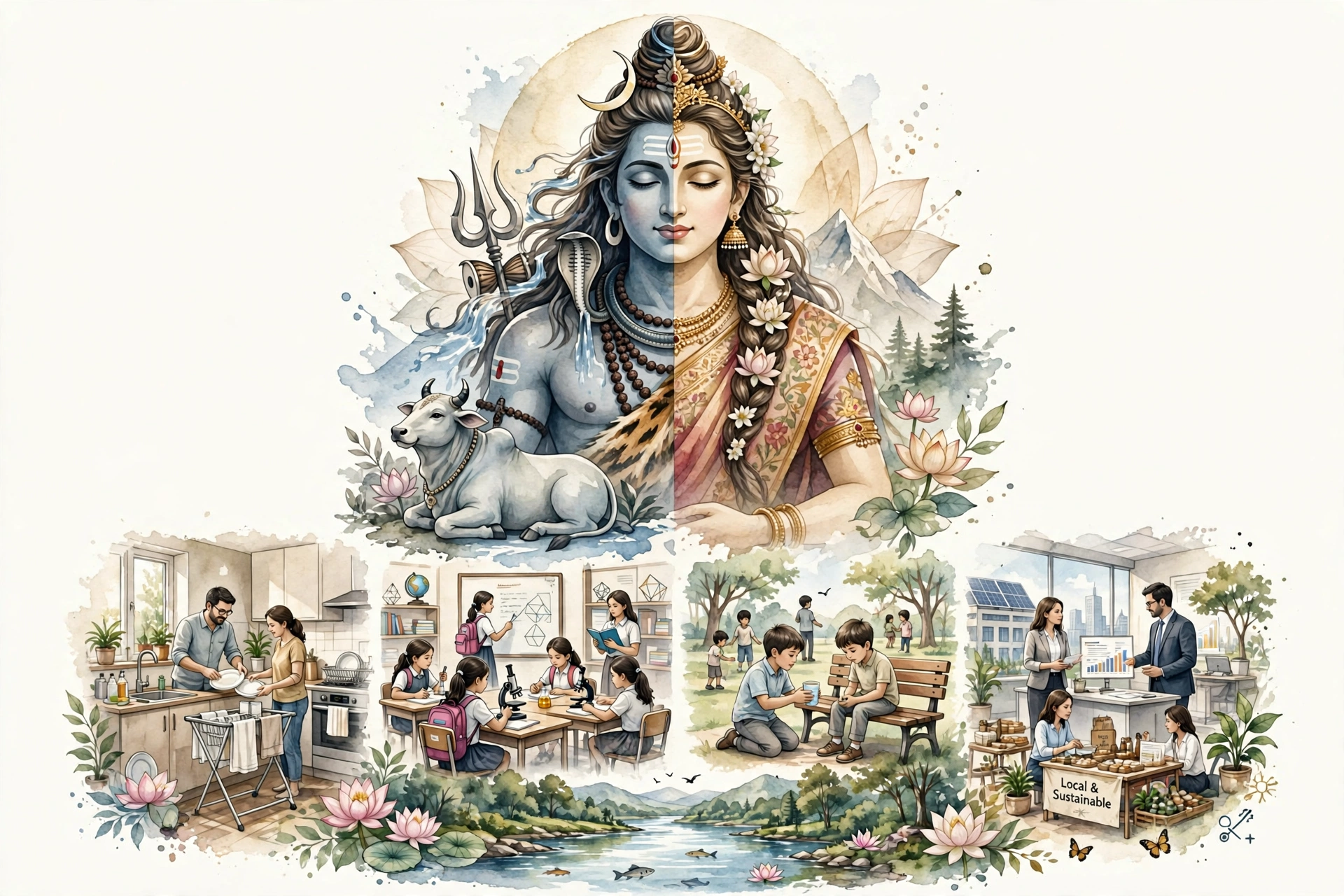
Whenever we picture Lord Shiva, several images come to mind: the Ganga flowing through his matted locks, the crescent moon on his forehead, the serpent around his neck, the trident in his hand, Nandi by his side, and nature surrounding him. Yet there is one form of Shiva that deserves particular reflection in contemporary society—the Ardhanarishvara, representing Shiva and Shakti as two halves of one whole. Why is Shiva depicted in this form? Is it merely a religious concept, or does it also hold a deeper message for our social lives?
Our ancestors understood long ago that women and men are not adversaries but partners in life. Without either, the picture of society remains incomplete. The union of Shiva and Shakti conveys precisely this message. Why, then, do we still hesitate to treat women and men as equals? We speak extensively about women’s dignity and empowerment, but often fail to begin the process within our own homes.
Do we genuinely give daughters and sons equal importance in education? Are women’s opinions given equal weight in major family decisions? Is it right to regard household work solely as a woman’s responsibility? If our answers to these questions are not entirely affirmative, we need to reconsider our attitudes and behaviour. Ardhanarishvara does not suggest that one should be superior to the other. Its message is straightforward: equal dignity and equal opportunities for all.
The change can begin at home. Sons and daughters must receive equal educational opportunities and the freedom to pursue careers of their choice. Boys should share household responsibilities, while girls should also be encouraged to develop a sense of responsibility and independence. Children must learn that caring for a family is not the duty of one individual but a shared responsibility. When equality is practised at home, those values naturally find their way into society.
But can society change simply by transforming family attitudes? Certainly not. Schools and colleges must also evolve. Educating children cannot be limited to textbooks and examinations. They must learn that considering girls inferior is wrong, just as forcing boys to suppress their emotions and appear perpetually tough is harmful. Respect is the right of every individual. Educational curricula should adequately recognise women’s achievements and contributions. Girls must be encouraged to assume leadership roles, while boys should be taught equality, empathy and respect.
Another important issue is economic independence. We tell women to become self-reliant, but do they always have access to their own income? Are they free to make financial decisions? Do they enjoy equal opportunities in employment and property ownership? Women’s empowerment, therefore, must mean more than protection and security; it must also entail economic strength. Women should have greater access to skill development, digital education, employment, small businesses, entrepreneurship and financial literacy. Economic independence enables women to make decisions about their lives with greater confidence and autonomy.
But will changing women alone solve the problem? Certainly not. Men must change, too. Boys should learn from childhood that doing household chores is not a sign of weakness, that caring for children is not exclusively a mother’s responsibility, and that respecting women is not an act of favour or generosity. A truly equitable society is one in which women and men share responsibility for their families, workplaces and communities. This is the real meaning of Ardhanarishvara: walking together as equal partners.
A closer look at Shiva’s iconography reveals that this symbolism extends beyond the relationship between women and men. Nandi stands beside him, a serpent adorns his neck, the Ganga flows through his matted locks, and the crescent moon rests on his forehead. His entire imagery is closely connected with nature. This can also remind us that human life cannot be separated from the natural world.
In the name of development, we are polluting rivers, reducing forest cover and exploiting natural resources at an unsustainable pace. We then complain about rising temperatures, declining water availability and environmental degradation. Are these not consequences of our failure to maintain a balance between development and nature?
Here, too, Shiva’s symbolism offers a lesson in balance. If we draw upon nature’s resources, we must also protect and replenish them. If we need rivers, we must keep them clean. If we depend on forests, we must conserve them. We must also preserve habitats for animals and birds. The message of Ardhanarishvara, therefore, is not confined to gender equality; it invites us to seek balance in every sphere of life.
The question now is how to translate this philosophy into practice. Meaningful change requires fewer grand speeches and more concrete measures. Every family should ensure that sons and daughters receive equal educational opportunities and are treated without discrimination. All family members should share household responsibilities. Every school and college should make gender equality and mutual respect an integral part of its regular programmes.
Every organisation must examine whether women receive equal opportunities in recruitment, promotion and leadership. Workplaces should have fair, time-bound and transparent mechanisms for addressing complaints. Local initiatives should connect women with skill development, employment and economic self-reliance, while ensuring that men and young people participate equally in these programmes.
Why should every institution not assess its progress annually against a few straightforward indicators? How many opportunities were made available to women? How many women advanced into leadership positions? How safe are workplaces? How many opportunities for economic independence were created? Has women’s participation in decision-making increased? Where shortcomings are identified, clear targets should be established for the following year. In this way, equality will cease to be merely a subject of speeches and become a measurable objective whose progress can be assessed.
Ultimately, what does it mean to worship Shiva? Is it simply a matter of offering water and reciting mantras, or does true devotion also require us to incorporate his teachings into our lives? If we bow before Ardhanarishvara, we must also acknowledge the equal dignity of women and men through our conduct. Shiva and Shakti remind us that neither half should be regarded as complete in isolation; their harmonious union represents the foundation of wholeness.
This is the outlook contemporary society needs. Women deserve dignity, while men, too, should enjoy the freedom to express their emotions without the constraints of rigid gender stereotypes. Families need partnership, society needs equal opportunities, and nature needs conservation rather than exploitation.
The message of Ardhanarishvara is simple: walk together, walk as equals, and walk in balance. When half of society is left behind, the whole of society can never truly progress.
(Author is a Professor at the Department of Hindi, Aryabhatta College, University of Delhi.)









[[comment.comment_text]]