Bunker Roy: The Man Who Found the Path to Development in the Wisdom of Villages

 57 minutes ago
What is the true measure of development? Is it determined by towering buildings, advanced technology, prestigious degrees and glittering cities? Or should it be measured by how self-reliant, dignified and empowered the most ordinary citizens are? Does bringing villages into the mainstream mean compelling rural communities to adopt an urban way of life? Or can development emerge from their own knowledge, experience and collective capabilities?
Sanjeet ‘Bunker’ Roy challenged these assumptions through his life and work. He demonstrated that knowledge is not confined to universities, technical institutions or government offices. It also exists in village pathways, farmers’ experiences, artisans’ skills and the practical wisdom of rural women. With his death on November 10, 2026, at the age of 81, India lost an extraordinary social innovator who taught the world to recognise the potential of ordinary people.
Born on June 30, 1945, in Burnpur, in what was then Bengal, Roy was educated at The Doon School and St. Stephen’s College, Delhi. He was also a national-level squash player. His background offered him opportunities for a comfortable and prestigious professional career. Yet an experience in Bihar transformed his priorities.
The devastating famine of 1966–67 brought him face to face with an India struggling against hunger, poverty and deprivation. During relief work in famine-affected Bihar, he witnessed the suffering of rural communities at close quarters. This was more than an episode of humanitarian engagement. It became a turning point in his understanding of life's purpose. He began questioning the meaning of education and personal achievement if they remained disconnected from the struggles of disadvantaged people. The experience inspired him to abandon the conventional path of professional success and work among rural communities.
That commitment eventually took him to Rajasthan. Rather than observing village life from a distance, he chose to understand it by living and working within rural communities. In 1972, he established the Social Work and Research Centre at Tilonia. The institution subsequently became internationally known as the Barefoot College.
It was not conceived as a conventional educational institution awarding degrees and certificates. Its objective was to identify and develop the abilities of people whom formal education and modern institutions frequently considered unqualified. Roy believed that the absence of formal education did not imply an absence of knowledge. This conviction challenged the deeply entrenched assumption that expertise belongs exclusively to academically qualified individuals.
A farmer understands soil, seeds, rainfall and changing weather through years of experience. A rural artisan possesses construction and repair skills passed down through generations. Women understand water management, food preservation, livestock care and household resources through everyday engagement with their surroundings. Such knowledge may not appear in textbooks, but it remains essential to rural society.
Roy sought to make this practical knowledge the foundation of development. He questioned the conventional relationship between experts and beneficiaries.
Development programmes are often designed outside villages, implemented by specialists and delivered to rural people as predetermined benefits. Roy attempted to reverse this relationship. For him, villagers were not passive recipients of development but its principal architects and participants.
The Barefoot College became a living expression of this philosophy. Rural men and women received training in solar energy, water conservation, education, healthcare and livelihood-related activities. The objective was not merely to impart technical skills but to enable communities to manage their own resources and essential services.
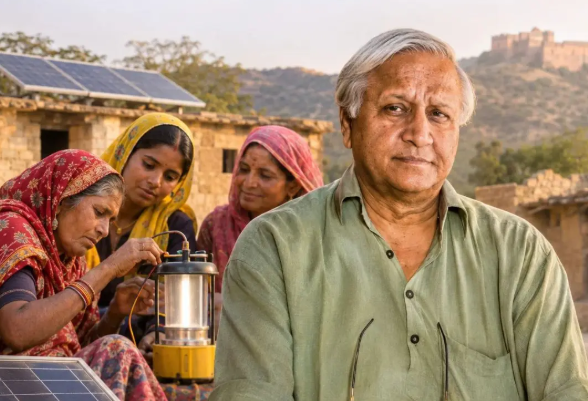
One of its most remarkable initiatives was the training of rural women as solar engineers. Women who had never received formal education, including elderly women and grandmothers, were trained to install, operate and repair solar energy systems. They became popularly known as the ‘Solar Mamas’.
This initiative challenged deeply rooted assumptions about education, technical competence and gender roles. Women traditionally excluded from technical professions demonstrated that practical intelligence, determination and experience could be as valuable as formal qualifications.
The question was not simply how to bring electricity to villages. It was also about who would possess the knowledge and control over the technology. Installing a solar power system means little if every minor technical problem requires an outside expert. Such dependence weakens the very idea of self-reliance.
By training rural women to manage and maintain solar systems, Roy sought to reduce this dependence. These women acquired technical skills, earned respect and assumed leadership roles within their communities. Their empowerment went beyond receiving the benefits of a development programme. They became its knowledge holders, practitioners and decision-makers.
The initiative gradually expanded beyond India to communities across Asia, Africa and Latin America. Women from different countries travelled to Tilonia, received training and returned to manage solar energy systems in their own villages. This experiment challenged the assumption that technical expertise must necessarily emerge from formal educational institutions. It demonstrated that rural communities possess the capacity to develop solutions suited to their own circumstances.
Gandhian philosophy had a clear influence on Roy’s approach to development. Self-reliance, decentralisation, village autonomy, dignity of labour and community participation formed the foundation of his work. Mahatma Gandhi believed that India's strength lay in its villages and that genuine progress depended on their ability to sustain themselves.
Roy translated these principles into practical experiments by combining traditional knowledge with appropriate modern technology. He did not argue that villages should remain isolated from technological progress. His contention was that technology must respond to community needs rather than make people dependent on external institutions and specialists. Technology, in his understanding, should empower people, not create new forms of dependence.
In water-stressed Rajasthan, rainwater harvesting and the conservation of traditional water resources became important components of the Barefoot College approach. In education, night schools provided opportunities to children engaged in agricultural work and household responsibilities during the day. Initiatives in healthcare, sanitation and local livelihoods also emphasised community participation.
These programmes reflected a broader understanding that rural problems cannot be addressed in isolation. Water, electricity, education, health and employment are interconnected. Sustainable solutions require the collective involvement of the people who experience these challenges every day.
Roy's contribution also deserves recognition in the broader history of India's voluntary sector and social movements. He helped establish that social transformation cannot be left entirely to governments and markets. Independent citizen initiatives and organised community action can create meaningful alternatives.
The significance of Tilonia, however, does not lie in presenting its model as a universal formula for every village. India's rural communities differ considerably in geography, economic conditions, social structures and cultural practices. The real importance of the Barefoot College lies in demonstrating that alternative development pathways can emerge when local knowledge, community participation and practical needs are placed at the centre of planning.
At a time when development discourse increasingly revolves around massive investments, industrial expansion, digital technology and large infrastructure projects, Roy's ideas invite a fresh examination of priorities. Modern technology and economic growth are not inherently opposed to rural welfare. But important questions must be asked: Who benefits from development? Who controls its resources? How much authority do ordinary people have in decisions affecting their lives? If rural communities remain merely consumers of services without meaningful control over their resources and institutions, claims of self-reliance remain incomplete.
This remains one of the central challenges facing India's rural development policies. The success of government schemes is frequently measured through expenditure, infrastructure created and the number of beneficiaries covered. Much less attention is paid to the role of Gram Sabhas in planning, the value assigned to local experience and who will operate and maintain facilities after a project is completed.
Roy's work encourages a reconsideration of this approach. Development cannot become sustainable through financial investment and technology alone. It also requires community ownership, trust and active participation. A village must not merely receive a development project; its people must have the ability to shape, manage and sustain it.
His life partner, Aruna Roy, also made an important contribution to India's social movements. Associated with the early years of the Barefoot College, she subsequently emerged as a prominent voice for workers' rights, transparency and the Right to Information movement through the Mazdoor Kisan Shakti Sangathan. Their public lives shared a fundamental belief in the dignity, intelligence and capabilities of ordinary people.
Bunker Roy received several national and international honours, including the Padma Shri in 1986, the Skoll Award in 2005 and the Blue Planet Prize in 2011. In 2010, Time magazine included him among the world's 100 most influential people. These recognitions reflected the international significance of his experiments in community-led development.
Yet the worth of a person's life cannot be measured merely through awards and honours. Roy's greatest achievement can be seen in the confidence of rural women and men who acquired new skills and assumed responsibilities within their communities. It can also be found in villages where people began to recognise that they did not always have to wait for outside experts to solve their problems. They could themselves become agents of knowledge and change.
On November 10, 2026, Roy passed away at his home in Tilonia, Rajasthan. The National Alliance of People's Movements (NAPM), paying tribute to him, described his life as a journey dedicated to grassroots knowledge, community empowerment and alternative development. Musical tributes by folk artist communities of western Rajasthan reflected the cultural and human relationships he had built during his years among rural people.
His departure raises a question more important than the construction of memorials or the organisation of commemorative events. Will his ideas find a meaningful place in development policies and social practice? Will rural experiences be recognised as legitimate knowledge? Will women receive genuine opportunities to participate in technology and decision-making? Will development programmes make people self-reliant or deepen their dependence on external systems?
Bunker Roy's legacy is not confined to an institution, a building or a particular programme. It survives in the belief that people considered ordinary by society possess extraordinary capacities for transformation. What they need is opportunity, dignity, recognition and the right to participate in decisions affecting their lives.
He urged society to understand development not as a process imposed from above, but as a collective journey built from below. The humanitarian concern awakened by the famine in Bihar took him to Tilonia, and the experiments he developed there helped the world recognise the wisdom of villages.
His life reminds us that rural development cannot happen by excluding rural people from the process. The real light of development does not lie merely in machines brought from outside or schemes designed in distant offices. It lies in the knowledge, skills, confidence and collective strength already present within communities. Bunker Roy spent his life recognising that light and helping it spread across the world. That is the enduring significance of his work and the most meaningful tribute to his legacy.
(The author, a senior journalist of Bihar, is a known commentator on governance, develop ment, and diver sity issues.










[[comment.comment_text]]