Israel-Iran War: Another Deadly Chapter in Regional Conflict

 1 year, 3 months ago
Israel, with alleged backing from the U.S., has initiated another conflict, demonstrating a distinct and assertive military approach.
In May 1948, Israel was established on 8,355 square miles of land already inhabited by Palestinians. This homeland was granted not due to local welcome, but because Jewish communities in Europe and the USA opposed further settlement there. The collective memory often overlooks the Holocaust perpetrated by the Nazis. Even former Israeli Prime Minister Golda Meir acknowledged holding a Palestinian passport.
Every Israeli citizen undergoes military training in addition to their chosen profession, prepared to serve the nation. Israel boasts rich resources across agriculture, industry, and science. It is also highly competitive globally in education, innovation, nutrition, and healthcare.
Israel's financial and military strength is well-established. Expatriate Israelis have significantly contributed to the economies and military capabilities of countries like the USA, from whom Israel also draws ideas and skills.
Despite its many advantages, Israel appears to seek conflict. Since 2016, with Benjamin Netanyahu largely at the helm, Israel has been frequently in the news, often for controversial reasons. The notion of attacking an enemy 1,500 km away, surrounded by eight countries, suggests a preference for confrontation.
Conflicts with Egypt
Beyond ongoing skirmishes with Palestinians since 1948, Israel fought two wars with Egypt in 1967 and 1973. The latter, supported by Syria and Jordan, involved a coordinated attack on October 6, 1973, in the Sinai Desert and Golan Heights, aimed at regaining territory lost in the Six-Day War of June 1967. Israel ultimately won both conflicts. In 1967, Israel gained control of the Sinai, the Old City of Jerusalem, and the Gaza Strip. When Jordan occupied Jerusalem, Israelis were expelled. In 1967, Israel reunified the divided capital, allowing Jews to return to the Western Wall, a site of immense religious significance for them.
Since 1948, Israelis and Palestinians have been in deep conflict, with animosity often exacerbated by U.S. foreign policy, which has consistently employed a "divide and rule" approach regardless of the ruling party.
Despite setbacks in Iraq and Afghanistan, the U.S. maintains approximately 30 military bases in Bahrain, Iraq, UAE, Kuwait, and Qatar. On June 23, the Al Udeid Air Base in Qatar, housing ten thousand U.S. troops, reportedly suffered a missile attack from Iran, resulting in 80 fatalities.
Saudi Arabia maintains a particularly close relationship with the U.S. During a recent visit, President Trump reportedly finalized deals with Saudi Arabia, Qatar, the UAE, and the Houthis of Yemen.
The Munich Massacre
Israel experienced a significant act of terrorism when a dozen of its athletes were murdered by the Palestinian group Black September during the 1972 Munich Olympics. Subsequently, Israel eliminated those responsible and also assassinated a Nazi leader implicated in the genocide of Jews during World War II. The Entebbe airport rescue operation in Uganda stands as a classic example of their security forces' capabilities.
October 7, 2023, A Turning Point
The brutal attack by Hamas (an organization associated with the PLO) on October 7, 2023, marked a critical turning point. Approximately 1,200 Israelis were killed, and 240 were taken hostage. Very few have been released in phases, despite a fragile ceasefire.
Siege of Gaza Strip
In retaliation, the Israeli Army established a lasting siege on the Gaza Strip, an area of 139 square miles. This prolonged siege has led to a humanitarian crisis, displacing tens of thousands from a population of two million. Israel claims to have spent $400 million on this operation so far.
Initially, organizations providing food, health support, relief, and drinking water were gradually permitted to enter. However, thousands of Palestinians have been killed, and even some relief workers and UN aid personnel have not been spared. Since March 2, 2025, no humanitarian aid, food, or health trucks have been allowed into Gaza, with over 9,000 trucks awaiting entry at the Egyptian border. Water, gas, and electricity supplies are minimal, leading to extremely dire living conditions.
Thousands of Palestinians have died, and an estimated 14,000 children face death due to starvation and malnutrition. Jews worldwide have expressed deep concern over the suffering of Palestinians in Gaza.
Israel and Hezbollah
Israel is known for engaging on multiple fronts simultaneously. Hezbollah, a Lebanese-based organization, has been consistently at odds with Israel due to its strong support for the Palestinian cause. In October 2024, Israel eliminated Hezbollah leader Hassan Nasrallah, who was replaced by Naeem Mohammed Qasim.
Hezbollah had been allied with the former Russian-backed Syrian regime. With Syrian rebels now in control and Israel having eliminated several Hezbollah leaders, a ceasefire was reached in November 2024, leading to Hezbollah's retreat to Lebanon. While they may be temporarily subdued, Hezbollah remains a formidable force, commanding one of the largest private armies globally.
Houthis of Yemen
The Houthi rebels of Yemen are also significant players in Middle Eastern geopolitics. They harbor strong anti-Israeli sentiments and have recently attacked Tel Aviv, causing considerable damage. Despite a recent deal President Trump reportedly struck with them during his visit to the region, the attack on Tel Aviv still occurred. The Houthis had, however, promised not to attack U.S. vessels and ships transiting the Red Sea and Suez Canal. In a sudden reversal, the Houthis have shown renewed hostility towards Americans and are now supporting Iran.
The Root Cause of the War
The current war between Israel and Iran began on June 13, with Israel initiating the attacks. The core of this conflict lies in Iran's nuclear program. Although Iran is a signatory to the Non-Proliferation Treaty (NPT), unlike Israel, it possesses multiple nuclear sites. Details about Israel's nuclear facilities are never disclosed. While the IAEA inspects Iran's nuclear facilities, it does not inspect those in Israel. Furthermore, the U.S. is determined to prevent Iran from developing a nuclear bomb, which some view as a double standard.
Israel had been prepared to attack Iran several months prior, but the U.S. intervened, as Trump sought to give Iran an opportunity for negotiations. While fresh talks ensued, Iran adopted an unyielding negotiating stance. On June 12, Trump hinted that an Israeli attack could occur soon.
The War Proper
As anticipated, on June 13, Israel attacked Iran's nuclear and military infrastructure. Modern warplanes and drones were deployed to strike key facilities and eliminate several top Iranian generals and scientists. According to the Israeli military, 200 aircraft were involved in attacking 100 targets. Key sites attacked included Iran's primary uranium enrichment facility at Natanz and a second facility at Fordow.
Israel's Prime Minister claimed that attack plans were made in November 2024, shortly after the killing of Hassan Nasrallah.
Instead of advocating for peace, Trump posted on his social platform, "Israel's attacks will only get worse. Iran must make a Nuclear deal." His intervention is likely to have significant implications for West Asian geopolitics.
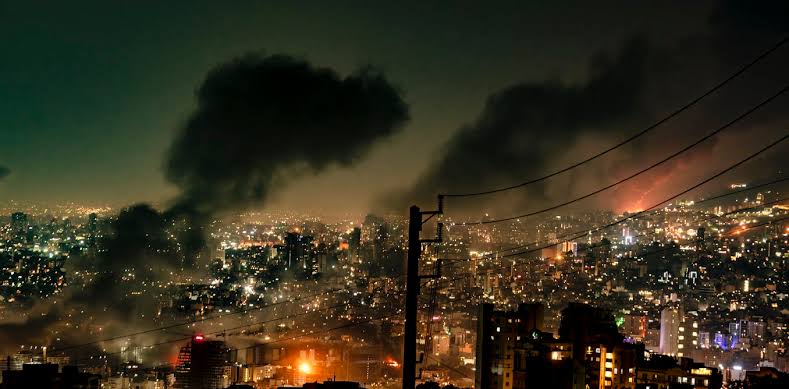
Later that night, Israel issued air raid sirens as retaliatory Iranian missiles began striking various parts of Israel. Explosions were heard in Tel Aviv, Jerusalem, and other locations.
Ayatollah Khamenei, Iran's supreme leader, addressed the nation, stating, "They started war but we will not allow them to escape safely from crime they have committed." The U.S. began deploying resources, including ships, to assist Israel in its retaliation.
Hezbollah condemned the Israeli attack and offered condolences but did not threaten to join Iran. Many countries and Pope Leo XIV condemned the Israeli attack and called for immediate de-escalation. After the Iranian President consented to negotiations on June 14, the U.S. resumed nuclear deal talks with Iran. However, by June 18, Ayatollah Khamenei declared that Iran would not surrender.
Use of Deadly B2, GBU-57 Bombers
Suddenly, on June 22, a U.S. B2, GBU-57 Bomber dropped a Massive Ordnance Penetrator on a uranium enrichment site at Natanz. This "bunker killer" bomb, weighing 30,000 pounds, could penetrate 200 feet below ground. However, Iranians had already relocated 400 kg of uranium from the site. U.S. attacks on two other sites, Fordow and Isfahan, were reportedly futile.
During the war, Iran managed to attack and damage significant Israeli assets, including the International Airport, Defence Headquarters, Mossad Headquarters, a Scientific Research Building, the Stock Exchange, a Bus Terminal, and partially devastating the cities of Tel Aviv and Haifa. The destruction of the Scientific Research Building, dating back to pre-World War II, is considered irreparable. Iran also claimed to have shot down five of Israel's advanced F-35 fighter jets.
According to Human Rights Activists, a Washington-based NGO, the 12-day war resulted in 28 fatalities and 1,000 injuries on the Israeli side. Iran reported 974 deaths and 3,458 wounded. Given the persistent claims and counter-claims from both Israel and Iran, one might question the necessity of this war.
An Unusual Ceasefire
After facing significant protests domestically and internationally, President Trump unilaterally announced a ceasefire on June 24. Initially, neither Israel nor Iran fully honored it.
Trump further claimed that Iran's nuclear enrichment facilities had been completely destroyed and that Israel was the sole, undisputed nuclear power in West Asia. Israel has accused Iran of violating the ceasefire, a claim denied by the Iranian military. Nevertheless, it is true that one hour before the ceasefire, Iran launched 20 missiles over Israel, damaging the city of Beersheba.
While temporary peace may prevail, it is not a lasting solution.
Likely Impact
Iran is unlikely to be deterred by Trump's threats. Instead, the U.S. should be concerned about its 40,000 troops stationed in the region. Iran will likely align its actions with Russia's suggestions.
Iran could also close the 3 km wide Strait of Hormuz, complicating global affairs, as 20% of the world's crude oil passes through it. Located in the territorial waters of Iran and Oman, Hormuz is a vital passage for Iran, Iraq, Kuwait, Saudi Arabia, and the UAE. Its closure would disrupt China's energy supply, as China is a major buyer of Iranian oil. Even a temporary closure affecting global trade and inflation could lead to shortages and increased prices for oil and essential commodities, even in India.
Interestingly, U.S. allies Qatar, Iraq, and Saudi Arabia have disapproved of the Israeli strikes and condemned the violation of Iran's sovereignty by Israel. Trump must now also consider the combined influence of Russia, China, North Korea, Turkey, and Pakistan, given their open support for Iran.
(Author, a retired civil servant, formerly served as the Chief Secretary in the state government of Sikkim.)








[[comment.comment_text]]