SIR Debate Escalates as Nationwide Protests Follow Delhi Clampdown

 an hour ago
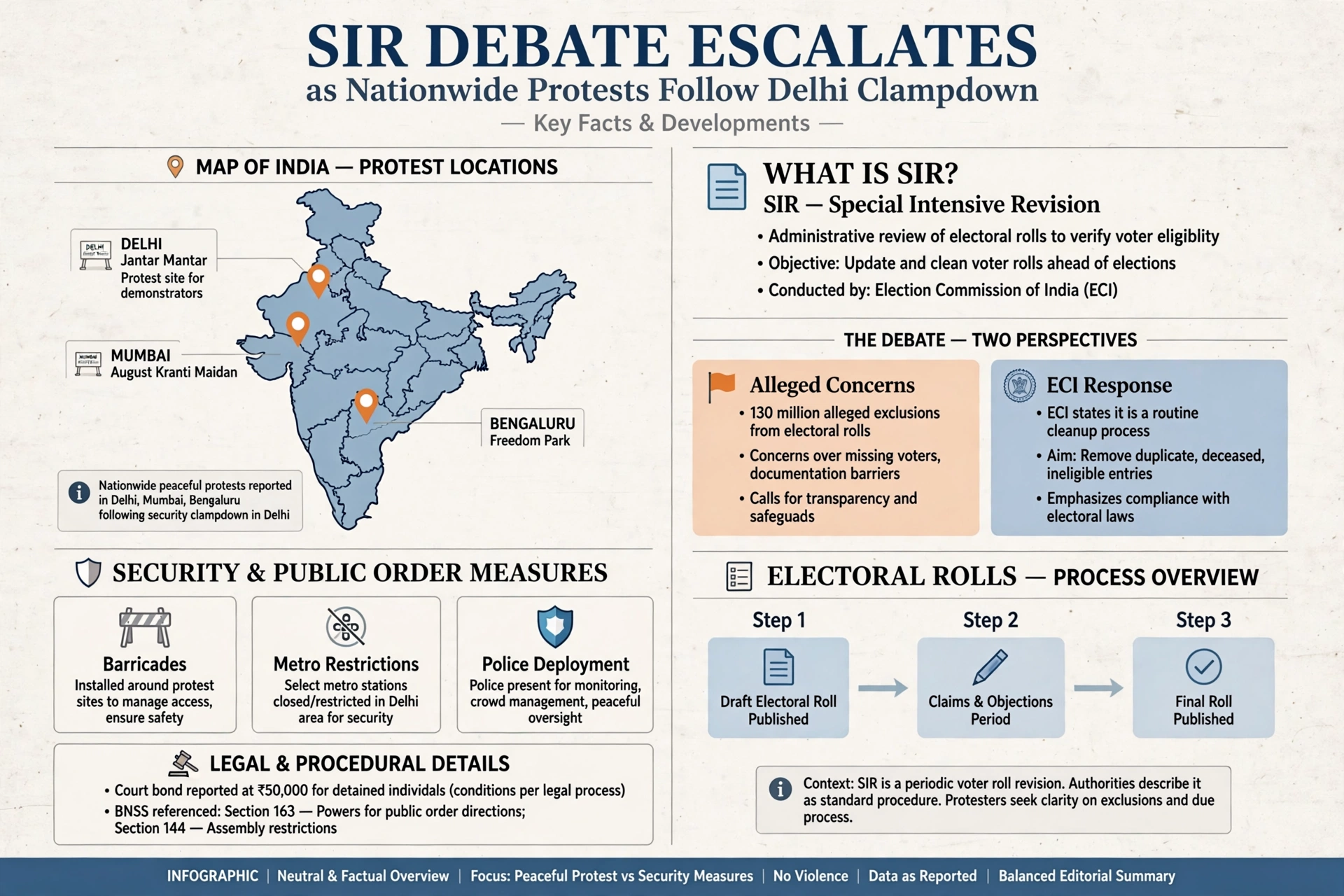
A high-stakes debate over India’s electoral roll management escalated into a national political confrontation this weekend, as security forces executed extensive containment measures across the capital while solidarity demonstrations spread to major cities including Mumbai and Bengaluru.
The youth-led Cockroach Janta Party (CJP), acting in coordination with the opposition INDIA bloc and civil society groups, called for a mass assembly at New Delhi’s Jantar Mantar to demand the resignation of Chief Election Commissioner (CEC) Gyanesh Kumar. The demonstrators allege that the Election Commission’s Special Intensive Revision (SIR) exercise led to the improper exclusion of 130 million voters nationwide. In response, election officials and government representatives maintain that the revision is a transparent, routine administrative cleanup necessary to remove duplicate, shifted, and deceased entries from official registries.
Capital Security Measures and Transit Disruption
In anticipation of the planned mobilization, the Union Home Ministry and Delhi Police implemented a heavy security protocol across New Delhi over the weekend. More than 30,000 police and paramilitary personnel, including 221 companies of the Central Armed Police Forces (CAPF), were deployed at key strategic points. Major vehicular access routes, such as the Dhaula Kuan intersection, were fitted with multi-layered steel barricades, spiked strips, and automated facial recognition monitoring.
To manage crowd flow and prevent large-scale gatherings within the central administrative zone, transit networks faced substantial operational adjustments.
The Ministry of Railways curtailed or cancelled over 250 local and long-distance trains heading toward New Delhi and Hazrat Nizamuddin stations. Simultaneously, the Delhi Metro Rail Corporation temporarily restricted entry and exit gates across more than 55 key transit stations, including major hubs like Rajiv Chowk, Central Secretariat, Patel Chowk, Mandi House, and Kashmere Gate. Authorities also implemented a temporary 24-hour suspension of mobile data services within a four-kilometer radius of the Janpath-Kartavya Path corridor.
High-Profile Detentions and Legal Proceedings
Law enforcement agencies focused their containment efforts on preventing key organizers and political figures from assembling at the designated protest sites. CJP founder Abhijeet Dipke was taken into preventive custody by police officers upon his flight’s arrival at Delhi Airport. In video footage recorded prior to his transport, Dipke challenged the administrative actions, asserting that peaceful civic organizers were being treated with undue severity. Fellow CJP organizers Saurav Das, Ashutosh Ranka, and national spokesperson Deepak Baliyan were similarly detained in separate multi-state operations.
As the day progressed, preventive detentions were extended to prominent opposition leaders attempting to join the march. Former Delhi Chief Minister Arvind Kejriwal was intercepted outside his Lodhi Estate residence, while West Bengal Chief Minister Mamata Banerjee, Kerala Chief Minister Pinarayi Vijayan, and former Tripura Chief Minister Manik Sarkar were temporarily held in police buses before being relocated to designated holding centers. Similar detentions occurred near the Supreme Court of India, where a gathering of lawyers was temporarily moved to the Yamuna Sports Complex before being released following interventions by bar association representatives.
On Sunday morning, CJP leaders Abhijeet Dipke, Ashutosh Ranka, and Saurav Das were presented before the Special Executive Magistrate (SEM) Court in Delhi Cantonment. The magistrate ordered their conditional release upon the execution of a ₹50,000 peace bond each under Sections 126 and 170 of the Bharatiya Nagarik Suraksha Sanhita (BNSS), binding them to maintain public order. Following his release, Dipke’s family expressed grief that procedural delays prevented him from attending his grandmother's funeral in Maharashtra; Delhi Police issued a clarification stating that travel arrangements had been offered to Dipke, which he declined for personal reasons.
Protests Spread to Mumbai and Bengaluru
The events in the capital acted as a catalyst for concurrent demonstrations in other major urban centres on Sunday:
* Mumbai: Demonstrators under the banner of 'Hum Bharat Ke Log', led by social activist Tushar Gandhi, organized a march near August Kranti Maidan. Mumbai Police erected barricades near Nana Chowk and preventively detained approximately 600 individuals, including Gandhi, who was taken to the D.N. Nagar police station. An FIR was subsequently registered regarding unpermitted assembly under the Bharatiya Nyaya Sanhita (BNS) and the Maharashtra Police Act.
* Bengaluru: A public gathering assembled at Freedom Park, where civic groups and youth representatives voiced concerns regarding electoral roll transparency. Public figures including actor Prakash Raj and commentator Dhruv Rathee addressed the crowd, advocating for institutional checks and balances in electoral administration.
Clashes, Viral Violence, and Counter-Demonstrations at Ground Zero
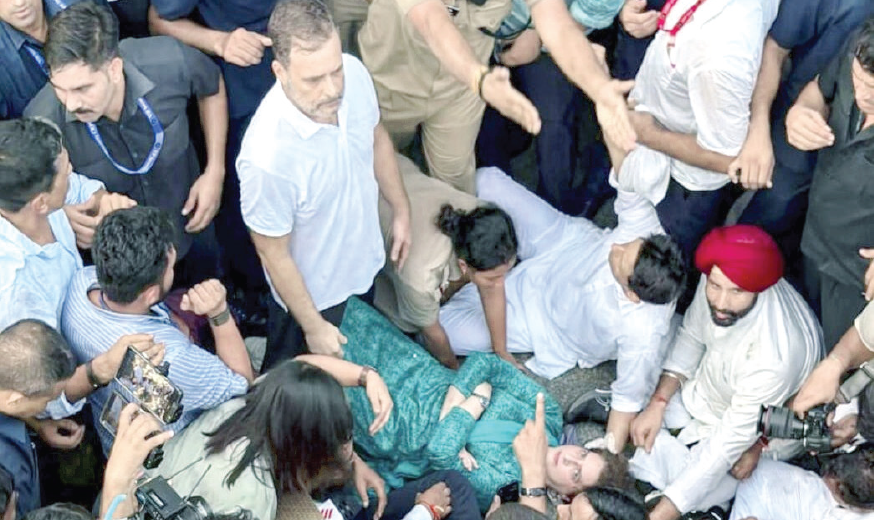
At Jantar Mantar and Connaught Place, strict enforcement of Section 163 of the BNSS—prohibiting gatherings of five or more people—kept the area under tight security supervision, complete with armored vehicles and water cannons. Despite repeated warnings broadcast via police loudspeakers, splinter groups of student activists from organizations such as the All India Students’ Association (AISA) reached the periphery, chanting slogans demanding accountability from election officials. Physical scuffles occurred as security personnel moved to escort non-compliant demonstrators to waiting transport vans.
Violent incidents also erupted on the periphery of the protest zone on Saturday. Delhi Police arrested four individuals after a video showing them assaulting a young woman on Deen Dayal Upadhyaya (DDU) Marg circulated widely on social media platforms. The arrested individuals have been identified as Raman Saini (50), Vivekanand alias Vivek (32), Kapil Kumar (27), and Ravinder Singh alias Govind Hindu (35). Police confirmed that all four men are members of the Hindu Raksha Dal.
Concurrently, a counter-demonstration took place along Janpath under the satirical banner of the 'Lal Hit Janata Party'.
Formed in opposition to the CJP’s platform, the counter-protesters expressed support for the Election Commission and law enforcement, condemning public disruptions and urging strict adherence to statutory procedures for addressing administrative grievances.
The Core Electoral Roll Debate
The expanding demonstrations highlight fundamental differences over the execution of the Special Intensive Revision:
* Opposition & Civic Critique: Opposition leaders, including Leader of the Opposition Rahul Gandhi and Congress President Mallikarjun Kharge, argue that the draft deletion of 130 million names disproportionately impacts young voters, seasonal migrant labourers, and economically weaker sections. Legal experts and advocacy groups have raised procedural concerns regarding the criteria used for draft exclusions, calling for comprehensive judicial oversight and independent audits of the revised registries.
* ECI & Government Defence: Representatives of the Election Commission and government spokespersons reiterate that the SIR is a standard statutory procedure designed to ensure electoral integrity by identifying deceased electors, address changes, and duplicate registrations. Officials emphasize that draft publication lists are subject to public claims and objections before final roll publication, and that security deployments were necessary to prevent unpermitted gatherings from disrupting municipal functionality.
The Path Ahead
While central Delhi has transitioned back to regular traffic flows under ongoing security monitoring, movement leaders and civil society representatives have indicated that public engagements regarding electoral roll transparency will continue through regional forums across the country. With legal proceedings ongoing for several detained activists across multiple states, attention remains focused on how statutory authorities, the judiciary, and civic representatives will navigate the balancing act between public order, administrative roll accuracy, and constitutional rights of assembly.
(The author is a former member of the history faculty at St. Xavier’s College, Mumbai. Views are personal.)





[[comment.comment_text]]