The Opposition’s Catch-22: Balancing Anti-BJP Consolidation with Regional Turf Wars

 an hour ago
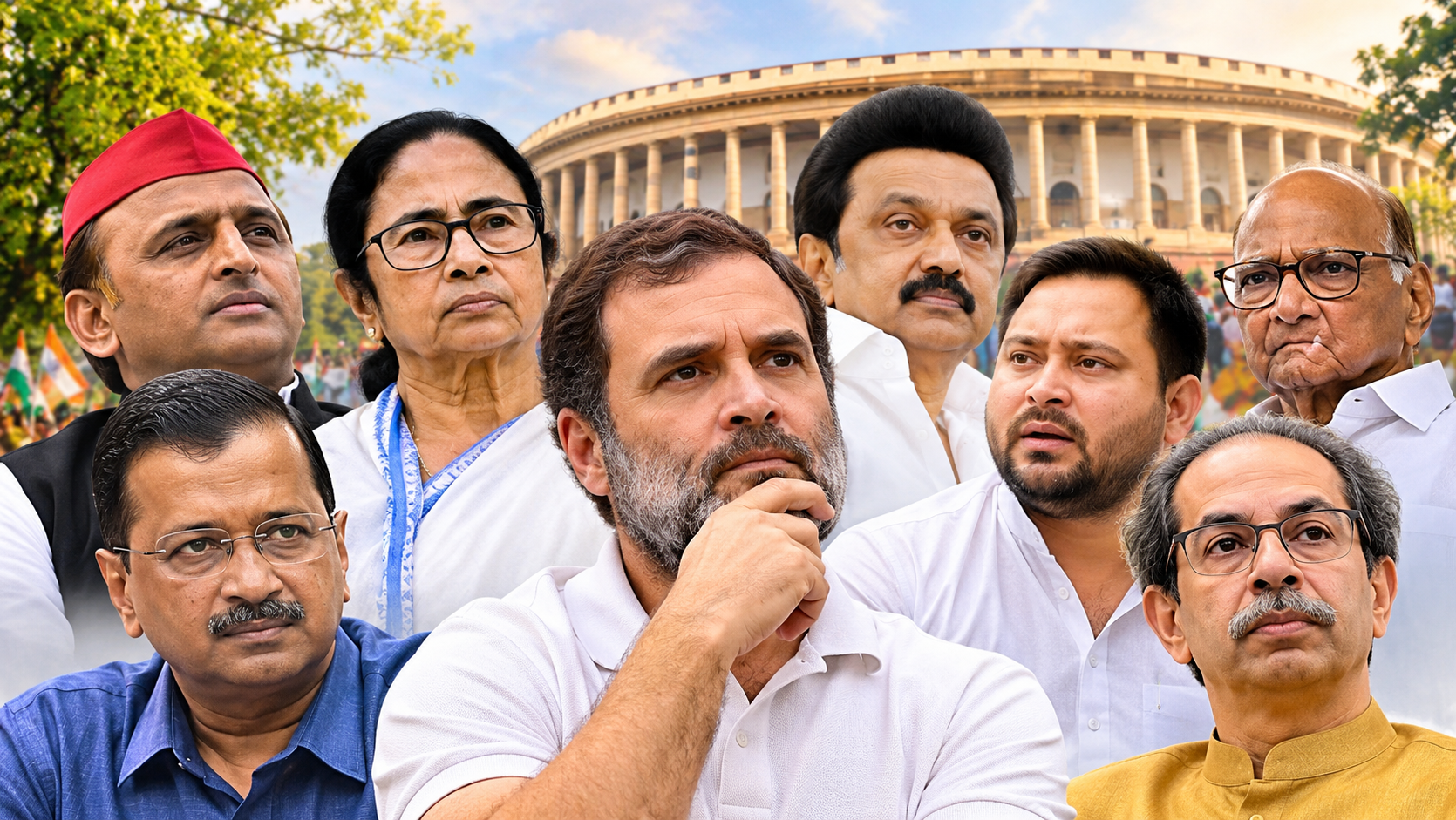
The political battle to challenge the BJP in the run-up to the 2029 Lok Sabha elections is increasingly turning into a struggle for survival among opposition parties themselves. The Aam Aadmi Party’s (AAP) decision to distance itself from the INDIA bloc reflects a growing contradiction within the opposition camp: while regional parties want to unite against the BJP at the national level, they remain deeply suspicious of the Congress’s ambitions in their respective states. What was conceived as a collective platform to challenge the BJP-led National Democratic Alliance (NDA) is gradually becoming an arena of competing political interests, leadership ambitions and electoral insecurities.
AAP’s political calculations are particularly significant because its concerns are rooted in its experience in Delhi and Punjab. The party understands that the Congress, despite its organisational decline in several states, retains a traditional voter base that can influence electoral outcomes. In Delhi, Congress support was an important factor in AAP’s rise to power, while in Punjab the party benefited from anti-incumbency against the Congress government and the consolidation of voters seeking an alternative in the 2022 Assembly elections. However, the relationship between the two parties has increasingly become competitive rather than cooperative. AAP now appears to believe that an alliance with Congress could eventually strengthen its principal political rival in Punjab, where the party has much more at stake following its defeat in Delhi.
The Delhi election results illustrate this dilemma. In the 2024 Lok Sabha elections, Congress and AAP contested separately allocated seats under an alliance arrangement, with Congress contesting three and AAP four of Delhi’s seven parliamentary constituencies. The BJP won all seven seats. However, the subsequent 2025 Assembly elections exposed the limitations of opposition coordination. AAP contested independently, the BJP secured 48 of the 70 Assembly seats with approximately 45.6 per cent of the vote, while AAP won 22 seats with around 43.6 per cent. Congress failed to win a single seat, although it secured approximately 6.3 per cent of the vote. The result ended AAP’s decade-long rule in Delhi and restored the BJP to power after 27 years. More importantly, it demonstrated how even a relatively small vote share held by a third party can influence the outcome of a closely contested election.
For AAP, the larger concern is not merely the immediate electoral challenge posed by Congress but the possibility of its gradual political revival at the expense of regional parties. The same dilemma confronts several opposition leaders who have built their political influence by replacing Congress in their respective states. Parties such as the Trinamool Congress in West Bengal, the Dravida Munnetra Kazhagam in Tamil Nadu, the Samajwadi Party in Uttar Pradesh, the Rashtriya Janata Dal in Bihar and various political formations in Maharashtra have emerged as significant forces in regions where Congress once enjoyed considerable influence. These parties may need Congress to consolidate anti-BJP votes nationally, but they have little interest in allowing it to regain political ground within their own states.
This contradiction is becoming the central weakness of the INDIA bloc. Its constituents share an objective of challenging the BJP, but they lack a common understanding of leadership, electoral priorities and the distribution of political space. At the national level, Congress expects recognition as the principal opposition party because of its parliamentary strength and nationwide presence. Regional parties, however, believe that electoral leadership should reflect their respective state-level influence. Consequently, cooperation against the BJP often gives way to competition over seats, leadership and voter bases.
The expansion of the BJP has further complicated this political landscape. For decades after Independence, Congress dominated national politics and governed a large majority of Indian states. Over time, regional parties emerged by mobilising voters against Congress governments, particularly in states where local political, social and economic grievances created opportunities for alternative leadership. Today, the BJP occupies much of the political space that Congress once controlled. Under Prime Minister Narendra Modi, the party has expanded its organisational presence, electoral influence and political reach across several regions. Its success has not been uniform, and in many states it continues to depend on regional allies, but its ability to remain electorally competitive across the country has fundamentally altered the opposition's political calculations.
The challenge for opposition parties is that several regional leaders who once appeared to be formidable alternatives to the BJP have themselves encountered serious political setbacks. Naveen Patnaik lost power in Odisha after more than two decades of Biju Janata Dal rule. Sharad Pawar and Uddhav Thackeray have faced organisational divisions and challenges to their political influence in Maharashtra. The Trinamool Congress under Mamata Banerjee continues to face a determined BJP challenge in West Bengal, while Tejashwi Yadav is attempting to strengthen the RJD's position in Bihar. AAP, meanwhile, has lost Delhi and is now concentrating its political resources on retaining Punjab. These developments suggest that regional dominance can no longer be taken for granted, particularly in an increasingly competitive national political environment.
Uttar Pradesh is likely to become one of the most consequential battlegrounds in this emerging political contest. With 80 Lok Sabha seats and 403 Assembly constituencies, the state remains central to the BJP's national electoral strategy. Samajwadi Party president Akhilesh Yadav faces the challenge of translating the party's parliamentary performance into an Assembly victory in 2027. His alliance with Congress proved electorally useful in the 2024 Lok Sabha elections, but the arrangement could become more complicated when the two parties negotiate Assembly seats. The Samajwadi Party has a substantial independent political base, while Congress is keen to rebuild its organisation and recover some of the support it has lost over the years. For Akhilesh Yadav, strengthening Congress may be necessary to consolidate anti-BJP votes, but it could also create a future competitor in a state where the SP seeks to remain the principal opposition force.
The position of the Bahujan Samaj Party is equally important. Mayawati, a four-time chief minister of Uttar Pradesh, has witnessed a significant decline in the party's electoral influence. Nevertheless, the BSP retains a political identity and voter base that could influence results in several constituencies. The All India Majlis-e-Ittehadul Muslimeen (AIMIM), led by Asaduddin Owaisi, may also affect electoral calculations in selected areas. If opposition parties fail to coordinate effectively, a division of votes could benefit the BJP. However, the impact of smaller parties cannot be assessed uniformly, as local candidates, caste equations, community preferences and constituency-specific factors also determine electoral outcomes.
The seven Assembly elections scheduled for 2027 in Uttar Pradesh, Punjab, Uttarakhand, Manipur, Goa, Gujarat and Himachal Pradesh will provide an important test of the opposition's political strength. The BJP currently governs five of these states, while Congress is in power in Himachal Pradesh and AAP governs Punjab. For the BJP, retaining its existing governments and expanding its influence in the remaining states will be a major political objective. For Congress, Himachal Pradesh is particularly important because it represents one of the few states where the party currently exercises direct governmental authority. For AAP, Punjab is crucial to its survival as a national political force. Losing another state after Delhi would substantially weaken its organisational and electoral standing.
Punjab, therefore, could become the most closely watched test of the Congress-AAP rivalry. AAP will seek to defend its government under Chief Minister Bhagwant Mann, while Congress will attempt to recover the political ground it lost in 2022. If the two parties contest separately, the division of anti-BJP votes could create opportunities for other political forces, including the BJP and the Shiromani Akali Dal. Yet Punjab's electoral dynamics are distinct from those of other states, and the outcome will depend on governance, farmers' concerns, employment, law and order, economic conditions and the credibility of political leadership.
Congress, meanwhile, faces a fundamental question about its national strategy. Its improved performance in the 2024 Lok Sabha elections, when it increased its parliamentary strength from 52 to 99 seats, was an important achievement. However, the party's gains were closely connected with state-level alliances and the broader consolidation of opposition votes. In Uttar Pradesh, the Samajwadi Party played a significant role in the INDIA bloc's performance; in Maharashtra, Congress benefited from coordination with the Shiv Sena (Uddhav Balasaheb Thackeray) and the Nationalist Congress Party (Sharadchandra Pawar); and in Tamil Nadu, its alliance with the DMK provided a strong electoral platform. These partnerships helped Congress improve its parliamentary position, but they also strengthened regional allies that may now be reluctant to accommodate its ambitions.
The problem is that Congress wants to emerge as the central force of opposition politics, while several of its allies want it to remain a supporting partner in their respective states. This is not simply a disagreement over seats. It reflects a deeper struggle over political identity and the future distribution of opposition leadership. Congress cannot expect regional parties to surrender their political space merely because it has a larger national presence. At the same time, regional parties cannot realistically challenge the BJP across the country without a broader national alliance.
The debate over Electronic Voting Machines and allegations of irregularities in electoral processes has also become a prominent feature of opposition politics. Congress and other opposition parties have repeatedly raised concerns about the transparency of elections, the accuracy of electoral rolls and the functioning of the Election Commission. Such concerns deserve examination through evidence, institutional scrutiny and transparent procedures. Electoral institutions must remain accountable, and political parties have every right to demand improvements in the electoral process. However, allegations without substantiated evidence cannot substitute for a credible political strategy. The opposition must demonstrate that it can offer a convincing alternative on governance, economic management, employment, education, healthcare and social security rather than relying primarily on allegations against electoral institutions.
The BJP's electoral advantage has not come solely from the weaknesses of its opponents. Its organisational structure, booth-level mobilisation, central leadership, welfare programmes and ability to maintain a consistent political narrative have contributed to its expansion. Opposition parties must recognise that challenging this strength requires more than electoral alliances and common criticism of the Prime Minister. They need stronger grassroots organisations, credible state leadership, coherent policy alternatives and a sustained engagement with voters.
The road to the 2029 Lok Sabha elections will therefore be determined as much by the internal politics of the opposition as by the BJP's performance in government. AAP's distancing from the INDIA bloc may be an early indication of a wider realignment in which regional parties increasingly prioritise their individual political survival over national opposition unity. The Samajwadi Party could face a similar dilemma in Uttar Pradesh, while other regional parties may also reconsider the terms of their relationship with Congress as the 2027 Assembly elections approach.
Ultimately, the opposition's greatest challenge is not simply the electoral strength of the BJP but its own inability to reconcile national ambitions with regional political realities. Congress must rebuild its organisation without alienating the very allies whose support helped it recover in 2024. Regional parties, in turn, must decide whether their long-term interests are better served by competing with Congress or by developing a sustainable framework of political cooperation.
The coming elections will reveal whether the INDIA bloc can evolve into a credible political alternative or remain a loose arrangement of parties united more by their opposition to the BJP than by a shared vision of governance. AAP's decision has exposed the fault lines, but the deeper crisis extends far beyond one party. Unless the opposition resolves its leadership disputes, electoral rivalries and organisational weaknesses, its ambition to prevent the BJP from securing another term in 2029 could remain an aspiration rather than a viable political strategy.






[[comment.comment_text]]