India’s Democracy on Trial (From Street Protests to Global Scrutiny)
 1 day, 1 hour ago
A democracy is characterised by the actions of individuals in positions of authority—by the room they provide for dissent, the freedom citizens have to challenge authority, and the institutions' willingness to protect their rights—rather than by the statements it makes about itself. Democracy is built on elections, but its core values are governmental accountability, fearless press, and civil rights. The worldwide consequences of a country's domestic democratic behaviour are unavoidable when it seeks to take the lead on the international scene.
India stands out as the largest democracy in the world due to the size of its elections and the robustness of its constitution. However, the calibre of its democratic institutions has been questioned by a number of international democracy indices. In light of this, the government's handling of student protests and the reaction of the international media have highlighted an unsettling question: Does a country's claim to democratic leadership ultimately depend on how those in power handle dissent and defend citizens' rights, or is it only validated by the size of its elections?
Big Democracy, Fragile Credibility
India is the biggest democracy in the world, yet evaluations by a number of international organisations cast doubt on how well it operates as a democracy. India is ranked 41st on the Economist Intelligence Unit's Democracy Index, making it a "flawed democracy". India is ranked 106th in the related ranking and 105th out of 179 nations on the V-Dem Institute's Liberal Democracy Index. India is categorised as "Partly Free" by Freedom House and as an "Electoral Autocracy" by V-Dem.
Since these organisations use distinct approaches and standards, their results cannot be considered directly comparable. However, their evaluations highlight an important distinction: a democracy's size and the calibre of its democratic functioning are not the same. An important accomplishment is the size of India's election process. However, free speech, nonviolent protest, and institutional responsibility continue to be crucial indicators of democratic strength.
Global Scrutiny, Democratic Credibility
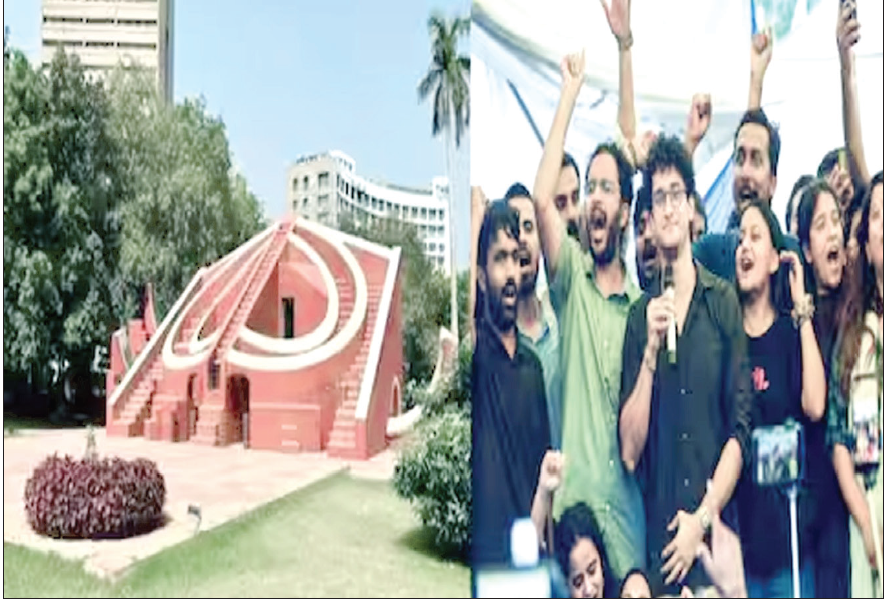
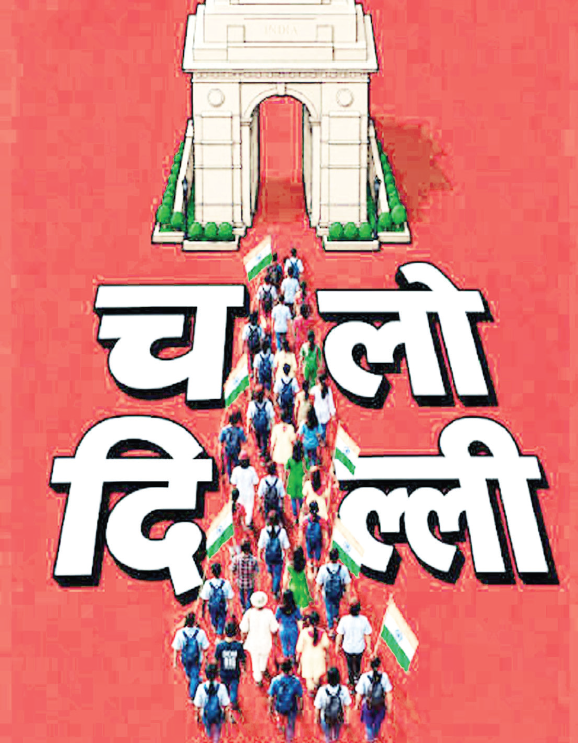
India's democratic behaviour has become the focus of international discussion due to the government's response to student protests organised by the Cockroach Janata Party (CJP). Police action, journalist detentions, and concerns about electoral openness have been major topics of coverage by The Guardian, Reuters, the Associated Press (AP), Al Jazeera, The New York Times, The Wall Street Journal, and The Washington Post.
In its piece published on October 16, "Modi's predicament: Gen Z pours out on India's streets as dissent surges," Reuters emphasised the growing dissatisfaction of young people over issues with unemployment, education, and electoral transparency. The Guardian placed the movement in the context of a larger demonstration against electoral justice and governmental accountability in an article published on October 19. In their October 10 story, "How can you stop these kids?" Al Jazeera concentrated on the police presence in Delhi, the incarceration of demonstrators, and the limitations placed on protests. Concerns regarding the alleged harassment of journalists covering the protests and the consequences for press freedom were also made public by Reuters and AP reporting.
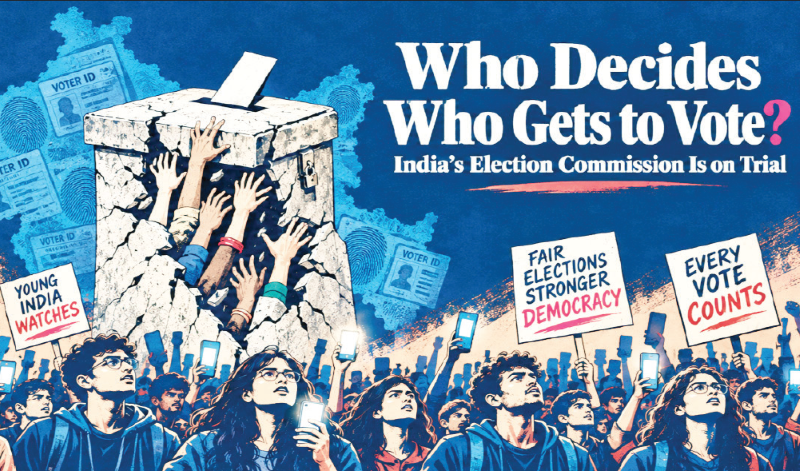
A common question has emerged from reports of mass detentions, restrictions at protest locations, alleged physical attacks on journalists, and disputes over the Special Intensive Revision (SIR) of electoral rolls: Were the actions taken in the name of upholding public order necessary and proportionate? Were the rights to independent media and nonviolent protest sufficiently upheld?
Interpreting these reports and commentary as a global or international consensus would be incorrect. However, rejecting them as nothing more than outside criticism would also be an attempt to avoid responsibility. A democracy builds its legitimacy by reacting to criticism with openness, unbiased inquiry, and commitment to constitutional values rather than by repressing it.
The State vs. Dissent
The dilemma is no longer simply about the behaviour of individuals in positions of authority; it also concerns the psychological well-being of society when the cry for justice starts to resound as a general mistrust. Similarly, if individuals are unable to express their complaints in between election cycles, journalists are afraid to criticise government policies, and students are hesitant to use their right to peaceful protest, democracy cannot be evaluated solely via elections. Although dissent may annoy those in positions of authority, democracy's capacity to tolerate disagreement is one of its defining characteristics.
An analysis of the government's response to student protests must concentrate on its actions and the ensuing repercussions rather than conjecturing about its motivations. Were the limitations placed on demonstrators appropriate and necessary? Were claims of mistreatment of journalists looked into objectively? Were there enough opportunities for students to voice their complaints? Were grievances over the electoral rolls' Special Intensive Revision (SIR) handled openly? Official guarantees are insufficient to resolve these issues. They call for proof, impartial examination, and responsible institutional procedures.
The right to peaceful and unarmed assembly is guaranteed by the Constitution, subject to reasonable limitations set in compliance with the law. Therefore, it would be incorrect to label all administrative actions as anti-democratic. On the other hand, it would be incorrect to assume that every action that is justified in the name of public order is also just. The true test is whether or not limits are required, whether their rationale is well-established, and whether or not civil freedoms are restricted beyond what is justified.
Press freedom is subject to the same rule. It is the duty of a journalist to examine the use of power, not to enhance the reputation of individuals in positions of authority. Claims that journalists have been mistreated or that their reporting has been obstructed call for a reliable and unbiased investigation. An independent press is essential to democratic accountability; it is not the state's enemy. Democracy is measured by the freedom and safety with which dissenting voices are permitted to pose challenging questions, not by how well those in positions of authority manage to avoid them.
The UNSC Bid vs. Democratic Credibility
India has long sought permanent participation in the United Nations Security Council (UNSC), claiming that the Council's 1945 global power structure no longer appropriately represents the demographic, economic, and strategic realities of the modern world. Important pillars of India's claim include its diplomatic reach, economic might, and contributions to global peace and prosperity.
However, permanent membership is neither an award given to a country nor a certification of democratic behaviour. Modifications to the UN Charter and adherence to the established ratification procedures would be necessary for reform. Therefore, it would be deceptive to infer a direct or automatic link between India's chances of obtaining a permanent seat, condemnation in the media, and police action against student demonstrators.
However, economic might and strategic clout are not the only factors that determine global leadership. The congruence between a country's declared beliefs and its behaviour is another factor that determines its legitimacy. Examining India's internal democratic processes becomes a natural and acceptable part of the global discourse when it promotes a more representative international order and positions itself as a champion of democratic values and a voice for developing nations.
In this broader environment, student protests, journalistic freedom, and disagreements over electoral rolls gain important. These events do not prove that India's international ambitions have been compromised on their own. They do, however, bring up a crucial accountability question: do India's domestic institutions adhere to the same values of democratic participation, representation, and transparency as the people want international institutions to?
Demanding a larger seat at the global high table is not enough to establish credibility as a global leader. Additionally, it must be developed domestically through upholding constitutional liberties, defending the right to dissent, guaranteeing institutional openness, and holding public officials responsible. In the end, a country's status internationally is determined by both the democratic principles it upholds domestically and the influence it wields elsewhere.
Conduct, Not Image
Interpreting negative foreign media coverage as the global consensus would be incorrect. India's constitutional framework, competitive elections, independent judiciary, and active civil society must all be considered while evaluating the country's democracy. However, the fact that these organisations exist does not excuse ignoring concerns about how they operate.
The solution must be found in unbiased investigations, openness, and efficient accountability, whether there are significant accusations regarding police activity against students, journalists report being hindered in their reporting, or residents have concerns about the change of voting records. A democracy shows its strength by allowing its behaviour to endure scrutiny rather than by defending itself against criticism. Addressing accusations with facts and evidence rather than brushing them off is the most believable way to respond to enquiries posed by the global media.
India wants to play a bigger part in international decision-making and have a permanent seat on the UN Security Council. Its prospects cannot be ascertained by a single home incident or foreign media reaction; instead, it depends on its economic might, diplomatic prowess, and international cooperation. However, democratic credibility continues to be a crucial component of India's overall foreign reputation. A country that aspires to a more egalitarian and representative global system must also act in a way that reflects these ideals at home.
India's true challenge is to increase public trust, which is the foundation of its democratic identity, rather than to save its reputation abroad. It is a source of pride to be the biggest democracy in the world, but maintaining its quality is a much bigger duty. Only when students may ask questions without fear, journalists can openly report the truth, and citizens don't have to worry about losing their rights if they express opposition will that responsibility be fulfilled.
Ultimately, a nation's global reputation is based on the freedom, fairness, and dignity it affords its own people as well as how well-known it is on the global stage. India wants to be a permanent member of the Security Council, but democratic credibility is the true litmus test.
(The author, a Doctorate in Laws, is a senior lawyer and civil society activist.)





[[comment.comment_text]]