A Youth Movement That Can Topple Ministers

 2 hours ago
A leaked exam, a satirical party and a ministerial resignation: in five months, India’s “Cockroach” movement has gone from online joke to street force. Whether it marks a passing storm or a new politics is still unsettled.
On July 25, supporters of a youth movement gathered at Jantar Mantar in New Delhi to celebrate the resignation of a union minister. Dharmendra Pradhan, the education minister, had stepped down after more than a month of sit-ins, hunger strikes and marches led by a group founded online only ten weeks earlier. Less than three months later, in the same city, at least 7,000 people were detained during a youth-led protest. Between those two scenes lies one of the most unusual political stories of the year: a campaign that began as satire and is now testing how far public pressure can reach into the institutions of the state.
The story begins with an examination. The National Eligibility cum Entrance Test for undergraduate medical admissions was held on May 3, with nearly 23 lakh registered candidates across 551 Indian cities and 14 centres overseas. Within days, allegations of malpractice and a paper leak surfaced. The National Testing Agency cancelled the exam, the Central Bureau of Investigation took up the case, and a nationwide retest was held on June 21. For the roughly two million students affected, the episode meant months of preparation voided and admissions timelines disrupted.
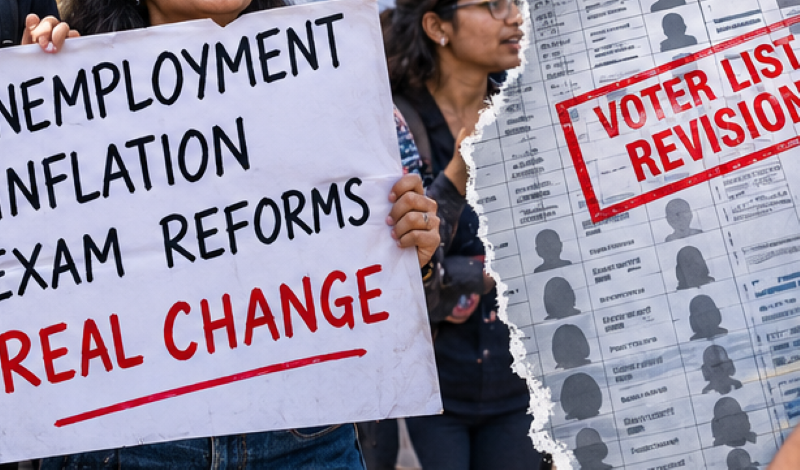
The Cockroach Janta Party, or CJP, was launched online on May 16 by Abhijeet Dipke, a political communications strategist. Its name echoed that of the ruling Bharatiya Janata Party, and its origins are tied to a remark attributed to Chief Justice Surya Kant, who reportedly described certain activists and unemployed youth as cockroaches. The remark was later clarified, but the label stuck, and the movement adopted it as an emblem. The CJP is not a registered political party. It has been described as a digital platform for young people frustrated by unemployment, inflation and institutional failures.
What began online moved quickly onto the streets. After holding its first press conference on June 3, the group began street protests on June 6, demanding Pradhan’s resignation over repeated paper leaks. Between June 20 and June 28, it staged a sit-in at Jantar Mantar, where the activist Sonam Wangchuk joined a hunger strike. On July 20, tens of thousands attempted to march to Parliament; police responded with tear gas and baton charges. Five days later, Pradhan announced his resignation, and the CJP called off its agitation. Pradhan said numerous effective measures had been taken in the months since the paper leak.
The resignation was followed by concessions. The Centre announced a task force under Nandan Nilekani to overhaul the examination system and introduced a bill proposing tougher penalties for exam-related offences. It also agreed to compensate the families of students who died by suicide and to drop cases against protesters. Supporters of the movement celebrated the outcome as a victory for young people. One student cautioned that the minister’s exit was a victory but not enough, and observers have debated whether the measures amount to lasting reform or damage control. Commentators have called Pradhan’s departure a rare instance during the Modi years of sustained public pressure producing a ministerial exit.
The movement’s second phase moved from examinations to elections. The target is the Special Intensive Revision, or SIR, of electoral rolls, an exercise that began in Bihar last year before that state’s elections and has since been extended nationwide. The Election Commission says the revision is meant to remove duplicate, deceased and ineligible entries and to protect electoral integrity. Opposition parties and protesters allege that it has disenfranchised eligible voters. Figures vary by source, CIVICUS Monitor reports that about 130 million names have been removed from voter lists, while other reporting notes that a revision in West Bengal removed roughly 9 million names, about 12 percent of the electorate, and that Election Commission data suggests rolls in some regions could shrink by as much as 30 percent.
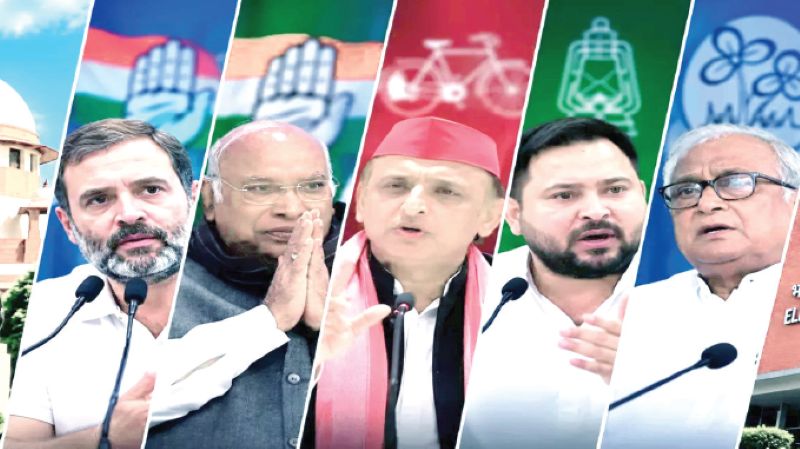
On October 2, the CJP announced nationwide demonstrations demanding the resignation of Chief Election Commissioner Gyanesh Kumar, an independent inquiry into the SIR and the restoration of pre-SIR rolls. On October 6, opposition lawmakers marched from Parliament to the Election Commission’s headquarters; police briefly detained several of them after they tried to breach barricades, and the opposition said 237 MPs took part. Opposition leader Rahul Gandhi described the growing protests as a fight to defend the Constitution. On October 10, at least 7,000 people were detained across Delhi, and reports cited around 10,000 detentions nationally ahead of the protest. On October 12, opposition parties marched to the Supreme Court and submitted a petition to the Chief Justice alleging irregularities.
The state’s response has drawn scrutiny. According to CIVICUS Monitor, Delhi Police imposed Section 163 restrictions barring gatherings of more than five people, closed metro stations and suspended mobile internet around Jantar Mantar. Journalists, lawyers, students and farmers were reportedly among those detained. On October 11, the Supreme Court issued an interim order directing that peaceful protesters must not be illegally detained, that metro and rail services function normally, and that internet services remain undisturbed in accordance with law.
The government and the Election Commission reject the allegations. They deny that the revision targets particular communities or benefits the ruling party, and maintain that its purpose is to clean the rolls. A BJP leader accused the Congress of fostering anarchy ahead of one opposition march. A further concern comes from inside the system, an Indian Express investigation, cited by CIVICUS, reported that election commissioners Sukhbir Singh Sandhu and Vivek Joshi raised objections on at least 14 occasions over ten months to decisions involving voter registration, deletion, restoration and data access. The allegations of manipulation are contested, and the dispute remains the subject of ongoing legal and political argument.
What distinguishes this movement from earlier student protests? Analysts point to several features. It uses satire and social media to impose immediate political cost, rather than relying only on petitions, courts or opposition parties. Its demands have widened from a single leaked paper to unemployment, institutional accountability and electoral integrity. It has symbolic figures, among them Dipke and Wangchuk, alongside student organisations. And it has moved alongside established opposition parties, a relationship one commentary framed as the young reminding the opposition how to oppose. Whether that alliance strengthens the youth movement or blurs its identity is an open question.
There are limits to what the movement has shown. It is youth-led and has drawn student groups and opposition support, but it does not speak for all young Indians. A movement born online can be volatile and easily misrepresented. Removing one minister is also different from changing recruitment systems, federal education policy, election administration or the wider employment picture. Detentions, too, cut both ways: they can generate sympathy, but they can also exhaust organisers and make sustained mobilisation harder.
The next tests are already scheduled. According to reports, a joint platform called People Against SIR, which brings together student groups, labour organisations, minority groups, Adivasi organisations and intellectuals, planned marches in districts and tehsils across the country on October 23. Its demands are broad, that no further elections be held on the basis of SIR-prepared rolls, and that state elections already conducted on them be annulled. The Election Commission denies manipulation, and the Supreme Court’s most recent order on protest rights is interim, so the larger questions about the revision itself remain open.
At the heart of the movement is a sense of cumulative grievance. For many students, the issue was never only one leaked paper. High-stakes examinations, whether for medical entrance, university admission or government recruitment, are seen by protesters as vulnerable to compromise, with little accountability for those in charge. Protesters have linked that concern to unemployment and rising prices. The electoral roll dispute added a further layer for protesters, because it raised the question of whether citizens could trust the mechanism through which they might otherwise seek change. The Centre has presented the task force and the proposed bill as its response.
So is this a passing storm or the start of a new politics? The evidence supports both readings. The sceptic can note that a movement just months old has one concrete victory, that its larger demands remain unmet, and that sustained street pressure is difficult to maintain. The supporter can note that it has forced a ministerial resignation, widened its agenda and drawn tens of thousands into public life. Which reading proves correct will depend less on any single march than on whether institutions answer the grievances behind it.
(The author, currently pursuing a Master’s degree in Journalism from Maharaja Sayajirao University of Baroda, is the founder of blogging site: dumpyourthoughts.)





[[comment.comment_text]]