Farmers' protest: Delhi turns into fortress as thousands march to Indian capital

 2 years, 7 months ago
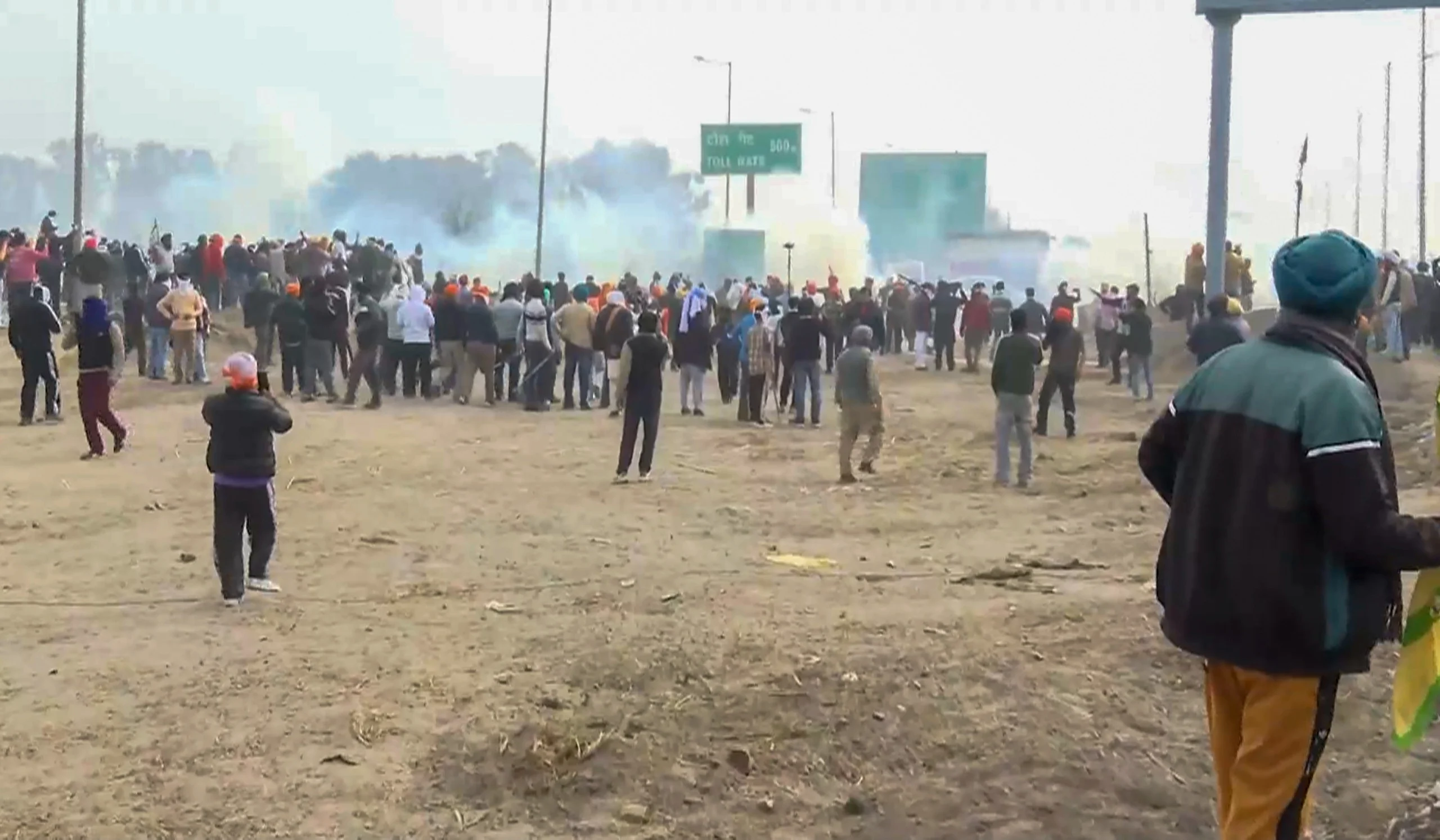
Police in Punjab, Haryana have fired tear gas to prevent thousands of protesting farmers demanding minimum crop prices from marching on Delhi
National capital is ringed by razor wire, cement blocks and fencing on three sides to keep protests at bay
Union minister Anurag Thakur says 'every problem can be solved through discussion
Vikrant Singh / Rajnish Kumar
New Delhi, EW News : Police in Punjab, Haryana and national capital have fired tear gas to prevent thousands of protesting farmers demanding minimum crop prices from marching on Delhi. The national capital is ringed by razor wire, cement blocks and fencing on three sides to keep protests at bay.
The government fears a repeat of 2020 - dozens died in a year-long protest that ended only after ministers agreed to repeal controversial agriculture laws. But just over two years later, farmers say other demands have not been met.
India's farmers form an influential voting bloc and and analysts say the government of Prime Minister Narendra Modi will be keen not to alienate them. His Bharatiya Janata Party (BJP) is seeking a third consecutive term in power in general elections this year.
In Haryana, thick clouds of tear gas being used to disperse protesters near the city of Ambala, about 200km (125 miles) north of the capital. Police flew drones continuously over the crowd and dropped tear gas on people below. "It literally rained tear gas shells through out the day," said kisan Amrik Singh. Police fired tear gas at the Shambhu border between Haryana and Punjab states. In Punjab's Sangrur, police fired tear gas shells at farmers, which left several of them injured. According to the protesting farmers, the tear gas made it difficult for them to breathe. They said that the police used water cannons and rubber bullets to stop them from crossing the border.
Farmers, most of whom are from Punjab, say they want to peacefully cross Haryana to reach Delhi, but they have not been allowed to do so. Scuffles between police and protesters have also been reported at the Shambhu border and the situation remains tense. In 2020, protesting farmers hunkered down for months, blocking national highways that connect the capital to its neighbouring states. The movement was seen as one of the biggest challenges to Prime Minister Narendra Modi's government.
Traffic jams and disruptions were reported across Delhi on Tuesday as authorities blocked roads and diverted traffic. Police have also prohibited large gatherings in the city, including at border points between the capital and neighbouring Uttar Pradesh and Haryana states, through which the farmers are trying to reach the capital.
In Haryana, the BJP-led state government has suspended internet services in seven districts until Tuesday. Two rounds of talks between farm union leaders and ministers have so far failed to break the deadlock. Farmers are asking for guaranteed floor prices - also known as minimum support price or MSP - which allows them to sell most of their produce at government-controlled wholesale markets, or mandis. They are also demanding that the government fulfil its promise of doubling farmers' income.
On Monday, federal ministers held a six-hour meeting with farm union leaders. The two sides reportedly came to an agreement on some of the demands, including the withdrawal of cases registered against protesters during the 2020 protests. But there was no consensus on the MSP. In 2021, after the farm laws were repealed, the government had said it would set up a panel to find ways to ensure support prices for all farm produce. But the committee is yet to submit its report.
More than 200 farmer unions are participating in the march. "We will move peacefully and our objective is that the government listens to our demands," Sarvan Singh Pandher, general secretary of the Punjab Kisan Mazdoor Sangharsh Committee, told media. Farmers' and trade unions have also announced a rural strike on 16 February during which no agricultural activities will be carried out. Shops, markets and offices in all villages will be closed while farmers will block major roads across the country. Meanwhile, Union minister Anurag Thakur says 'every problem can be solved through discussion.' The Samyukta Kisan Morcha on Tuesday wrote a letter to Prime Minister Narendra Modi, condemning the use of tear gas shells, rubber bullets and lathi charge against farmers at the Punjab border.




[[comment.comment_text]]