Netanyahu's Trial by Fire: Israel's Election and the Limits of Change

 1 day, 1 hour ago
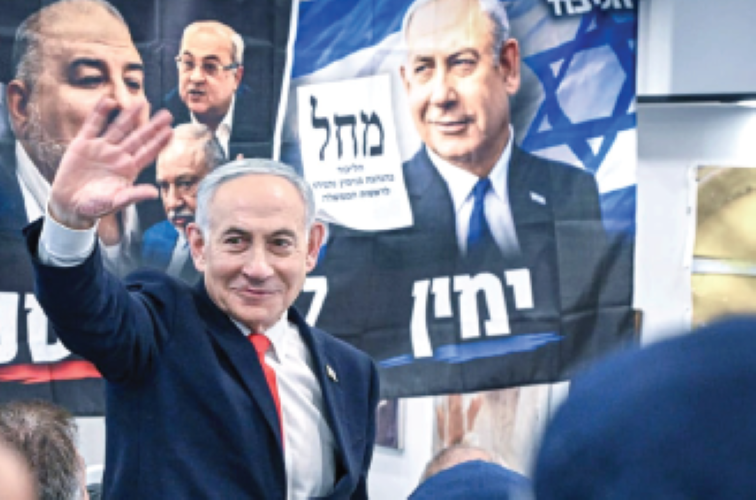
Israel's latest parliamentary election was more than another electoral test for Prime Minister Benjamin Netanyahu. In the aftermath of the Hamas-led attack of October 7, 2023, it also became a test of the country's security consciousness, political accountability and social cohesion. Exit polls suggest that neither Netanyahu's camp nor the opposition led by Gadi Eisenkot has secured a clear majority.
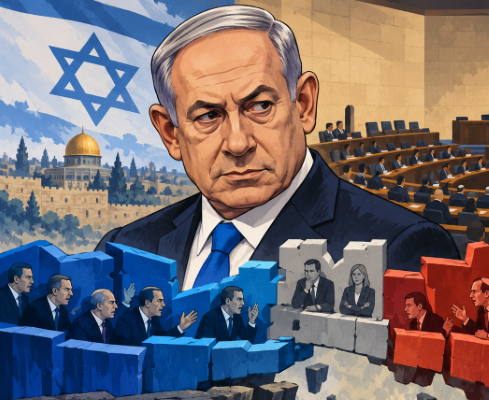
Israel's Knesset has 120 seats, and a government needs the support of at least 61 lawmakers to command a majority. Recent exit polls put both the pro-Netanyahu and anti-Netanyahu blocs at around 51 seats, while some projections give the opposition a narrow lead of 52 or 53. Both camps are within reach of power, but neither holds the key to forming a government on its own.
The outcome is undoubtedly uncomfortable for Netanyahu. Having dominated Israeli politics for more than two decades, he retains a substantial electoral base, and Likud is projected to emerge as the largest party. Yet his political dominance appears to have reached its limits. He may once again have to depend on ultra-Orthodox and hard-right allies to form a government. The opposition faces its own predicament, with Eisenkot's "Change Bloc" also falling short of a majority.
Arab Parties Hold the Key
Arab parties could play a decisive role in breaking the deadlock. Exit polls project them winning between 16 and 18 seats, potentially making them kingmakers if neither major bloc reaches the 61-seat threshold. Mansour Abbas, leader of the United Arab List (Ra'am), has indicated that he is in contact with representatives of both the pro- and anti-Netanyahu camps.
This possibility exposes a longstanding paradox in Israeli politics. Arab citizens, whose political participation has often been marginalised by mainstream Jewish parties, could find themselves at the centre of coalition negotiations. They constitute approximately 22 per cent of Israel's population, and their political representatives appear poised for a significant electoral showing. Yet securing their support will not be straightforward. Their demands concerning equal citizenship, civil rights and the Palestinian question could prove politically difficult for both major camps to accommodate.
What High Turnout Reveals
Voter participation was particularly striking. Turnout reached 77.7 per cent by the close of polling, with approximately 5.7 million voters casting their ballots. This was the highest participation rate since 1999 and nearly seven percentage points above the 2022 election. The figures suggest that Israelis are far from politically disengaged. Amid war, security failures, economic pressures and social divisions, they are determined to make their voices heard.
High turnout, however, does not necessarily signal a decisive appetite for political change. It may equally reflect the deep polarisation dividing Israeli society into two broadly comparable camps. For some, Netanyahu remains an experienced and resolute leader capable of navigating regional threats. For others, the security failure of October 7 and the concentration of executive power have seriously undermined confidence in his leadership.
Beyond the Netanyahu Question
The election has often been portrayed as a referendum on Netanyahu. The more consequential question, however, is whether a change of prime minister would alter Israel's security doctrine, its approach to the Palestinians or its broader regional strategy.
Israel's proportional representation system allows voters to choose parties rather than individual candidates. Consequently, emerging as the largest party and forming a government are two different challenges. A vote for Likud does not necessarily constitute personal endorsement of Netanyahu, just as his defeat would not, by itself, demonstrate a fundamental shift in Israeli society's security priorities.
Nor does the opposition represent a conventional left-wing alternative. Much of Eisenkot's appeal rests on his military background, emphasis on institutional accountability and commitment to administrative integrity. The central contest, therefore, is not over whether Israel needs security, but over who should exercise power and what mechanisms should hold its leadership accountable.
The Test of National Unity
Israel faces several challenges simultaneously, like regional confrontation involving Iran and its network of allies, a prolonged military campaign in Gaza, and deep domestic political divisions. In this context, the prospect of a national unity government has regained relevance. Israel has previously attempted to overcome political deadlock by bringing rival factions together during periods of crisis.
But a unity government cannot be reduced to an arithmetic exercise in power-sharing. Its value would depend on whether it could establish a minimum consensus on contentious questions, including judicial independence, military conscription, religious autonomy and the Palestinian issue.
The exemption of ultra-Orthodox men from military service has become particularly contentious. It is no longer merely a question of religious freedom, yet it also concerns national obligation and social justice. Prolonged mobilisation of military reservists has sharpened perceptions of this imbalance.
The Limits of Change
If Netanyahu leaves office, a new government could alter Israel's style of governance, its approach to judicial institutions and the exercise of executive power. It could also influence the country's diplomatic language and decision-making processes; and that could lead to a major shift in geopolitics.
A fundamental shift on the Palestinian question, however, appears less likely. The opposition has not placed a two-state solution at the centre of its political programme, nor has the election produced a broad mandate against military operations in Gaza or the expansion of settlements in the West Bank.
Israel's election, therefore, matters for reasons that extend beyond Netanyahu's return to power or departure from office. It reveals a society demanding greater accountability from its leaders while remaining deeply attached to security-centred politics.
The real challenge is whether a new government can change the way power is exercised and make Israel more inclusive, strengthen its institutions and reduce regional confrontation. Leaders may change that changing the country's political direction is a far more difficult task.
(The writer is a senior Delhi-based journalist and political analyst. Views are personal.)







[[comment.comment_text]]